

2025 1Z0-1055-25 Dumps PDF - 1Z0-1055-25 Real Exam Questions Answers
Valid 1Z0-1055-25 Test Answers & Oracle 1Z0-1055-25 Exam PDF
Oracle 1Z0-1055-25 Exam Syllabus Topics:
| Topic | Details |
|---|---|
| Topic 1 |
|
| Topic 2 |
|
| Topic 3 |
|
| Topic 4 |
|
| Topic 5 |
|
NEW QUESTION # 26
Which two tools can you use to build layouts for BI Publisher reports?
- A. BI Composer
- B. Report Developer
- C. Layout Editor
- D. BI Answers
- E. Template Builder for Word
Answer: B,C
NEW QUESTION # 27
While creating the setup for employee bank accounts, you have the profile option CE_USE_EXISTING_BANK_BRANCH set to Yes.
What can the users now search for by default?
- A. Bank and Bank Branch
- B. Bank Branch identifier
- C. Bank Branch only
Answer: A
Explanation:
Comprehensive and Detailed In-Depth
The profile option CE_USE_EXISTING_BANK_BRANCH in Oracle Financials Cloud controls whether users can select from pre-existing banks and branches or enter new bank information manually when setting up employee bank accounts.
When set to Yes:
Behavior: Users are provided with a list of predefined banks and branches to select from. This ensures consistency in bank data and reduces errors associated with manual entry.
Default Search Capability: Users can search and select both Bank and Bank Branch from the existing list.
Reference:
When set to No:
Behavior: The system allows users to manually enter bank and branch details as free text, without relying on predefined lists.
Default Search Capability: Since there are no predefined lists, users do not have search options and must input all bank information manually.
Therefore, with the profile option CE_USE_EXISTING_BANK_BRANCH set to Yes, users can search for and select both the Bank and Bank Branch from the predefined options, ensuring accurate and standardized bank account setups.
NEW QUESTION # 28
In the implementation project you are leading, the customer has a requirement to add new transactional attributes to the Expense Approver Report workflow notification. Which two Business Intelligence catalog objects should you copy (or customize) and edit?
- A. The Output types
- B. The Original Source
- C. The Data Model
- D. The layout template
Answer: C,D
Explanation:
Comprehensive and Detailed In-Depth
To incorporate new transactional attributes into the Expense Approver Report workflow notification in Oracle Financials Cloud, you need to customize specific Business Intelligence Publisher (BI Publisher) catalog objects. The two primary objects that require customization are:
The Data Model (Option B):
Purpose: The Data Model defines the data structure and sources for the report. It determines which attributes from the application's data sources are available for inclusion in the report.
Customization Process:
Navigate to the BI Catalog: Shared Folders > Financials > Workflow Notifications > Expenses.
Locate the Expense Approval Data Model.
Use the Customize option to create a copy of the data model in the Custom folder.
Edit the copied data model to include the new transactional attributes required for the notification.
Reference:
The Layout Template (Option A):
Purpose: The Layout Template defines the visual presentation of the notification, including which data fields are displayed and their formatting.
Customization Process:
In the same BI Catalog location, find the Expense Report Approval report.
Use the Customize option to create a copy of the report layout template in the Custom folder.
Download the copied layout template (an .rtf file) and open it using Microsoft Word with the BI Publisher Template Builder add-in.
Insert the new transactional attributes into the template as needed.
Upload the modified template back to the BI Catalog and set it as the default layout.
By customizing both the Data Model and the Layout Template, you ensure that the new transactional attributes are not only retrieved from the data source but also properly displayed in the workflow notification.
Note: Options C (The Original Source) and D (The Output types) are not directly involved in the process of adding new attributes to the workflow notification and therefore are not relevant to this requirement.
NEW QUESTION # 29
Your company asks you to build new Payables reports. You will be using Oracle Transactional Business Intelligence (OTBI) and deep links. Deep links allow you to directly drill down from OTBI reports to purchase orders and view the related purchase order details. Which three predefined job roles allow you to use this drill-down feature?
- A. Accounts Payable Manager
- B. Accounts Payable Agent
- C. Account Payable Invoice Supervisor
- D. Accounts Payable Specialist
- E. Accounts Payable Analyst
Answer: A,D,E
Explanation:
Comprehensive and Detailed In-Depth
In Oracle Financials Cloud, Oracle Transactional Business Intelligence (OTBI) provides robust reporting capabilities, including the use of deep links that enable users to drill down from summary reports into detailed transactional data, such as purchase orders. Access to these drill-down features is governed by specific job roles that encompass the necessary privileges.
Predefined Job Roles with Drill-Down Capabilities:
Accounts Payable Analyst (Option A):
Role Overview: This role is primarily focused on analyzing payables data, including the ability to access and drill down into detailed transactions to support financial analysis and reporting.
Privileges: Includes access to OTBI reports and the capability to drill down into transactional details such as invoices and payments.
Reference:
Accounts Payable Manager (Option B):
Role Overview: This managerial role oversees the entire accounts payable process, ensuring efficient operations and compliance. The role requires comprehensive access to payables data, including the ability to drill down into specific transactions for oversight and decision-making.
Privileges: Grants access to manage and review payables transactions, with drill-down capabilities into invoices, payments, and related purchase orders.
Accounts Payable Specialist (Option E):
Role Overview: This role is responsible for the day-to-day processing of accounts payable transactions, including invoice entry and payment processing. Access to detailed transaction data is essential for resolving issues and ensuring accuracy.
Privileges: Provides the ability to view and process payables transactions, with drill-down access to detailed information such as purchase order details linked to invoices.
NEW QUESTION # 30
Your company wants to maximize early payment discount opportunities and will be using the "Campaign Management for Ealy Payment Discount Offers" feature, which allows them to on board suppliers into an early payment discounts program via email- based campaigns. Suppliers can respond directly from email and their responses are automatically processed and applied in payment process requests.
Which three response options are available to suppliers when replying to a campaign
- A. Reject the Offer
- B. Accept All Offers
- C. Enroll in a standing offer.
- D. Subscribe
- E. Unsubscribe
- F. Decline the Offer
Answer: C,E,F
NEW QUESTION # 31
Your company has set certain entertainment daily limits in its Entertainment Policy to restrict employee entertainment expenses. Oracle Expenses supports the requirements within your entertainment policy where you can configure and define daily sum limits, along with single instance limits and yearly limits that depend on your policy requirements.
What are three considerations when enabling and defining daily limits in entertainment policies?
- A. The limits defined in the policy will be enforced per attendee regardless of whether the policy has rate determinants set up.
- B. This policy can be associated with both travel and entertainment policies.
- C. The limits apply only to company employees and excludes nonemployees.
- D. Use the entertainment policy to define single, daily, or yearly limits that need to be enforced per attendee.
- E. Use the entertainment policy to define single or multiple daily limits that need to be enforced per attendee or group of attendees.
- F. The limits defined in the policy will be enforced per attendee only if the policy has rate determinants set up.
- G. This policy can be associated only with entertainment policies.
Answer: D,F,G
NEW QUESTION # 32
Your Company is considering using BI publisher to create additional reports. They want to know about the various features and benefits of this tool.
Which are two benefits of BI publisher customize feature?
- A. Writing code is not required
- B. Report output is sent to an e-commerce site
- C. A backup copy of the report is automatically saved in my folders
- D. Patches do not override report customizations
- E. You do not need any special roles to access this feature
Answer: C,D
NEW QUESTION # 33
You have created an approval rule as follows:
Rule 1: If the invoice amount > $1000, route it to User 1.
Rule 2: If the invoice amount < $1000, auto-approve it.
What will happen if a user creates an invoice for $1000 and routes it for approval?
- A. Invoice will be auto-approved.
- B. The initiate option is greyed out for the invoice.
- C. The workflow will fail once approval is initiated, and the invoice will not get processed.
- D. Invoice will be sent to User 1 for approval.
Answer: C
Explanation:
Comprehensive and Detailed In-Depth
In Oracle Payables, when configuring invoice approval rules, it's crucial to ensure that all possible scenarios are accounted for to prevent workflow errors. In the given setup:
Rule 1: Invoices with an amount greater than $1000 are routed to User 1 for approval.
Rule 2: Invoices with an amount less than $1000 are auto-approved.
However, there is no rule defined for invoices equal to $1000. This omission creates a gap in the approval process. When an invoice for exactly $1000 is submitted, the system doesn't find a matching rule to apply, leading to a workflow failure. As a result, the approval process cannot proceed, and the invoice remains unprocessed.
Best Practice: To avoid such issues, it's essential to define comprehensive and inclusive approval rules that cover all possible scenarios. In this case, modifying the rules to include invoices equal to $1000 would resolve the problem. For example:
Revised Rule 1: If the invoice amount ≥ $1000, route it to User 1.
Revised Rule 2: If the invoice amount < $1000, auto-approve it.
This adjustment ensures that invoices with an amount of exactly $1000 are routed appropriately, preventing workflow failures.
Reference:
How You Create Invoice Approval Rules Using a Spreadsheet
Predefined Invoice Approval Rules: Explained
NEW QUESTION # 34
One of your clients notifies their suppliers of rejected invoices via email. You suggest that they instead send notifications to suppliers for rejected electronic invoices using industry-standard XML as a UBL 2.1 Invoice Response Message. Your client wants to know about the benefits of making this switch.
Which two benefits of this feature can you share with them?
- A. Suppliers can view the rejection reason in their system and take corrective action.
- B. You can customize automatic responses per invoice type.
- C. The notification provides suppliers with the option to request Payables manual intervention and support.
- D. There is automatic processing of electronic response messages.
Answer: B,D
NEW QUESTION # 35
You are an Expenses Manager at a large company and need to address complaints from your corporate card provider about delayed transaction payments incurred by former employees who are now inactive. To ensure timely and efficient processing of valid business charges posted to an inactive employee's corporate credit card, you can run the following two processes: Upload Corporate Card Transactions and Process Corporate Card Transactions for Inactive Employees.
Which two are capabilities included in these processes?
- A. Individual Pay Liability
- B. Outstanding Cash Advances
- C. Employee Termination Date
- D. Grace Period
Answer: C,D
Explanation:
Comprehensive and Detailed In-Depth
In Oracle Financials Cloud, managing corporate card transactions for inactive employees is crucial to maintain timely payments and avoid disputes with card providers. The processes Upload Corporate Card Transactions and Process Corporate Card Transactions for Inactive Employees are designed to handle such scenarios effectively.
Key Capabilities of These Processes:
Employee Termination Date (Option A):
Role in Processing: The system identifies inactive employees based on their termination or inactive status. When the Process Corporate Card Transactions for Inactive Employees process is executed, it scans for employees whose status has changed to inactive (e.g., due to termination or unpaid leave) and identifies any outstanding corporate card transactions associated with them.
Reference:
Grace Period (Option D):
Role in Processing: A grace period can be configured to allow the system to process transactions that are posted after an employee's termination date. This ensures that any legitimate business expenses incurred shortly before termination are not overlooked. The default grace period is set to 0 days but can be adjusted as needed.
Configuration Path: To modify the grace period, navigate to the Manage Expenses System Options page:
In the Setup and Maintenance work area, select:
Offering: Financials
Functional Area: Expenses
Task: Manage Expenses System Options
Options Not Included:
Outstanding Cash Advances (Option B):
This pertains to any cash amounts advanced to employees that have not yet been reconciled. The processes in question focus on corporate card transactions and do not directly address outstanding cash advances.
Individual Pay Liability (Option C):
This refers to scenarios where employees are responsible for paying their corporate card bills directly (Individual Pay). The processes mentioned are designed to handle transactions for inactive employees, regardless of the payment liability setup (Individual Pay, Company Pay, or Both Pay).
By utilizing these processes and configuring the grace period appropriately, companies can ensure that all valid business expenses incurred by inactive employees are processed efficiently, thereby maintaining good standing with corporate card providers and ensuring accurate financial reporting.
How Corporate Card Transactions for Inactive Employees Are Processed
NEW QUESTION # 36
You are a consultant for a mid-sized company. They have asked you to identify Cash Management reports that can be used to gain a better understanding of the company's cash position. You found four key reports.
Which option correctly matches each report with its description?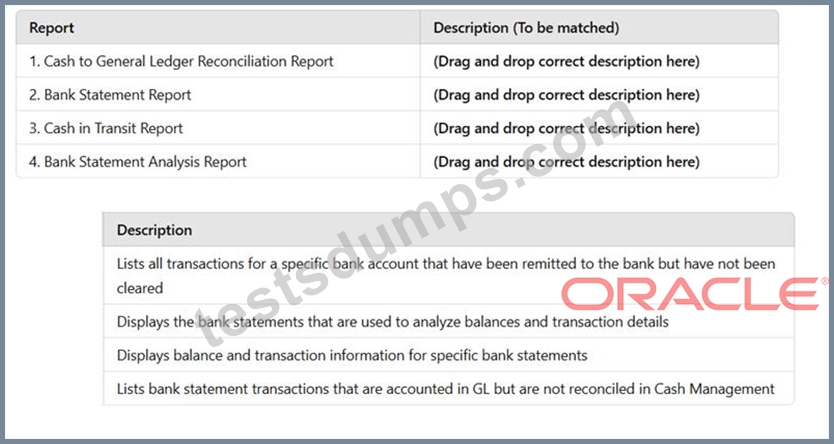
Answer:
Explanation: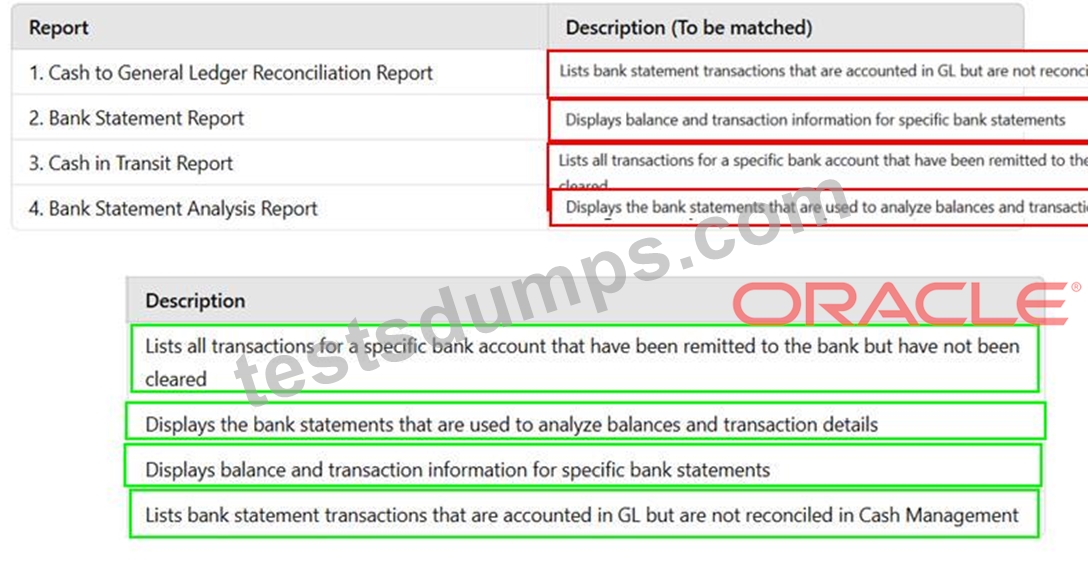
NEW QUESTION # 37
You are trying to use the Match in Full option for a purchase order, but your search for the PO is returning no results.
Which two are the reasons for this?
- A. The match approval level is set to 3-way matching
- B. The match approval level is set to 4-way matching
- C. The Purchase Order is already partially matched to an invoice
- D. The Supplier or Purchase Order is set up for self-billing
Answer: C,D
NEW QUESTION # 38
An installment for $2,000 USD is due for payment on July 31, 2022. The installment has two discounts: the first discount date is June 15, 2022 for $150 USD and the second discount date is June 30, 2022 for $50 USD.
You submit a Payment Process Request with the following criteria:
Payment Date = June 20, 2022
Pay Through Date = July 30, 2022
Date Basis = Due Date
What will be the resulting status of the installment and discount?
- A. The installment is selected and a discount of $50 USD is applied.
- B. The installment is not selected because the due date is after the Pay Through Date.
- C. The installment is selected and no discount is applied.
- D. The installment is selected and a discount of $150 USD is applied.
- E. The installment is not selected because the discount dates are before the Pay Through Date.
Answer: B
NEW QUESTION # 39
Your cloud customer wants to use AI to automate key processes in Payables. You are tasked with setting up the required roles for AI apps.
When you create the user-defined AIAPPS_BIP_ROLE, which two role hierarchies should you add?
- A. BI_Author
- B. BI_Integration
- C. BIP_DataModelDeveloper
- D. AIAPPS_Data_Model_Developer
- E. AIAPPS_Author
Answer: D,E
Explanation:
Comprehensive and Detailed In-Depth
Oracle Adaptive Intelligence (AI) for Payables integrates with Oracle Payables Cloud to enhance automation and streamline invoice processing. To enable AI functionalities, certain roles must be assigned to users to allow them to access and configure AI-based reporting and automation tools.
AIAPPS_Author (Option A):
This role allows users to create and modify AI-based reports, dashboards, and analytics in Oracle Transactional Business Intelligence (OTBI) and BI Publisher.
Reference:
AIAPPS_Data_Model_Developer (Option D):
This role is essential for developing AI-driven data models that power analytics and automation within AI for Payables.
Options B, C, and E Analysis:
BI_Integration (Option B):
While BI Integration supports data extraction and reporting in BI Publisher, it is not specifically required for AI-based automation in Payables.
Verdict: Not required for AIAPPS_BIP_ROLE.
BI_Author (Option C):
This role provides general BI report development access but does not grant access to AI-based configurations or data models.
Verdict: Not required for AIAPPS_BIP_ROLE.
BIP_DataModelDeveloper (Option E):
This role is related to BI Publisher Data Model Development but does not include AI model configuration.
Verdict: Not required for AIAPPS_BIP_ROLE.
Thus, the correct answers are A. AIAPPS_Author and D. AIAPPS_Data_Model_Developer.
NEW QUESTION # 40
Previously, cash advances were applied automatically to expenses when the auditor ran the expense reimbursement process. Now, Oracle Expenses allows employees to have the ability to manually apply their cash advances to the relevant expense report. As an Application Implementation Consultant, you advise your client to enable this feature and allow employees to perform manual application of cash advances to their expense reports for the US Business Unit.
Which statement is NOT true about this feature?
- A. If approvers or auditors reject expense reports, the cash advances that are applied to the reports are automatically removed and returned to the employee's available cash advances.
- B. Employees need to include a justification if they don't apply an available cash advance when submitting an expense report.
- C. Unused cash advance amounts are applied to the next expense report or refunded to the company by the employee.
- D. Auditors can make changes to cash advances that are applied to an expense report.
Answer: D
NEW QUESTION # 41
Your organization has decided to create employee expense items by leveraging the digital assistant feature and sending expense receipts via email.
Which is the next processing step after an email with an expense receipt is received in the expenses application?
- A. The application sends the expenses team receipt notification
- B. The application extracts the receipt details and creates expense items
- C. The application assigns an expense type based on category
- D. The Application automatically matched receipts to corporate card charges
- E. The application verifies the sender's email address and compares it with the employee's email addressed in HCM
Answer: E
NEW QUESTION # 42
You implemented the service provider model for Payables payments, where your United Kingdom (UK) headquarters works solely as an outsourced payment processing unit on behalf of your other UK business units.
What is this type of payment service provider model known as?
- A. Self-Service
- B. Dedicated
- C. Procurement
- D. Dedicated and Self-Service
Answer: B
NEW QUESTION # 43
A Payables user creates a manual invoice, and a Withholding Tax Classification Code defaults on the invoice line when the invoice is saved. Where does this Withholding Tax Classification Code default from?
- A. From the Party Tax Profile of the Third Party Site
- B. From the Site Assignments of the Supplier Site
- C. From the Ship-to Location selected on the invoice
Answer: B
Explanation:
A). From the Site Assignments of the Supplier Site (Correct Answer)
The Withholding Tax Classification Code can be assigned at the supplier site level in Oracle Financials Cloud.
When a supplier site has a predefined withholding tax classification, this automatically defaults onto the invoice line when an invoice is created for that supplier site.
This setup ensures that consistent withholding tax is applied to transactions related to that supplier.
According to Oracle documentation:
"For supplier sites that use withholding tax, the withholding tax classification that you define at the supplier site assignment level is used to populate the default tax classification on the invoice." (Oracle Financials Cloud Payables Guide) B). From the Party Tax Profile of the Third Party Site (Incorrect Answer) The Party Tax Profile contains tax-related settings for a supplier or third-party entity, including tax registration details.
However, it does not directly default the Withholding Tax Classification Code onto invoice lines.
Instead, the Party Tax Profile provides high-level tax configurations that may influence tax calculations but does not assign the default withholding tax classification.
C). From the Ship-to Location selected on the invoice (Incorrect Answer) The Ship-to Location on an invoice is used for logistics and sales tax calculations based on where goods are delivered.
It does not impact withholding tax, which is typically linked to the supplier or supplier site.
Therefore, the Withholding Tax Classification Code does not default from the Ship-to Location.
Final Conclusion:
The correct source of the default Withholding Tax Classification Code on an invoice line is the Supplier Site Assignment.
This ensures that withholding tax is consistently applied to transactions involving that supplier, reducing errors in tax calculations.
Reference:
Oracle Financials Cloud Documentation - Withholding Tax Classifications in Payables (Oracle Documentation Link) Explanation:
Comprehensive and Detailed In-Depth
In Oracle Financials Cloud, when a Payables user creates a manual invoice, the Withholding Tax Classification Code can default onto the invoice line from various sources depending on the system configurations. The correct source for defaulting this code is from the Site Assignments of the Supplier Site.
Explanation of Each Option:
NEW QUESTION # 44
You're a Payables supervisor, and your team has been struggling to keep up with the high volume of incomplete invoices coming through the Oracle Cloud Supplier Portal, causing delays in timely period closures. As a Payables supervisor, you have the ability to identify and then cancel incomplete supplier portal invoices without having to contact suppliers.
Which two options are available for the Payables Supervisor to identify incomplete supplier portal invoices for cancellation?
- A. Query invoices on the Manage Invoices page
- B. Query the Payables Invoice Register
- C. Run the Period Close Exception Report
- D. Run the Period Invoice Audit Report
Answer: A,C
Explanation:
Comprehensive and Detailed In-Depth
Managing incomplete invoices is crucial to ensure a smooth period close process in Oracle Financials Cloud. As a Payables Supervisor, you have specific tools and reports at your disposal to identify and address these incomplete supplier portal invoices:
Query Invoices on the Manage Invoices Page (Option C):
Purpose: The Manage Invoices page allows you to search and view all invoices within the system. By applying filters such as status (e.g., "Incomplete") and source (e.g., "Supplier Portal"), you can identify invoices that are incomplete and originated from the supplier portal.
Action Steps:
Navigate to the Manage Invoices page.
Use the search filters to specify criteria:
Status: Set to "Incomplete".
Source: Set to "Supplier Portal".
Review the filtered list to identify invoices that require cancellation.
Reference:
Run the Period Close Exception Report (Option D):
Purpose: The Payables Period Close Exceptions Report provides details of transactions that prevent the Payables period from closing, including incomplete invoices. Running this report helps in identifying any such invoices that need attention before period closure.
Action Steps:
Navigate to the Scheduled Processes work area.
Submit the Payables Period Close Exceptions Report.
Review the report output to identify incomplete supplier portal invoices.
Options A (Query the Payables Invoice Register) and B (Run the Period Invoice Audit Report) are not specifically designed to identify incomplete invoices:
Payables Invoice Register: This report provides a list of invoices but does not specifically highlight incomplete ones.
Period Invoice Audit Report: This report focuses on auditing invoices for compliance and accuracy, not necessarily on their completion status.
Therefore, the most effective tools for identifying incomplete supplier portal invoices for cancellation are Option C: Query invoices on the Manage Invoices page and Option D: Run the Period Close Exception Report.
NEW QUESTION # 45
SIMULATION
MANAGE POLICIES BY EXPENSE CATEGORY
The US1 Business Unit has an expense policy on meals that allows an employee to claim 30 USD per day for an evening meal, regardless of their role and location.
Answer:
Explanation:
See the Explanation for Step by Step Solution
Explanation:
Step-by-Step Solution: Configuring Expense Policies by Expense Category in Oracle Financials Cloud To implement the expense policy for meals in Oracle Financials Cloud, follow these steps:
Step 1: Navigate to the Expense Policies Setup
Log in to Oracle Financials Cloud with the appropriate Expense Manager or Financial Administrator role.
Go to the Setup and Maintenance work area.
Select Manage Policies by Expense Category (Task Name: Manage Expense Policies by Expense Category).
Select the US1 Business Unit to ensure the policy applies to the correct entity.
Step 2: Create or Update the Meal Expense Category
Under Manage Policies by Expense Category, locate or create the Meals Expense Category.
If the Meals category does not exist:
Click Create Expense Category.
Enter Category Name: "Meals".
Category Type: "Meals and Entertainment".
Save the entry.
Step 3: Define Expense Limits for Evening Meals
Select the Meals Expense Category and click Edit.
Navigate to the Policies and Limits tab.
Under Amount Limits, click Add New Rule.
Description: "Evening Meal Limit".
Limit Type: "Maximum Allowed Amount".
Limit Amount: Enter 30 USD.
Per: Select Day.
Apply to All Employees (since this applies regardless of role and location).
Location-Based Rules: Leave blank since it applies universally.
Click Save and Close.
Step 4: Enable and Activate the Policy
Ensure the policy is enabled by selecting the checkbox for Active.
Click Submit to finalize the configuration.
Run the "Validate and Deploy Expense Policies" process to apply changes.
Step 5: Testing the Policy
Simulate an Expense Report Submission:
Have an employee create a new expense report.
Select Meals as the expense category.
Enter an evening meal expense of 35 USD (which exceeds the policy limit).
Verify if a policy violation warning appears, restricting the claim to 30 USD.
Submit an expense of 30 USD and ensure no policy violation occurs.
Expected Outcome:
Employees can claim up to 30 USD per day for an evening meal.
Any claim above 30 USD triggers a policy violation warning.
The rule applies to all employees regardless of role and location.
Conclusion
By following the above steps, you successfully configure an expense policy for meals that limits evening meal claims to 30 USD per day. This ensures compliance with the company's expense management guidelines while streamlining the expense approval process in Oracle Financials Cloud.
NEW QUESTION # 46
......
1Z0-1055-25 Exam Dumps - PDF Questions and Testing Engine: https://www.testsdumps.com/1Z0-1055-25_real-exam-dumps.html
Realistic 1Z0-1055-25 Exam Dumps with Accurate & Updated Questions: https://drive.google.com/open?id=1qMWQsH7X5rAueJ5k0zEhczWuJWy7p76E
