

2025 Latest 100% Exam Passing Ratio - ANVE Dumps PDF
Pass Exam With Full Sureness - ANVE Dumps with 346 Questions
NEW QUESTION # 39
What type of lens is this?
- A. An M12 lens
- B. A block lens
- C. A CS-mount lens
- D. A C-mount lens
Answer: A
Explanation:
"M12 lenses are easily recognized by their small size and the thread on the lens barrel. The M12 refers to the metric thread diameter (12 mm), which is much smaller than C/CS-mount lenses. These are often used in compact and modular camera models."
- Axis Communications Academy, Network Video Fundamentals, 2022
"M12-mount lenses are also called 'board lenses' and are screwed directly into the camera's sensor module."
- Axis M12 Lens Accessories Guide
References:
Axis Communications Academy, Network Video Fundamentals, 2022 (p. 33)
Axis Lens Accessories - M12 Lenses
NEW QUESTION # 40
Which one of the following camera parameters may become a limiting factor for the camera in delivering full frame rate?
- A. Aspect ratio 16:9
- B. Exposure time
- C. Flicker-free mode
- D. Noise reduction
Answer: B
Explanation:
Exposure time can become a limiting factor for the camera in delivering full frame rate. Longer exposure times allow more light to hit the camera sensor, improving image quality in low light conditions but also reducing the number of frames per second (fps) that the camera can capture. Shorter exposure times allow higher frame rates but may result in underexposed images in low light conditions.
Reference: Axis Communications - Camera Exposure Settings
NEW QUESTION # 41
Audio detection can be used
- A. Only with cameras with built in microphone.
- B. Only in quiet areas.
- C. In all Axis cameras but an extra intelligent video (IV) module is necessary.
- D. For detecting a change in decibel levels.
Answer: D
NEW QUESTION # 42
In environments with rain or snow, an Axis bullet camera has which benefit?
- A. The built-in IR immediately melts any snow landing on the front side
- B. The camera can vibrate to shake off any drops from the glass front
- C. The weather shield is tilted with the camera, protecting the glass front
- D. The built-in wipers automatically removes any drops blocking the view
Answer: C
Explanation:
In environments with rain or snow, an Axis bullet camera benefits from having a weather shield that tilts with the camera. This shield helps protect the camera's glass front from raindrops and snow, ensuring clear visibility and reducing the need for frequent cleaning. The design helps maintain optimal image quality in various weather conditions.
References: Axis Communications Bullet Camera Features
NEW QUESTION # 43
AXIS Design Tool is used for
- A. Estimating bandwidth and creating a bill of materials.
- B. Determining camera coverage and creating a bill of materials.
- C. Selecting the right cameras and choosing AXIS Camera Station licenses.
- D. Plan network topology and determining camera coverage.
Answer: B
Explanation:
AXIS Design Tool is used for determining camera coverage and creating a bill of materials. This tool helps system designers and installers to accurately plan camera placements, ensuring optimal coverage of the surveillance area, and to generate a comprehensive list of required components, facilitating project planning and budgeting.
NEW QUESTION # 44
Ghost image is when
- A. The frame rate is too low.
- B. The shutter time is too long.
- C. The gain is too high.
- D. The lens is using too high f-stop value.
Answer: B
NEW QUESTION # 45
If the subject is 3 m (10 ft) away, what is the pixel density for a 1920x1080 camera?
- A. 324 px/m (108 px/ft)
- B. 162 px/m (54 px/ft)
- C. 576 px/m (192 px/ft)
- D. The information is insufficient
Answer: B
Explanation:
For a 1920x1080 camera, the pixel density at a distance of 3 meters (10 feet) can be calculated using the formula for pixel density (pixels per meter/foot). Given the resolution and distance, the pixel density is 162 pixels per meter (54 pixels per foot). Axis provides guidelines and tools for calculating pixel density to ensure the camera setup meets the required image quality for identification and recognition purposes in their technical resources and planning tools.
NEW QUESTION # 46
Why is corridor format useful for this scene?
- A. It enables slower shutter speeds to be used
- B. It increases the maximum frame rate
- C. It increases the light sensitivity
- D. It increases the vertical field of view
Answer: D
Explanation:
The corridor format is particularly useful for scenes such as the one depicted because it optimizes the camera's field of view for narrow, vertical areas. Traditional horizontal formats waste much of the frame on walls or empty spaces when monitoring hallways, staircases, or aisles. By rotating the camera 90 degrees and using the corridor format, you maximize the vertical field of view, allowing for better coverage and more effective surveillance in such environments. Axis Communications documents and product guides frequently highlight this advantage for corridor format applications.
NEW QUESTION # 47
Which network features are usually combined to prevent access to the surveillance network?
- A. IP subnets and VLANs
- B. Router port forwarding and VLANs
- C. Router port forwarding and IP subnets
- D. IEEE 802.3ad link aggregation and HTTPS encryption
Answer: A
NEW QUESTION # 48
Two cameras are streaming 6 Mbit/s each. Approximately how much storage is required to record one hour of video from both streams?
- A. 11.4 GB
- B. 2.6 GB
- C. 5.4 GB
- D. 24.2 GB
Answer: C
Explanation:
To calculate the storage required to record one hour of video from two cameras streaming at 6 Mbit/s each, we use the following steps:
* Total bitrate for both cameras: 6 Mbit/s×2=12 Mbit/s6 \text{ Mbit/s} \times 2 = 12 \text{ Mbit/s}6 Mbit
/s×2=12 Mbit/s
* Convert Mbit/s to Mbyte/s: 12 Mbit/s÷8=1.5 Mbyte/s12 \text{ Mbit/s} \div 8 = 1.5 \text{ Mbyte/s}
12 Mbit/s÷8=1.5 Mbyte/s
* Calculate the total data for one hour: 1.5 Mbyte/s×3600 seconds=5400 Mbytes1.5 \text{ Mbyte/s}
\times 3600 \text{ seconds} = 5400 \text{ Mbytes}1.5 Mbyte/s×3600 seconds=5400 Mbytes
* Convert Mbytes to Gbytes: 5400 Mbytes÷1024=5.27 Gbytes5400 \text{ Mbytes} \div 1024 = 5.27 \text { Gbytes}5400 Mbytes÷1024=5.27 Gbytes
Approximately, the storage required is 5.4 GB.
Reference: Axis Communications. "Calculating storage requirements." Axis Storage Calculation.
NEW QUESTION # 49
Which of the following conditions has to be met to use multicast streaming?
- A. The video device needs to run on firmware version 5.20 or higher
- B. The client has to run AXIS Camera Management or AXIS Camera Station
- C. The client has to support streaming over RTSP
- D. The network infrastructure has to support multicast
Answer: D
Explanation:
For multicast streaming to be effective, the network infrastructure must support multicast protocols. This involves network switches and routers that can handle multicast traffic, allowing video streams to be efficiently distributed to multiple clients simultaneously. Multicast reduces the load on the network by sending a single stream of data to multiple receivers, making it essential for large-scale surveillance deployments.
[Reference: Axis Communications - Multicast Streaming Requirements]
Top of Form
Bottom of Form
NEW QUESTION # 50
A camera's recording stream has a bitrate of 8 Mbit/s. How much storage is used per hour?
- A. 28.8 GB
- B. 288 GB
- C. 3.6 GB
- D. 36 GB
Answer: C
Explanation:
To calculate the storage used per hour by a camera's recording stream with a bitrate of 8 Mbit/s, you can use the following formula:
Storage (GB/hour)=bitrate (Mbit/s)×seconds per hour8×1024\text{Storage (GB/hour)} = \frac{\text{bitrate (Mbit/s)} \times \text{seconds per hour}}{8 \times
1024}Storage (GB/hour)=8×1024bitrate (Mbit/s)×seconds per hour
Since there are 3600 seconds in an hour:
Storage (GB/hour)=8×36008×1024=288008192=3.6 GB\text{Storage (GB/hour)} = \frac{8 \times 3600}{8
\times 1024} = \frac{28800}{8192} = 3.6 \text{ GB}Storage (GB/hour)=8×10248×3600=819228800=3.6 GB Thus, the camera uses 3.6 GB of storage per hour. Axis documentation on storage requirements for video streams provides similar calculations to estimate storage needs based on bitrate.
NEW QUESTION # 51
What is 3D privacy masking?
- A. A privacy mask with three dimensions
- B. A privacy mask that remains in the field of view
- C. A privacy mask that contains three individual set of blobs
- D. A privacy mask that is changing its shape depending on angle of view
Answer: D
Explanation:
3D privacy masking in Axis cameras refers to a privacy mask that changes its shape depending on the angle of view. This advanced feature ensures that the privacy mask effectively covers the designated area regardless of the camera's viewing angle, providing consistent privacy protection as the camera moves or zooms.
NEW QUESTION # 52
If a customer wants a covert surveillance solution, they should choose
- A. bullet cameras.
- B. onboard cameras.
- C. dome cameras.
- D. modular cameras.
Answer: D
Explanation:
For covert surveillance, modular cameras are the best choice. These cameras consist of a small sensor unit connected to a main unit by a cable, allowing the sensor unit to be discreetly placed in tight spaces while the main unit is hidden elsewhere. This makes modular cameras ideal for situations where discretion is paramount. Axis Communications offers a range of modular cameras specifically designed for covert applications, as detailed in their product documentation and solutions guides.
NEW QUESTION # 53
Which camera aspect ratio is preferred to cover as much as possible of the narrow aisles in a warehouse?
- A. 1:3
- B. 21:9
- C. 9:16
- D. 16:9
Answer: C
Explanation:
"For covering narrow aisles, a vertical aspect ratio such as 9:16 is preferred as it matches the shape of the scene, allowing for better coverage and detail along the aisle's length."
- Axis Communications Academy, Network Video Fundamentals, 2022
"The corridor format (9:16 aspect ratio) maximizes image usability in vertically oriented scenes, such as warehouse aisles or hallways."
- Axis Corridor Format Technology
References:
Axis Communications Academy, Network Video Fundamentals, 2022 (p. 20)
Axis Web Article: Corridor Format
NEW QUESTION # 54
AXIS Device Manager can provide information about the
- A. warranty period.
- B. RMA status.
- C. environmental temperature.
- D. camera's uptime.
Answer: D
Explanation:
AXIS Device Manager can provide information about the camera's uptime. This tool offers comprehensive device management features, including monitoring and reporting the operational status and uptime of Axis devices. It helps ensure that devices are functioning correctly and allows for proactive maintenance. This feature is highlighted in Axis Communications' documentation on AXIS Device Manager capabilities.
NEW QUESTION # 55
Match each function to the correct video surveillance system component. Drag each gray box from the left column to the matching blue box in the right column.
Answer:
Explanation:
Explanation:
NEW QUESTION # 56
Which security features are provided through a managed switch?
- A. IP subnets and VLANs
- B. IEEE 802.1 X port-based authentication and VLANs
- C. IEEE 802.1 X port-based authentication and HTTPS encryption
- D. HTTPS encryption and IP subnets
Answer: B
NEW QUESTION # 57
Match each function to the correct video surveillance system component. Drag each gray box from the left column to the matching blue box in the right column.
Answer:
Explanation: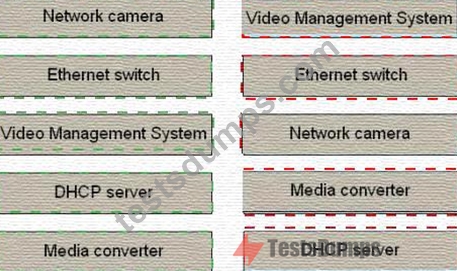
Explanation:
NEW QUESTION # 58
The capability to view and record up to four different areas of the whole image of an AXIS P1346 is called
- A. Multicast streaming.
- B. Multi-view streaming.
- C. Multi-link streaming.
- D. Broadcast streaming.
Answer: B
NEW QUESTION # 59
Signed firmware
- A. makes it possible to trace the video back to the camera origin.
- B. ensures that a device can start only with Axis firmware.
- C. provides tamper-protected storage of cryptographic information.
- D. guarantees that the installed operating system is genuinely from Axis.
Answer: B
Explanation:
"Signed firmware guarantees that the installed operating system is genuinely from Axis and has not been tampered with. The camera verifies the firmware signature before installation or upgrade."
- Axis Communications, Signed Firmware
"With signed firmware, you are assured that the firmware is authentic and has not been modified."
- Axis Communications Academy, Network Video Fundamentals, 2022
References:
Axis Technical Note: Signed Firmware
Axis Communications Academy, Network Video Fundamentals, 2022 (p. 90)
NEW QUESTION # 60
Lowering the shutter speed can produce
- A. increased noise.
- B. motion blur.
- C. a darker image.
- D. reflections.
Answer: B
Explanation:
Lowering the shutter speed can produce motion blur because the camera sensor is exposed to light for a longer period, capturing the movement of objects within the frame. This results in a blurry representation of moving objects, which can be useful for artistic effects but undesirable for capturing fast-moving subjects clearly.
References: Axis Communications camera user guides and image capture documentation.
NEW QUESTION # 61
Which is a benefit of using VLANs and IP subnets?
- A. The network provides end-to-end encryption to prevent malicious users from intercepting network traffic
- B. Network surveillance video can be kept separate from other network traffic, reducing the risk that malicious users will intercept it
- C. An encrypted communication link is established over the internet, allowing surveillance video to be securely viewed off-site
- D. The network will only allow access from authorized devices, eliminating the risk that malicious users disconnect cameras to intercept network traffic
Answer: B
NEW QUESTION # 62
......
Axis ANVE Certification Exam is an ideal certification for network video professionals to validate their expertise and signify their commitment to excellence in the field. With a strong and practical test covering industry standard topics and trends, the certification offers a valuable asset to individuals and organizations alike. Professionals interested in advancing their careers in the network video surveillance sector would do well to consider Axis ANVE certification as a potential path towards achieving their ambitions.
Axis ANVE (Axis Network Video) exam is a certification program designed to assess an individual's knowledge and expertise in the area of network video surveillance. ANVE exam covers a wide range of topics related to video surveillance, including network design and implementation, camera selection and placement, video analytics, and video management software. The Axis ANVE certification is recognized globally and is highly valued by employers in the security industry.
Verified ANVE dumps Q&As - 100% Pass from TestsDumps: https://www.testsdumps.com/ANVE_real-exam-dumps.html
Pass ANVE Exam in First Attempt Guaranteed 2025 Dumps: https://drive.google.com/open?id=173HJWSAKfKSyChDaZZJrx2ptzMB1X3LO
