

[2026] Pass Fortinet FCP_FAZ_AN-7.6 Premium Files Test Engine pdf - Free Dumps Collection
New 2026 Realistic FCP_FAZ_AN-7.6 Dumps Test Engine Exam Questions in here
NEW QUESTION # 25
Refer to the exhibit. Which statement about the displayed event is correct?
- A. The risk source is isolated.
- B. The security event risk is considered open.
- C. The security risk was escalated.
- D. An incident was created from this event.
Answer: B
Explanation:
The event status is shown as Unhandled with Critical severity, indicating that the associated security risk is still open and has not yet been investigated or resolved.
NEW QUESTION # 26
Exhibit.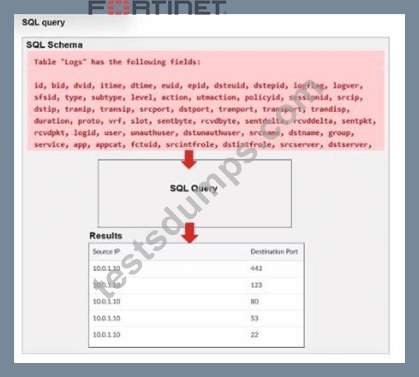
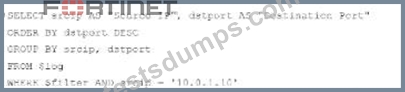
A fortiAnalyzer analyst is customizing a SQL query to use in a report.
Which SQL query should the analyst run to get the expected results?
- A.
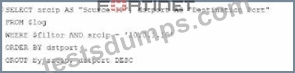
- B.
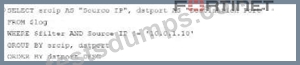
- C.
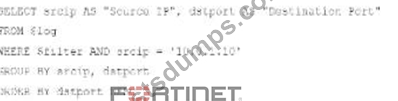
- D.
Answer: A
Explanation:
The requirement here is to construct a SQL query that retrieves logs with specific fields, namely "Source IP" and "Destination Port," for entries where the source IP address matches 10.0.1.10. The correct syntax is essential for selecting, filtering, ordering, and grouping the results as shown in the expected outcome.
Analysis of the Options:
* Option A Explanation:
* SELECT srcip AS "Source IP", dstport AS "Destination Port": This syntax selects srcip and dstport, renaming them to "Source IP" and "Destination Port" respectively in the output.
* FROM $log: Specifies the log table as the data source.
* WHERE $filter AND srcip = '10.0.1.10': This line filters logs to only include entries with srcip equal to 10.0.1.10.
* ORDER BY dstport DESC: Orders the results in descending order by dstport.
* GROUP BY srcip, dstport: Groups results by srcip and dstport, which is valid SQL syntax.
This option meets all the requirements to get the expected results accurately.
* Option B Explanation:
* WHERE $filter AND Source IP != '10.0.1.10': Uses != instead of =. This would exclude logs from the specified IP 10.0.1.10, which is contrary to the expected result.
* Option C Explanation:
* The ORDER BY clause appears before the FROM clause, which is incorrect syntax. SQL requires the FROM clause to follow the SELECT clause directly.
* Option D Explanation:
* The GROUP BY clause should follow the FROM clause. However, here, it's located after WHERE, making it syntactically incorrect.
Conclusion:
* Correct Answer: A. Option A
* This option aligns perfectly with standard SQL syntax and filters correctly for srcip = '10.0.1.10', while ordering and grouping as required.
References:
FortiAnalyzer 7.4.1 SQL query capabilities and syntax for report customization.
NEW QUESTION # 27
Which statement about the FortiSOAR management extension is correct?
- A. It requires a dedicated FortiSOAR device or VM.
- B. It requires a FortiManager configured to manage FortiGate.
- C. It runs as a docker container on FortiAnalyzer.
- D. It does not include a limited trial by default.
Answer: C
Explanation:
Fortinet offers two dedicated products, FortiSOAR and FortiSIEM, that expand these capabilities and add many others. FortiSOAR is available as a stand-alone product and as a management extension application that can be installed on FortiAnalyzer.
NEW QUESTION # 28
Which log will generate an event with the status Unhandled?
- A. An IPS log with action=pass.
- B. An AV log with action=quarantine.
- C. A WebFilter log will action=dropped.
- D. An AppControl log with action=blocked.
Answer: A
Explanation:
In FortiOS 7.4.1 and FortiAnalyzer 7.4.1, the "Unhandled" status in logs typically signifies that the FortiGate encountered a security event but did not take any specific action to block or alter it. This usually occurs in the context of Intrusion Prevention System (IPS) logs. IPS logs with action=pass: When the IPS engine inspects traffic and determines that it does not match any known attack signatures or violate any configured policies, it assigns the action "pass". Since no action is taken to block or modify this traffic, the status is logged as "Unhandled."
NEW QUESTION # 29
Which two methods can you use to send notifications when an event occurs that matches a configured event handler? (Choose two.)
- A. Send SNMP trap
- B. Send SMS notification
- C. Send Alert through Fabric Connectors
- D. Send Alert through FortiSIEM MEA
Answer: A,C
Explanation:
Send Alert through Fabric Connectors: This method involves creating a Fabric Connector profile and selecting the option "Send Alert through Fabric Connectors" in the event handler notification settings. Notifications are then sent in JSON format to the configured endpoint, such as Microsoft Teams or other integrated platforms.
Send SNMP trap: You can configure SNMP traps to be sent when an event triggers an incident.
This involves setting the SNMP Trap IP address, community string, trap type, and protocol in the system's analytics or incident settings.
NEW QUESTION # 30
As part of your analysis, you discover that an incident is a false positive.
You change the incident status to Closed: False Positive.
Which statement about your update is true?
- A. The corresponding event will be marked as mitigated.
- B. The incident will be deleted.
- C. The audit history log will be updated.
- D. The incident number will be changed
Answer: C
Explanation:
When an incident is closed as a false positive in FortiAnalyzer, it is not deleted or renumbered.
Instead, the closure action is recorded in the audit history, preserving a traceable record of analyst actions for accountability and compliance.
NEW QUESTION # 31
Refer to the exhibit. What is the analyst trying to create?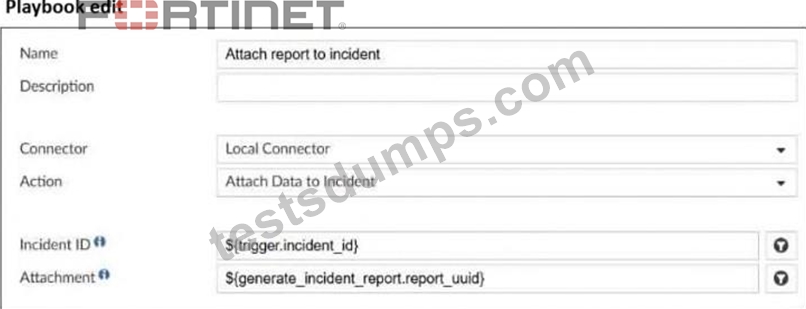
- A. A trigger variable to use in a playbook
- B. A SOC report in a playbook
- C. An output variable to use in a playbook
- D. A report in a playbook
Answer: C
Explanation:
The analyst is defining output variables (referencing a report UUID and incident ID) so they can be passed between tasks in the playbook. The syntax shown (${trigger.incident_id} and
${generate_incident_report.report_uuid}) is used specifically for output variable creation and usage.
NEW QUESTION # 32
Why must you wait for several minutes before you run a playbook that you just created?
- A. FortiAnalyzer needs that time to debug the new playbook.
- B. FortiAnalyzer needs that time to parse the new playbook.
- C. FortiAnalyzer needs that time to back up the current playbooks.
- D. FortiAnalyzer needs that time to ensure there are no other playbooks running.
Answer: B
NEW QUESTION # 33
Which statement about the FortiSIEM management extension is correct?
- A. It allows you to manage the entire life cycle of a threat or breach.
- B. It can be installed as a dedicated VM.
- C. Its use of the available disk space is capped at 50%.
- D. It requires a licensed FortiSIEM supervisor.
Answer: D
Explanation:
To run the FortiSIEM Collector management extension application, the following requirements must be met:
FortiAnalyzer 7.0.1 or above
FortiSIEM Supervisor, Worker, Collectors 6.3.0 or above.
FortiSIEM Linux Agent 6.3.0 or above.
FortiSIEM Windows Agent 4.1.2 or above.
NEW QUESTION # 34
What is the purpose of using data selectors when configuring event handlers?
- A. They apply their filter criteria to the entire event handler so that you don't have to configure the same criteria in the individual rules.
- B. They are common filters that can be applied simultaneously to all event handlers.
- C. They filter the types of logs that FortiAnalyzer can accept from registered devices.
- D. They download new filters can be used in event handlers.
Answer: A
Explanation:
When configuring event handlers on FortiAnalyzer, data selectors act as global filter criteria.
These filters are applied at the event handler level, allowing all rules within that handler to inherit the same conditions. This avoids the need to repeatedly configure identical filters for each individual rule.
NEW QUESTION # 35
Refer to the exhibit with partial output: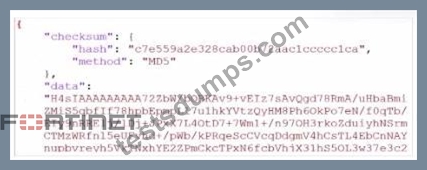
Your colleague exported a playbook and has sent it to you for review. You open the file in a text editor and observer the output as shown in the exhibit.
Which statement about the export is true?
- A. The playbook is misconfigured.
- B. Your colleague put a password on the export.
- C. The option to include the connector was not selected.
- D. The export data type is zipped.
Answer: D
Explanation:
In the exhibit, the data structure shows a checksum field and a data field with a long, seemingly encoded string. This format is indicative of a file that has been compressed or encoded for storage and transfer.
Export Data Type:
The data field is likely a base64-encoded string, which is commonly used to represent binary data in text format. Base64 encoding is often applied to data that has been compressed (zipped) for easier handling and transfer. The checksum field, with an MD5 hash, provides a way to verify the integrity of the data after decompression.
NEW QUESTION # 36
You need to move reports between two ADOMs.
Which two statements are true? (Choose two.)
- A. All charts and datasets associated with the report will be imported together.
- B. The data and time will be appointed to the original report name to avoid conflicts.
- C. The ADOMs must be compatible types.
- D. You need to convert the reports into templates first.
Answer: A,C
Explanation:
When moving reports between ADOMs, all associated charts and datasets are imported together to maintain report integrity.
The source and destination ADOMs must be compatible types to successfully move reports between them.
NEW QUESTION # 37
What happens when the indicator of compromise (IOC) engine on FortiAnalyzer finds web logs that match blacklisted IP addresses?
- A. A new infected entry is added for the corresponding endpoint under Compromised Hosts.
- B. The detection engine classifies those logs as Suspicious.
- C. FortiAnalyzer flags the associated host for further analysis.
- D. The endpoint is marked as Compromised and, optionally, can be put in quarantine.
Answer: A
NEW QUESTION # 38
Refer to the exhibit. An analyst is trying to create a dataset to pull all gambling websites that were visited by end users.
Which SQL query on FortiAnalyzer will give the result shown in the exhibit?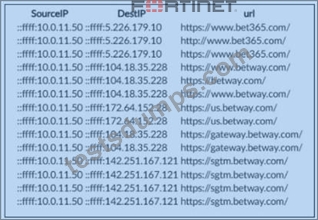
select srcip as "SourceIP", dstip as "DestIP", url from $log where
- A. catdesc = $log
select srcip as "SourceIPv6", dstip as "DestIPv6", url from $log where - B. catdesc = 'Gambling'
- C. catdesc = 'Dating'
select srcip as "SourceIP", dstip as "DestIP", url from 'Gambling' where - D. catdesc = 'Gambling'
select srcip as "SourceIP", dstip as "DestIP", url from $log where
Answer: B
Explanation:
This query selects the source IP, destination IP, and URL from the log data and filters results to only entries categorized as Gambling, which produces a list of visited gambling websites like those shown in the exhibit.
NEW QUESTION # 39
As part of your analysis, you discover that an incident is a false positive. You change the incident status to Closed: False Positive.
Which statement about your update is true?
- A. The corresponding event will be marked as mitigated.
- B. The incident will be deleted.
- C. The audit history log will be updated.
- D. The incident number will be changed
Answer: C
Explanation:
When an incident in FortiAnalyzer is identified as a false positive and its status is updated to
"Closed:
False Positive," certain records and logs are updated to reflect this change.
Option A - The Audit History Log Will Be Updated:
FortiAnalyzer maintains an audit history log that records changes to incidents, including updates to their status. When an incident status is marked as "Closed: False Positive," this action is logged in the audit history to ensure traceability of changes. This log provides accountability and a record of how incidents have been handled over time.
NEW QUESTION # 40
As part of your analysis, you discover that a Medium severity level incident is fully remediated.
You change the incident status to Closed: Remediated.
How will FortiAnalyzer handle this incident?
- A. The corresponding event will be marked as Mitigated
- B. The incident will be deleted from the incident queue
- C. The incident severity will be nullified
- D. The incidents dashboards will be updated
Answer: D
Explanation:
When an incident status is changed to Closed: Remediated, FortiAnalyzer updates the incident records and reflects the new status in the incident dashboards. The incident remains in the system for historical and reporting purposes, and dashboard metrics are updated accordingly.
NEW QUESTION # 41
Which two actions should you take to view compromised hosts on FortiAnalyzer? (Choose two.)
- A. Subscribe to the Outbreak Detection Service so that the FortiAnalyzer has the latest event handlers.
- B. Enable device detection on FortiGate devices that are sending logs to FortiAnalyzer.
- C. Enable web filtering in firewall policies on FortiGate devices, and make sure the FortiGate logs are sent to FortiAnalyzer.
- D. Subscribe FortiAnalyzer to FortiGuard to keep its local threat database up to date.
Answer: C,D
Explanation:
In order to configure IOC, you require the following:
* A one-year subscription to IOC. Note that FortiAnalyzer does include an evaluation license, but it is restrictive and only meant to give you an idea of how the feature works.
* A web filter services subscription on FortiGate device(s)
* Web filter policies on FortiGate device(s) that send traffic to FortiAnalyzer
NEW QUESTION # 42
Which statement describes archive logs on FortiAnalyzer?
- A. Logs that are indexed and stored in the SQL database
- B. Logs a FortiAnalyzer administrator can access in FortiView
- C. Logs previously collected from devices that are offline
- D. Logs compressed and saved in files with the .gz extension
Answer: D
Explanation:
In FortiAnalyzer, archive logs refer to logs that have been compressed and stored to save space. This process involves compressing the raw log files into the .gz format, which is a common compression format used in Fortinet systems for archived data. Archiving is essential in FortiAnalyzer to optimize storage and manage long-term retention of logs without impacting performance.
Let's examine each option for clarity:
* Option A: Logs that are indexed and stored in the SQL database
* This is incorrect. While some logs are indexed and stored in an SQL database for quick access and searchability, these are not classified as archive logs. Archived logs are typically moved out of the database and compressed.
* Option B: Logs a FortiAnalyzer administrator can access in FortiView
* This is incorrect because FortiView primarily accesses logs that are active and indexed, not archived logs. Archived logs are stored for long-term retention but are not readily available for immediate analysis in FortiView.
* Option C: Logs compressed and saved in files with the .gz extension
* This is correct. Archive logs on FortiAnalyzer are stored in compressed .gz files to reduce space usage. This archived format is used for logs that are no longer immediately needed in the SQL database but are retained for historical or compliance purposes.
* Option D: Logs previously collected from devices that are offline
* This is incorrect. Although archived logs may include data from devices that are no longer online, this is not a defining characteristic of archive logs.
* FortiAnalyzer 7.4.1 documentation and configuration guides outline that archived logs are stored in compressed files with the .gz extension to conserve storage space, ensuring FortiAnalyzer can handle a larger volume of logs over extended periods.
NEW QUESTION # 43
After a generated a repot, you notice the information you were expecting to see in not included in it. However, you confirm that the logs are there:
Which two actions should you perform? (Choose two.)
- A. Check the time frame covered by the report.
- B. Test the dataset.
- C. Increase the report utilization quota.
- D. Disable auto-cache.
Answer: A,B
Explanation:
When a generated report does not include the expected information despite the logs being present, there are several factors to check to ensure accurate data representation in the report.
* Option A - Check the Time Frame Covered by the Report:
* Reports are generated based on a specified time frame. If the time frame does not encompass the period when the relevant logs were collected, those logs will not appear in the report. Ensuring the time frame is correctly set to cover the intended logs is crucial for accurate report content.
* Conclusion: Correct.
* Option B - Disable Auto-Cache:
* Auto-cache is a feature in FortiAnalyzer that helps optimize report generation by using cached data for frequently used datasets. Disabling auto-cache is generally not necessary unless there is an issue with outdated data being used. In most cases, it does not directly impact whether certain logs are included in a report.
* Conclusion: Incorrect.
* Option C - Increase the Report Utilization Quota:
* The report utilization quota controls the resource limits for generating reports. While insufficient quota might prevent a report from generating or completing, it does not typically cause specific log entries to be missing. Therefore, this option is not directly relevant to missing data within the report.
* Conclusion: Incorrect.
* Option D - Test the Dataset:
* Datasets in FortiAnalyzer define which logs and fields are pulled into the report. If a dataset is misconfigured, it could exclude certain logs. Testing the dataset helps verify that the correct data is being pulled and that all required logs are included in the report parameters.
* Conclusion: Correct.
Conclusion:
* Correct Answer: A. Check the time frame covered by the report and D. Test the dataset.
* These actions directly address the issues that could cause missing information in a report when logs are available but not displayed.
References:
FortiAnalyzer 7.4.1 documentation on report generation settings, time frames, and dataset configuration.
NEW QUESTION # 44
......
Fortinet FCP_FAZ_AN-7.6 Exam Syllabus Topics:
| Topic | Details |
|---|---|
| Topic 1 |
|
| Topic 2 |
|
| Topic 3 |
|
| Topic 4 |
|
Updated Official licence for FCP_FAZ_AN-7.6 Certified by FCP_FAZ_AN-7.6 Dumps PDF: https://www.testsdumps.com/FCP_FAZ_AN-7.6_real-exam-dumps.html
Newly Released FCP_FAZ_AN-7.6 Dumps for Fortinet Certified Professional Certified: https://drive.google.com/open?id=1k-VmgbfWSlp_RGPgiWdwj_ICyilCDyr4
