

[Aug 07, 2026] Pass Enterprise Architecture OGEA-103 Exam With 199 Questions
Ultimate Guide to Prepare Free The Open Group OGEA-103 Exam Questions and Answer
The OGEA-103 certification exam covers a wide range of topics that include architecture development method, governance, architecture content framework, business architecture, data architecture, application architecture, technology architecture, and architecture capability framework. It is a challenging exam that requires a deep understanding of enterprise architecture concepts and principles. OGEA-103 exam is intended for enterprise architects, solution architects, IT architects, and other professionals who aspire to work in enterprise architecture roles.
NEW QUESTION # 57
You are working as an Enterprise Architect within the Enterprise Architecture (EA) team at a healthcare and life sciences company. The EA team is developing a secure system for researchers to share clinical trial information easily across the organization and with external partners.
Due to the highly sensitive nature of the information, each architecture domain must consider privacy and safety concerns. The healthcare division has been directed to minimize disruptions to clinical trials while introducing the new system gradually.
How would you identify the work packages for introducing the new system? Based on the TOGAF standard, which of the following is the best answer?
- A. Draw up an Implementation Factor Catalog to indicate actions and constraints. Use a Consolidated Gaps, Solutions, and Dependencies Matrix, then group similar activities into work packages and identify dependencies.
- B. Use a Consolidated Gaps, Solutions, and Dependencies Matrix to create work packages and sequence them into Capability Increments. Document in a Transition Architecture State Evolution Table.
- C. Identify Solution Building Blocks for development or procurement, then use a CRUD matrix to rank and select the most cost-effective work packages. Schedule the rollout sequentially across regions.
- D. Use a Consolidated Gaps, Solutions, and Dependencies Matrix to classify each solution, group them into work packages, then regroup into Capability Increments. Document in an Architecture Definition Increments Table.
Answer: D
Explanation:
In the TOGAF framework, understanding and addressing stakeholder concerns is crucial, particularly for complex projects with high stakes like the AI-first initiative described in the scenario. This approach aligns well with TOGAF's ADM (Architecture Development Method) and its emphasis on effective stakeholder management and risk assessment. Here's why this is the best course of action:
Stakeholder Analysis and Documentation:Conducting a stakeholder analysis is foundational in the early stages of any TOGAF project, particularly during the Preliminary and Architecture Vision phases. This process involves identifying the different stakeholders, understanding their positions, documenting their concerns, and considering any cultural factors that might influence their perspective on the AI-first initiative. Given the diverse concerns raised (such as job security, skill requirements, and cybersecurity), it's essential to have a clear understanding of each stakeholder group's priorities and fears.
Recording Concerns in the Architecture Vision Document:The Architecture Vision phase in TOGAF focuses on defining the high-level scope and objectives of the architecture project. By documenting stakeholder concerns and the corresponding views in the Architecture Vision document, the EA team ensures that these concerns are transparently acknowledged and addressed as part of the strategic direction. This step not only aligns with TOGAF best practices but also helps in building stakeholder buy-in and trust.
Architecture Requirements Specification and Risk Management:Risk management is a key aspect of TOGAF's ADM, particularly in the Requirements Management and Implementation Governance phases. Documenting the requirements for addressing specific risks in the Architecture Requirements Specification provides a structured way to ensure that identified risks are acknowledged and managed throughout the transformation. Regular assessments and feedback loops ensure ongoing alignment and adaptability to emerging risks, which is particularly important given the dynamic nature of AI and its associated challenges.
Alignment with TOGAF ADM Phases:This approach follows the prescribed flow of TOGAF's ADM, starting with stakeholder engagement in the Preliminary and Architecture Vision phases and progressing to risk assessment in the Requirements Management phase. By maintaining afocus on stakeholder needs and formalizing these into architecture requirements, the EA team can ensure that the architecture not only meets business objectives but also mitigates stakeholder concerns.
TOGAF Reference on Stakeholder Management Techniques:TOGAF places significant emphasis on managing stakeholder concerns through its stakeholder management techniques, which highlight the need to systematically identify, analyze, and address the concerns of all involved parties. This practice helps ensure that the architecture is viable and accepted across the organization.
By conducting a thorough stakeholder analysis and integrating the findings into both the Architecture Vision and the Architecture Requirements Specification, the EA team can proactively address stakeholder concerns, manage risks, and align the AI-first initiative with the agency's strategic objectives. This approach is consistent with TOGAF's guidance and provides a structured framework for addressing both business and technical challenges in the context of an AI-first transformation.
NEW QUESTION # 58
Consider the illustration.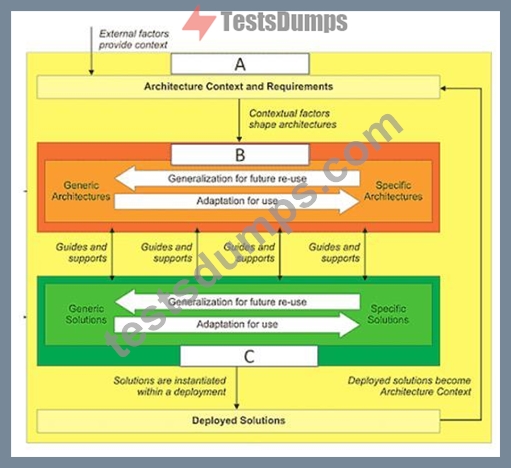
What are the items labelled A, B and C?
- A. A-Enterprise Strategic Architecture, B-Segment Architecture, C-Solutions Architecture
- B. A-Architecture Vision, B-Business Architecture, C-Information Systems Architecture
- C. A-Enterprise Architecture, B-Architecture Building Blocks, C-Solutions Building Blocks
- D. A-Enterprise Continuum, B-Architecture Continuum, C-Solutions Continuum
Answer: D
Explanation:
The illustration shows the relationship between the Enterprise Continuum, the Architecture Continuum, and the Solutions Continuum, which are key concepts in the TOGAF framework. The Enterprise Continuum is a view of the Architecture Repository that shows how generic foundation architectures can be leveraged and specialized to support the requirements of an individual organization. The Architecture Continuum specifies a structured classification for architectural artifacts, such as models, patterns, and descriptions, that can be reused and adapted across different domains and levels of abstraction. The Solutions Continuum identifies implemented solutions that support various stages of business and IT capability evolution, such as common systems, industry solutions, and organization-specific solutions. The illustration also shows how the architecture context and requirements are influenced by external factors, such as business drivers, stakeholders, and standards, and how they shape the generic and specific architectures and solutions. The illustration also shows how the deployed solutions become part of the architecture context for future iterations of the architecture development cycle. References:
*TOGAF Standard, 10th Edition, Part II: Architecture Development Method, Chapter 6: Architecture Repository, Section 6.2 Enterprise Continuum.
*TOGAF Standard, 10th Edition, Part IV: Architecture Content Framework, Chapter 35: Enterprise Continuum and Tools, Section 35.1 Introduction.
NEW QUESTION # 59
Complete the sentence. The architecture domains that are considered by the TOGAF standard as subsets of an overall enterprise architecture are Business, Technology,
- A. Logical and Physical
- B. Capability and Segment
- C. Application and Data
- D. Information and Data
Answer: C
Explanation:
These domains provide a consistent way to describe and understand the architecture from different perspectives, such as business, information, and technology12. Each domain has its own set of concepts, models, views, and artifacts that define the structure and behavior of the architecture within that domain12.
The other options are incorrect because:
* Logical and Physical are not architecture domains, but rather levels of abstraction that can be applied to any domain. Logical architecture describes the functionality and behavior of the system, while physical architecture describes the implementation and deployment of the system3.
* Information and Data are not distinct architecture domains, but rather aspects of the same domain. Information architecture describes the meaning and context of the data, while data architecture describes the structure and format of the data4.
* Capability and Segment are not architecture domains, but rather levels of granularity that can be applied to any domain. Capability architecture describes the current and desired states of a specific business capability, while segment architecture describes a subdivision of the enterprise that has a clear business focus5.
NEW QUESTION # 60
Please read this scenario prior to answering the question
You are employed as an Enterprise Architect for a company that supplies products for industrial production automation. You are part of an Enterprise Architecture (EA) team that has responsibilities across the company.
The company has multiple manufacturing plants where it assembles both standard and customized products.
Each of these plants operates its own planning and production scheduling systems, as well as applications and control systems that drive the automated production line.
During a recent management meeting, the agenda included discussion of how a competitor company had improved production efficiency by replacing multiple planning and scheduling systems with a single cloud- based system. This had reduced lifecycle costs through reduced duplication, lowered software maintenance costs, and supported incremental replacement. The CIO claimed the company ' s current systems architecture is already optimized. However, as the competitor has reported better financial results, the CEO has requested an investigation of a cloud-based solution.
In response, the Architecture Board approved a Request for Architecture Work to find out if such an architecture transformation would lead to efficiency improvements. You have been asked to help the architecture team with this project.
A concern of the plant managers is the safety and dependability of using a remote centralized system for planning and scheduling production. The system they choose must also be able to work with the local partners in the supply chain at each plant.
The company has an Enterprise Architecture (EA) practice and uses the TOGAF standard as the basis for its work. It has been running for many years and has established governance and development processes for EA.
The Chief Information Officer (CIO) sponsors the Enterprise Architecture program.
Refer to the scenario
You have been asked to describe how you will start the architecture project.
Based on the TOGAF standard, which of the following is the best answer?
- A. You would develop baseline and target Architectures for each manufacturing plant, ensuring that the views corresponding to selected viewpoints address key concerns of the stakeholders. A business case, together with performance metrics and measures should be defined to ensure the architecture meets the business needs. A consolidated gap analysis between the architectures will then validate the approach and determine the capability increments needed to achieve the target state.
- B. You would gather information from your suppliers and conduct a series of briefings with those of them that are on the current approved supplier list. Based on the findings from the research, you would define a preliminary Architecture Vision including summary views, high-level requirements, and high-level definitions of the baseline and target environments from a business, information systems, and technology perspective. You would then use the Architecture Vision to build agreement among the key stakeholders.
- C. You would run a series of interviews at each manufacturing plant to discover and document business requirements. This would also help you understand the systems and integrations with local partners.You would create a matrix of stakeholders and their primary concerns. You would then determine and record the main stakeholder requirements for the architecture. You would then create clear high-level descriptions of the current and future architectures.
- D. You would conduct a series of workshops with the local partners to gather requirements from them.
Based on the findings from the workshops, you would define a preliminary Architecture Vision including summary views, high-level requirements, and high-level definitions of the baseline and target environments from a business, information systems, and technology perspective. You would then use the Architecture Vision to build agreement among the local partners.
Answer: D
Explanation:
Option A best aligns with TOGAF Phase A: Architecture Vision, which is the starting phase for an architecture development cycle in TOGAF. This phase sets the foundation for the architecture engagement and ensures alignment with stakeholders and their concerns, especially when evaluating a major transformation like moving to a cloud-based planning and scheduling system.
# Key TOGAF Concepts Supporting Option A:
1. Phase A: Architecture Vision Objectives
Establish the high-level scope, constraints, and expectations.
Identify stakeholders and define their concerns and business requirements.
Create the Architecture Vision, which includes:
Summary-level Baseline and Target Architecture views (business, data, application, and technology).
Initial requirements and key concerns.
Stakeholder buy-in and approval for moving forward.
2. Engagement with Stakeholders
In this case, the plant managers and local supply chain partners have concerns regarding safety and dependability.
TOGAF emphasizes early engagement with business stakeholders to ensure concerns are identified and incorporated into the vision.
3. Creating Architecture Vision Document
A deliverable of Phase A.
Includes high-level descriptions of the baseline and target architectures, initial business goals, and stakeholder viewpoints.
Used to build agreement and obtain formal approval to proceed with detailed architecture work in later phases (B-D).
# Why Other Options Are Incorrect:
B: Focuses on suppliers and not the actual stakeholders impacted by the architecture - i.e., plant managers and internal operations. This diverts from TOGAF's stakeholder-driven approach in Phase A.
C: This reflects Phases B-D of the ADM (Business, Information Systems, and Technology Architecture). It is too detailed and premature for the start of the project. In Phase A, you don't yet develop full baseline and target architectures or conduct a consolidated gap analysis.
D: While interviewing stakeholders is valid in Phase A, this option lacks a holistic view of the Architecture Vision development, and skips the TOGAF requirement to produce summary views of the baseline and target architectures and to use them to drive stakeholder buy-in. It is tactically correct, but strategically incomplete.
# TOGAF Source References:
TOGAF 9.2 - Section 6.2 (Phase A: Architecture Vision)
" The Architecture Vision describes how the proposed architecture support the business goals, and the strategic direction. It also provides a high-level description of the baseline and target architectures and identifies key stakeholders and concerns. " TOGAF 9.2 - Part IV, Architecture Content Framework
" The Architecture Vision includes the scope, constraints, and expectations. It forms the basis for approval to proceed with further architecture development. "
NEW QUESTION # 61
Consider the following statements.
1. All processes, decision-making, and mechanisms used will be established so as to minimize or avoid potential conflicts of interest.
2. More effective strategic decision-making will be made by C-Level executives and business leaders.
3. All actions implemented and their decision support will be available for inspection by authorized organization and provider parties.
4. Digital Transformation and operations will be more effective and efficient.
Which statements highlight the value and necessity for Architecture Governance to be adopted within organizations?
- A. 2& 3
- B. 1 & 4
- C. 2 & 4
- D. 1 & 3
Answer: D
Explanation:
Explanation
Statements 1 and 3 highlight the value and necessity for Architecture Governance to be adopted within organizations. Architecture Governance is the practice and orientation by which Enterprise Architectures and other architectures are managed and controlled at an enterprise-wide level12. It ensures that architectural decisions are aligned with the organization's strategy, objectives, and standards. Architecture Governance also involves establishing and maintaining processes, decision-making, and mechanisms to avoid or minimize potential conflicts of interest, such as between different stakeholders, business units, or projects34. Moreover, Architecture Governance requires transparency and accountability for all actions implemented and their decision support, so that they can be inspected and evaluated by authorized parties, such as auditors, regulators, or customers5 . References:
*The TOGAF Standard, Version 9.2 - Architecture Governance - The Open Group
*Architecture Governance - The Open Group
*Tutorial: Governance in TOGAF's Architecture Development Method (ADM)
*Architecture Governance in TOGAF: Ensuring Effective Management and Compliance
*The TOGAF Standard, Version 9.2 - Definitions - The Open Group
*[Architecture Governance in TOGAF: Ensuring Alignment and Control]
NEW QUESTION # 62
Scenario
You are working as an Enterprise Architect within an Enterprise Architecture (EA) team at a global company that sells consumer products. The company produces many products that buyers use and enjoy.
The company has announced a major change to its products that will occur over a four-year period. This change includes the introduction of digital products and services. An architecture to support this strategy has been finished, along with a roadmap for a set of projects to implement this significant change. This will be a cross-functional effort between the product design and software teams. It is planned to be developed in phases.
The company faces a challenge in presenting and providing access to different services through its products and digital platforms while ensuring compliance with data privacy laws. In some countries and regions, the data residency requirements mean that the company has to store certain data within the region where it is collected. As a result, the company's application portfolio and infrastructure must connect with various cloud services and data repositories in different countries.
The EA team has inherited the architecture used by the current products, some of which can be carried over to the new products. The EA team has started to define which parts of the architecture to carry forward. Enough of the Business Architecture has been defined so that work can commence on the Information Systems and Technology Architectures. Those architectures need to be defined to support the key digital services that the company plans to provide.
The company uses the TOGAF Standard as the foundation for its Enterprise Architecture framework, and architecture development follows the purpose-based EA Capability model outlined in the TOGAF Series Guide: A Practitioner's Approach to Developing Enterprise Architecture Following the TOGAF ADM. The EA team reports to the Chief Information Officer (CIO), who oversees the program.
You have been asked how to decide and organize the work to deliver the requested architectures.
Based on the TOGAF standard, which of the following is the best answer?
- A. You look outside the company to study how other companies organize their data models and application portfolios. You create just enough architecture description for the Application, Data, and Technology Architectures to identify the different options. For each project, this includes identification of candidate architecture and solution building blocks. You then identify solution providers, perform a readiness assessment, and assess the viability and fitness of the solution options. You then write the draft Implementation and Migration plan.
- B. You refer to the superior architecture for guidance. You review the projects identified, their dependencies, and synergies, then decide the sequence for starting the projects. You develop high-level architecture descriptions. For each project, you determine how much work is needed, identify reference architectures, and candidate building blocks. You identify the resource needs taking into account cost and value. You document the different options, risks, and ways to control them to enable feasibility analysis and trade-off with the stakeholders.
- C. You research leading data companies, using your findings to help in developing high-level Target Data, Application, and Technology Architectures. You review the Architecture Vision to determine the level of detail, time, and scope of the ADM cycle phases required for each project. You identify and estimate the cost of the main resources. You then prepare an Architecture Roadmap and request the Architecture Board to review the roadmap. You then start the project.
- D. You commence an iteration of ADM Phase A, identifying the stakeholders and revising the Architecture Vision. You perform a Stakeholder Analysis and update the Stakeholder Map. You conduct workshops and interviews to reflect the stakeholders who are now the key drivers for the digital products and services. You coordinate with the CIO to ensure alignment with the overall roadmap and update the Implementation and Migration Plan accordingly.
Answer: B
Explanation:
Comprehensive and Detailed Step-by-Step Explanation
Context of the Scenario
The company is in the process of delivering requested architectures to support the introduction of digital products and services. The Business Architecture is sufficiently defined, and the focus is on developing the Information Systems and Technology Architectures.
TOGAF emphasizes breaking down large, complex transformation programs into manageable projects, focusing on dependencies, risks, trade-offs, and sequencing of efforts. Based on the scenario, the company must deal with:
Data privacy and residency compliance across different regions.
Re-use of existing architecture for efficiency.
Alignment of digital services with a global roadmap.
The activity described aligns with ADM Phases B (Business Architecture), C (Information Systems Architecture), and D (Technology Architecture), with a focus on delivering architectures for implementation.
Option Analysis
Option A:
Strengths:
Refers to developing high-level architecture descriptions and identifying reference architectures and candidate building blocks, which align with ADM Phases B, C, and D.
Addresses feasibility analysis, trade-offs, and stakeholder engagement, which are part of architecture development and decision-making in TOGAF.
Ensures that the architecture descriptions are resource-conscious, including cost and value analysis, dependencies, risks, and synergies between projects.
Conclusion: Correct, as it provides a complete approach to organizing the work to deliver architectures while adhering to TOGAF principles.
Option B:
Strengths:
Suggests creating architecture descriptions for the Application, Data, and Technology Architectures, which are necessary for delivering requested architectures.
Addresses readiness assessments and the fitness of solutions.
Weaknesses:
Emphasizes looking outside the company and studying other companies' models, which is not necessarily aligned with TOGAF unless justified by specific gaps.
Skips essential TOGAF steps like feasibility analysis and detailed stakeholder engagement.
Conclusion: Incorrect, as it places undue emphasis on external research instead of leveraging TOGAF's structured ADM.
Option C:
Strengths:
Suggests reviewing the Architecture Vision and determining scope, which aligns with TOGAF principles.
Proposes preparing an Architecture Roadmap and involving the Architecture Board for review.
Weaknesses:
Does not cover important elements such as candidate building blocks, feasibility analysis, or stakeholder engagement.
Suggests starting the project prematurely without proper sequencing or risk trade-offs.
Conclusion: Incorrect, as it skips key steps and lacks a structured approach to dependencies and resource management.
Option D:
Strengths:
Suggests revising the Architecture Vision and conducting a Stakeholder Analysis, which aligns with Phase A of the ADM.
Weaknesses:
Returning to Phase A is not required here, as the Architecture Vision has already been defined. Revising the vision at this stage indicates a step backward.
Lacks focus on feasibility analysis, dependencies, and sequencing, which are the immediate needs in this phase.
Conclusion: Incorrect, as it unnecessarily revisits earlier ADM phases instead of progressing.
TOGAF
Reference
ADM Phases B, C, D: Emphasizes developing detailed architectures, identifying candidate building blocks, and addressing dependencies, risks, and resource needs (TOGAF 9.2, Chapters 8-10).
Architecture Roadmap and Feasibility Analysis: Guides sequencing and trade-offs for implementation (TOGAF 9.2, Section 12.4).
Stakeholder Engagement: Critical for ensuring alignment and feasibility (TOGAF 9.2, Section 24.2).
Decision-Making and Trade-offs: TOGAF emphasizes documenting risks and trade-offs as part of feasibility analysis (TOGAF 9.2, Section 6.4.1).
NEW QUESTION # 63
Which of the following describes how the Enterprise Continuum is used when developing an enterprise architecture?
- A. To coordinate with the other management frameworks in use
- B. To identify and understand business requirements
- C. To describe how an architecture addresses stakeholder concerns
- D. To classify architecture and solution assets
Answer: D
Explanation:
The Enterprise Continuum consists of two complementary concepts: the Architecture Continuum and the Solutions Continuum1. The Architecture Continuum provides a consistent way to describe and understand the generic and reusable architecture building blocks, such as models, patterns, and standards, that can be applied and tailored to specific situations2. The Solutions Continuum provides a consistent way to describe and understand the specific and implemented solution building blocks, such as products, services, and components, that realize the architecture building blocks3. The Enterprise Continuum enables the reuse and integration of architecture and solution assets across different levels of abstraction, scope, and detail, ranging from foundation architectures to organization-specific architectures1.
The Enterprise Continuum is used when developing an enterprise architecture to support the following activities1:
* Selecting relevant architecture and solution assets from the Architecture Repository or other sources, based on the business drivers, goals, and requirements
* Adapting and customizing the architecture and solution assets to suit the specific needs and context of the enterprise
* Defining and developing the target architecture and the architecture roadmap, based on the gaps and opportunities identified between the baseline and the target states
* Defining and developing the implementation and migration plan, based on the architecture roadmap and the solution building blocks
* Governing and managing the architecture and solution assets throughout the architecture lifecycle, ensuring their quality, consistency, and compliance
NEW QUESTION # 64
Consider the following ADM phases objectives.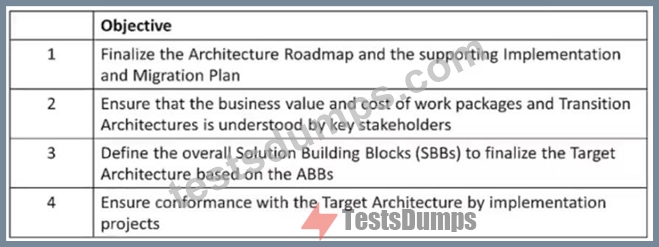
Which phase does each objective match?
- A. 1E-2F-3E-4G
- B. 1G-2E-3F-4E
- C. 1F-2F-3E-4G
- D. 1F-2G-3F-4F
Answer: A
Explanation:
1E: To identify delivery vehicles (projects programs portfolios) that will deliver the Target Architecture 2F:
To confirm readiness and ability to undergo change 3E: To determine whether an incremental approach is required and if so identify Transition Architectures that will deliver continuous business value 4G: To perform appropriate governance functions while the solution is being implemented Reference: The TOGAF Standard | The Open Group Website, Section 3.2 ADM Phases.
NEW QUESTION # 65
Which of the following best describes the class of information known as the Reference Library within the Architecture Repository?
- A. A record of the governance activity across the enterprise
- B. Processes to support governance of the Architecture Repository
- C. Specifications to which architectures must conform
- D. Guidelines and templates used to create new architectures
Answer: D
Explanation:
Explanation
The class of information known as the Reference Library within the Architecture Repository contains guidelines and templates used to create new architectures. The Reference Library provides a set of resources that can be leveraged or customized for specific architecture development purposes. It includes generic building blocks, patterns, models, standards, frameworks, methods, techniques, best practices, etc. Reference:
The TOGAF Standard | The Open Group Website, Section 2.4 Architecture Repository.
NEW QUESTION # 66
Consider the following ADM phases objectives.
Which phase does each objective match?
- A. 1E-2F-3E-4G
- B. 1G-2E-3F-4E
- C. 1F-2F-3E-4G
- D. 1F-2G-3F-4F
Answer: A
Explanation:
Explanation
1E: To identify delivery vehicles (projects programs portfolios) that will deliver the Target Architecture 2F:
To confirm readiness and ability to undergo change 3E: To determine whether an incremental approach is required and if so identify Transition Architectures that will deliver continuous business value 4G: To perform appropriate governance functions while the solution is being implemented Reference: The TOGAF Standard | The Open Group Website, Section 3.2 ADM Phases.
NEW QUESTION # 67
Please read this scenario prior to answering the question
You are the Lead Enterprise Architect at a major agribusiness company. The company's main harvest is lentils, a highly valued food grown worldwide. The lentil parasite, broomrape, has been an increasing concern for many years and is now becoming resistant to chemical controls. In addition, changes in climate favor the propagation and growth of the parasite. As a result, the parasite cannot realistically be exterminated, and it has become pandemic, with lentil yields falling globally.
In response to the situation, the CEO has decided that the lentil fields will be used for another harvest. The company will also cease to process third-party lentils and will repurpose its processing plants. Thus, the target market will change, and the end-products will be different and more varied.
The company has recently established an Enterprise Architecture practice based on the TOGAF standard as method and guiding framework. The CIO is the sponsor of the activity. A formal request for architecture change has been approved. At this stage there is no fixed scope, shared vision, or objectives.
Refer to the scenario
You have been asked to propose the best approach for architecture development to realize the CEO's change in direction for the company.
Based on the TOGAF standard which of the following is the best answer?
- A. You propose that the team uses the architecture definition document and focus on architecture development starting simultaneously phases B, C and D. This is because the CEO has identified the need to change. This will ensure that the change can be defined in a structured manner and address the requirements needed to realize the change.
- B. You propose that this engagement define the baseline Technology Architecture first in order to assess the current infrastructure capacity and capability for the company. Then the focus should be on transition planning and incremental architecture deployment. This will identify requirements to ensure that the projects are sequenced in an optimal fashion so as to realize the change.
- C. You propose that the priority is to produce a new Request for Architecture Work leading to development of a new Architecture Vision. The trade-off method should be applied to identify and select an architecture satisfying the stakeholders. For an efficient change the EA team should be aligned with the organization's planning, budgeting, operational, and change processes.
- D. You propose that the team focus on architecture definition including development of business models, with emphasis on defining the change parameters to support this new business strategy that the CEO has identified. Once understood, the team will be in the best position to identify the requirements, drivers, issues, and constraints for the change.
Answer: C
Explanation:
Explanation
A Request for Architecture Work is a document that describes the scope, approach, and expected outcomes of an architecture project. A Request for Architecture Work is usually initiated by the sponsor or client of the architecture work, and approved by the Architecture Board, which is a governance body that oversees the architecture work and ensures compliance with the architecture principles, standards, and goals. A Request for Architecture Work triggers a new cycle of the Architecture Development Method (ADM), which is the core process of the TOGAF standard that guides the development and management of the enterprise architecture12 An Architecture Vision is a high-level description of the desired outcomes and benefits of the proposed architecture. An Architecture Vision is the output of Phase A: Architecture Vision of the ADM cycle, which is the first phase of the architecture development. An Architecture Vision defines the scope and approach of the architecture work, and establishes the business goals and drivers that motivate the architecture work. An Architecture Vision also involves obtaining the approval and commitment of the sponsors and other key stakeholders, and initiating the Architecture Governance process3 A trade-off analysis is a technique that can be used to evaluate and compare different architecture alternatives and select the most suitable one. A trade-off analysis involves identifying the criteria and factors that are relevant to the decision, such as costs, benefits, risks, and opportunities, and assessing the strengths and weaknesses of each alternative. A trade-off analysis also involves balancing and reconciling the multiple, often conflicting, requirements and concerns of the stakeholders, and ensuring alignment with the Architecture Vision and the Architecture Principles.
Therefore, the best answer is D, because it proposes the best approach for architecture development to realize the CEO's change in direction for the company. The answer covers the Request for Architecture Work, the Architecture Vision, and the trade-off analysis techniques that are relevant to the scenario.
References: 1: The TOGAF Standard, Version 9.2, Part II: Architecture Development Method (ADM), Chapter 7: Request for Architecture Work 2: The TOGAF Standard, Version 9.2, Part VI: Architecture Capability Framework, Chapter 50: Architecture Governance 3: The TOGAF Standard, Version 9.2, Part II:
Architecture Development Method (ADM), Chapter 18: Phase A: Architecture Vision : The TOGAF Standard, Version 9.2, Part III: ADM Guidelines and Techniques, Chapter 30: Trade-Off Analysis
NEW QUESTION # 68
Please read this scenario prior to answering the question
You are employed as an Enterprise Architect in a team at a large company. The company sells luxury food and drinks in more than 10,000 stores worldwide. The company is a leader in using technology to connect with its customers. This includes online ordering, mobile apps, and rewards programs. The company is also famous for bringing new ideas to the market, like ordering through apps, using Al to suggest personalized options, self-service pickup stations, and changing prices based on demand.
The stores are open every day. They send timely sales data to a central system that manages inventory. This system can predict what products are needed, adjust how much stock there is, and order more stock automatically. The stores and the main inventory system work directly with the mobile apps, allowing orders to be made online. The central inventory system is located at the company's main data center.
The company will merge with a major competitor. This competitor has a synergistic business. Leaders from both companies have told shareholders that the merger will happen fast. There will be minimal impact for customers. All stores will keep the current brand names. They will combine their systems, choosing the best ones to use.
This means their store management and back-office systems will become one. They will stop using duplicate systems and use one main system to manage the stores.
They will also cut down on the number of back-office applications they use.
The Request for Architecture Work to oversee the merger has been approved.
Stakeholders, concerns, and business requirements have been identified. The stakeholders have made it clear that they expect to continue to be able to innovate quickly, and that changes should not restrict that capability. The scope of what is inside and what is outside the architecture efforts has been confirmed. The next step is to revisit and review the Architecture Principles, as they form part of the constraints on architecture work.
Business Continuity is essential given that the business depends on real-time ordering and automated inventory management. During the systems integration, maintaining service for customers and inventory operations must be prioritized Refer to the scenario You have been asked to identify the most relevant Architecture Principles for the merger besides Business Continuity.
Based on the TOGAF standard, which of the following is the best answer?
[Note: You should assume that the company follows the example set of Architecture Principles provided in the TOGAF standard, ADM Techniques, Architecture Principles chapter.]
- A. Primacy of Principles will make sure that the same principles apply to bothorganizations of the newly merged operation, creating consistency acrosslocations. Data as an Asset is critical. Since you're maintaining separate mobileapps but consolidating back-end systems, treating data as an asset becomesessential. This principle helps ensure that customer data, and inventoryinformation from both brands are properly integrated and managed.Technology Independence is important when consolidating the back-officeapplications and order processing systems.
- B. Control Technical Diversity will help by standardizing technology platforms aspart of the integration process. This will be vital for standardizing the appintegration for digital orders with the back-office systems, and will reducecomplexity and costs during integration. Data Trustee will establish owners tomanage the shared data across the company, thereby assuring data quality.Ease-of-Use is needed to make sure that new user interfaces for the appscontinue to be easy to use.
- C. Service orientation will speed up the merger and make it easier to integratesystems while maintaining business operations. Maximize Benefit to theEnterprise will make sure that merger decisions prioritize the overall benefit tothe combined company. Common Use Applications across the mergedcompany is preferred over the use of similar or duplicative applications forcertain parts of the company. This help supports the goal of merging back-office systems to reduce duplication.
- D. Compliance with the Law makes sure that all company activities comply withrelevant laws and regulations. This principle provides the foundation forensuring the merger meets all legal requirements.
Requirements-BasedChange will make sure that when combining systems, changes to applicationsand technology are only made if required by business needs. ResponsiveChange Management focuses on the speed needed to achieve the goals setby the leaders for a quick merger. We are committed to quickly blending thecompanies as planned.
Answer: C
Explanation:
You are asked to identify the most relevant Architecture Principles, besides Business Continuity, that apply to a rapid merger, where:
* Back-office and store management systems will be consolidated
* Duplicate applications will be eliminated
* Innovation must remain fast
* Customer experience must remain uninterrupted
* Combined enterprise value is the priority
TOGAF's example Architecture Principles include four main categories:
* Business Principles
* Data Principles
* Application Principles
* Technology Principles
Option D contains the principles that best support the specific needs of the merger as described.
# Why Option D is correct
1. Service Orientation (Business Principle)
This principle states that architecture should be organized around services, enabling flexibility, loose coupling, and ease of integration.
For the merger:
* Integrating two companies' store systems, mobile apps, and inventory platforms requires modular, interoperable services.
* Service orientation directly supports the requirement that innovation must not slow down.
* It allows systems to be merged with minimal disruption.
This principle supports fast integration + ongoing innovation - exactly what stakeholders demand.
2. Maximize Benefit to the Enterprise (Business Principle)
This principle ensures decisions are made from an enterprise-wide (not departmental or local) perspective.
In the scenario:
* Two companies are merging.
* Decisions must prioritize combined enterprise value, not local optimizations by either company.
* System consolidation and elimination of duplicates requires an enterprise-first mindset.
This principle aligns perfectly with a merger that aims to unify operations and reduce redundancy.
3. Common Use Applications (Application Principle)
This is one of the MOST relevant principles in any merger.
TOGAF defines this principle as:
"Applications should be shared across the enterprise and not duplicated." In the scenario:
* Back-office systems and store management tools must be consolidated.
* Duplicate applications are explicitly to be reduced.
* One main system will be used across stores.
This principle directly matches the merger's objectives.
# Summary
Option D contains the three principles that best support:
* A major merger
* System consolidation
* Reduction of duplication
* Enterprise-wide benefit
* Flexible, service-oriented integration
* Continued innovation
Therefore, Option D is the most appropriate selection according to TOGAF's example Architecture Principles.
NEW QUESTION # 69
Please read this scenario prior to answering the question
You are employed as an Enterprise Architect at a technology company, reporting directly to the Chief Enterprise Architect. The company supplies personnel and delivers cloud- based solutions to numerous government agencies.
The nature of the business is such that the data and the information stored on the company systems is the company's major asset and is highly confidential. The company employees work remotely and need constant access to the company systems, which is done by the public infrastructure. They use message encryption, secure internet connections using Virtual Private Networks (VPNs), and other standard security measures. The company provides computer security awareness training for all its staff.
The Chief Security Officer (CSO) has noted an increase in distributed denial of service (DDoS) attacks on companies with a similar profile. The CSO understands that even with thorough preparation, a major attack could stop employees from being able to do their jobs. This could lead to a large financial loss, damage to the company's reputation with customers, and employees being unable to work.
A risk assessment has been completed and the company has looked for cyber insurance that covers such attacks. The price for this insurance is very high. The CTO has decided not to get cyber insurance to cover such attacks.
The company follows the TOGAF standard as the method and guiding framework for its Enterprise Architecture (EA) practice. The Chief Technology Officer (CTO) is the sponsor of the activity. The practice uses an iterative approach for its architecture development.
This has enabled the decision makers to gain valuable insights into the different aspects of the business Please read this scenario prior to answering the question You have been asked to describe the steps you would take to strengthen the current architecture to improve data protection.
Based on the TOGAF standard which of the following is the best answer?
- A. You would run a planning exercise to assess the business continuity
requirements and analyze the current Enterprise Architecture for gaps. You create a formal change request related to business resilience and maintaining critical business functions. You would arrange a meeting of the Architecture Board to assess and approve the change request. Once approved you would create a new Request for Architecture Work to begin an ADM cycle to implement the changes. - B. You would request technology updates from existing suppliers that improve the company's capabilities to detect, react, and recover from an incident. You would run a simulated ransomware attack to evaluate the current Enterprise Architecture's resilience and recovery capabilities. Using the findings, you would perform a gap analysis of the current Enterprise Architecture, and prepare change requests to address identified gaps. You would document the changes implemented and add to the Architecture Repository.
- C. You would hold an Architecture Compliance Review with the scope to examine the company's ability to respond to such attacks. You would identify the departments involved and have them nominate representatives. You would then tailor checklists to address the requirement for increased business continuity and resilience. You would circulate the checklists to the nominated representatives for them to complete. You would review the completed checklists, identifying and resolving issues. You would then determine and present your recommendations to the Architecture Board.
- D. You would ensure that business value and cost of continuity measures are understood by key stakeholders, and that the company has in place up-to-date processes for managing change to the current Enterprise Architecture. You recommend that DDoS mitigation be addressed at the infrastructure level to ensure effective, scalable protection. Changes should be made to the baseline description of the Technology Architecture. The changes should be approved by the Architecture Board and implemented by change management techniques.
Answer: A
Explanation:
In this scenario, the CTO hasnotpurchased cyber-insurance, the CSO is concerned about increased DDoS risk, and YOU (the EA) are asked"to describe the steps you would take to strengthen the current architecture to improve data protection." Because the company follows theTOGAF standardand uses aniterative ADM cycle, the correct response must:
* Start with therisk/continuity concern
* Use the formal TOGAFchange management process
* Lead to aRequest for Architecture Work
* Initiate anew ADM cycleto update the architecture properly
* Ensure Architecture Board governance
OptionBis the only answer that matches TOGAF's required process.
#Why Option B is correct (TOGAF-aligned)
Option B follows TOGAF'sArchitecture Change Management (Phase H)process:
* Assess the business continuity requirements- Correct: Phase H requires evaluating change triggers such as new risks, threats, or incidents.- DDoS risk # business continuity concern # legitimate architecture change trigger.
* Analyze the current architecture for gaps- Correct: TOGAF Phase H requires assessing whether the current baseline architecture can support required resilience.
* Create a formal Change Request- Exactly correct: Phase H outputsArchitecture Change Requests (ACRs)for significant changes.- ACR includes description, rationale, and impact (in this case:
resilience, continuity, and data protection).
* Architecture Board reviews/approves the change request- Correct: All major architecture changes must go through Architecture Governance.
* Create a new Request for Architecture Work (RFAW)- Required when the change is significant and needs a new ADM cycle.- Strengthening data protection and business continuity DEFINITELY qualifies as a major change.
* Begin a new ADM cycle to implement the changes- Perfectly aligned with TOGAF's iterative approach:Business continuity # update Technology Architecture # updated security patterns # updated Target Architecture.
This is exactly the TOGAF-prescribed method to strengthen an architecture when significant new risks appear.
Therefore,Option B is the correct and TOGAF-compliant answer.
#Why the other options are incorrect
A - Not TOGAF-aligned
* Starts with vendors and simulations (not TOGAF-first steps).
* No mention of Architecture Board or Change Management.
* No Request for Architecture Work.
* Gap analysis alone is not the first step for significant architectural risk.
C - Too narrow and skips TOGAF governance
* Jumps straight to modifying the Technology Architecture baseline.
* No Change Request, no RFAW, no ADM cycle initiation.
* Recommends a solution ("DDoS mitigation at infrastructure level") before architectural assessment.
D - Misuses Architecture Compliance Review
* Architecture Compliance Reviews check conformity to an existing architecture-not evaluate new risks or design resilience enhancements.
* A compliance review isnotthe correct first step for addressing new threats.
NEW QUESTION # 70
Complete the sentence. ______ can be used to explain how generic solutions can be leveraged and specialized to meet the needs of an organization.
- A. The Architecture Repository
- B. The TOGAF ADM
- C. The Solutions Landscape
- D. The Enterprise Continuum
Answer: D
Explanation:
Comprehensive and Detailed In-Depth Explanation from Expert in Enterprise Architecture, guiding in TOGAF and ArchiMate:
The Enterprise Continuum is a TOGAF concept that provides a logical classification mechanism for architecture and solution assets, ranging from:
Generic, industry-wide solutions
To organization-specific architectures and implementations
It explains:
How generic architectures and solutions are adapted, specialized, and reused The relationship between Foundation, Common Systems, Industry, and Organization-Specific assets Why Option D is correct:
The Enterprise Continuum explicitly describes how generic solutions are leveraged and specialized to meet enterprise-specific needs.
Why the other options are incorrect:
A . Architecture Repository: Stores assets but does not explain specialization.
B . Solutions Landscape: Describes deployed solutions, not classification or specialization.
C . TOGAF ADM: A development method, not a classification concept.
NEW QUESTION # 71
Which deliverable is first produced in Phase A, also updated in Phase E, and helps the architect to understand the baseline and target for the enterprise?
- A. Consolidated Gaps, Solutions, and Dependencies Matrix
- B. Stakeholder Map
- C. Architecture Contracts
- D. Capability Assessment
Answer: D
Explanation:
Comprehensive and Detailed Explanation
The question is about a deliverable that:
* Is first created in Phase A: Architecture Vision.
* Is updated in Phase E: Opportunities and Solutions.
* Helps the architect understand both the baseline and the target for the enterprise.
Let's review each option:
* A. Architecture Contracts
* These are created in Phase G: Implementation Governance.
* They formalize agreements between architecture and implementation teams, but are not produced in Phase A.
* Incorrect.
* B. Capability Assessment
* In Phase A, the Capability Assessment is produced to assess the organization's current capability maturity and to identify strengths and weaknesses (baseline).
* In Phase E, it is updated to reflect the required target capability and to inform planning of the work packages and Transition Architectures.
* This deliverable helps architects understand both baseline and target capability for the enterprise.
* Correct.
* C. Consolidated Gaps, Solutions, and Dependencies Matrix
* This is produced in Phase E to consolidate results from Gap Analysis across Phases B, C, and D.
* It is not started in Phase A, so it does not meet the condition.
* Incorrect.
* D. Stakeholder Map
* This is produced in Phase A as part of stakeholder management.
* It is not updated in Phase E, and it does not directly address baseline vs. target capability.
* Incorrect.
Correct Mapping
The deliverable that fits all three conditions is the Capability Assessment (B).
References
* The Open Group, TOGAF Standard, Version 9.2, Part II: ADM - Phase A (Capability Assessment as an input to the Architecture Vision) and Phase E (updated Capability Assessment to guide Opportunities and Solutions).
* The Open Group, TOGAF 9 Certified Study Guide - description of Capability Assessment as a baseline/target capability comparison tool.
NEW QUESTION # 72
Consider the following ADM phases objectives.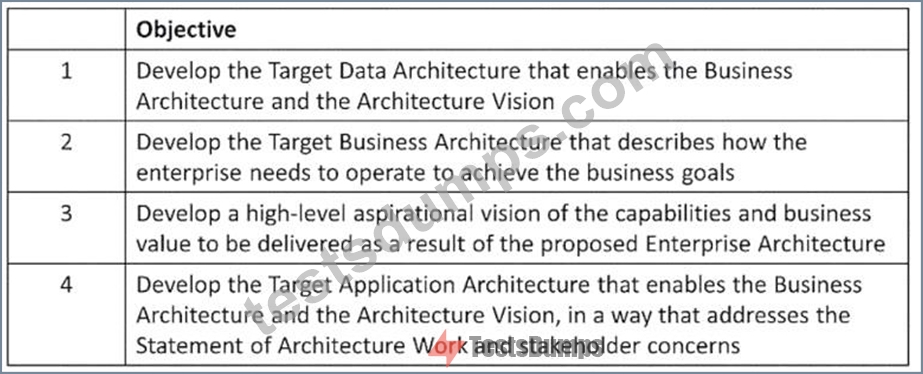
Which phase does each objective match?
- A. 1C-2D-3B-4A
- B. 1C-2B-3A-4C
- C. 1B-2D-3A-4C
- D. 1A-2B-3C-4D
Answer: B
Explanation:
* The objectives listed in the question correspond to the objectives of different phases of the TOGAF ADM (Architecture Development Method), which is a method for developing and managing an enterprise architecture1.
* The ADM consists of nine phases, each with a specific purpose and output. The phases are1:
* Preliminary Phase: To prepare and initiate the architecture development cycle, including defining the architecture framework, principles, and governance.
* Phase A: Architecture Vision: To define the scope, vision, and stakeholders of the architecture initiative, and to obtain approval to proceed.
* Phase B: Business Architecture: To describe the baseline and target business architecture, and to identify the gaps between them.
* Phase C: Information Systems Architectures: To describe the baseline and target data and application architectures, and to identify the gaps between them.
* Phase D: Technology Architecture: To describe the baseline and target technology architecture, and to identify the gaps between them.
* Phase E: Opportunities and Solutions: To identify and evaluate the opportunities and solutions for implementing the target architecture, and to define the work packages and transition architectures.
* Phase F: Migration Planning: To finalize the implementation and migration plan, and to ensure alignment with the enterprise portfolio and project management.
* Phase G: Implementation Governance: To provide architecture oversight and guidance for the implementation projects, and to manage any architecture change requests.
* Phase H: Architecture Change Management: To monitor the changes in the business and technology environment, and to assess the impact and performance of the architecture.
* Based on the above definitions, we can match each objective with the corresponding phase as follows:
* Objective 1: Develop the Target Data Architecture that enables the Business Architecture and the Architecture Vision. This objective is achieved in Phase C: Information Systems Architectures, where the data architecture is defined as a subset of the information systems architecture2.
* Objective 2: Develop the Target Business Architecture that describes how the enterprise needs to operate to achieve the business goals. This objective is achieved in Phase B: Business Architecture, where the business architecture is defined as a subset of the enterprise architecture3.
* Objective 3: Develop a high-level aspirational vision of the capabilities and business value to be delivered as a result of the proposed Enterprise Architecture. This objective is achieved in Phase A: Architecture Vision, where the architecture vision is defined as a high-level description of the target architecture and its benefits4.
* Objective 4: Develop the Target Application Architecture that enables the Business Architecture and the Architecture Vision, in a way that addresses the Statement of Architecture Work and stakeholder concerns. This objective is achieved in Phase C: Information Systems Architectures, where the application architecture is defined as a subset of the information systems architecture2.
References:
* 1: The TOGAF Standard, Version 9.2, Chapter 5: Architecture Development Method (ADM)
* 2: The TOGAF Standard, Version 9.2, Chapter 9: Phase C: Information Systems Architectures
* 3: The TOGAF Standard, Version 9.2, Chapter 8: Phase B: Business Architecture
* 4: The TOGAF Standard, Version 9.2, Chapter 7: Phase A: Architecture Vision
NEW QUESTION # 73
Consider the following chart:
Which important concept for Enterprise Architecture Practitioners does it illustrate?
- A. An Enterprise Architecture must be developed in phases with a limited fixed duration.
- B. ADM phases must be run simultaneously until the relevant information has been produced.
- C. ADM phases must be run in a sequenced approach to produce the Architecture.
- D. Enterprise Architects must use Gantt charts to communicate with Stakeholders.
Answer: C
Explanation:
The chart shown is a Gantt chart, which is commonly used for project management to illustrate a project schedule. In the context of TOGAF (The Open Group Architecture Framework), which is a framework for enterprise architecture, this Gantt chart is demonstrating the sequenced approach to the Architecture Development Method (ADM). The ADM is the core process of TOGAF which provides a tested and repeatable process for developing architectures. The ADM is described as being iterative, over the whole process, between phases, and within phases. For each iteration of the ADM, a fresh decision must be taken about each of the parameters (scope, granularity, time period, and architecture assets).
The ADM consists of a number of phases that have to be followed in sequence:
* Preliminary Phase: Framework and principles
* Phase A: Architecture Vision
* Phase B: Business Architecture
* Phase C: Information Systems Architectures, including Data and Application Architectures
* Phase D: Technology Architecture
* Phase E: Opportunities and Solutions
* Phase F: Migration Planning
* Phase G: Implementation Governance
* Phase H: Architecture Change Management
* Requirements Management
Each phase is dependent on the outputs of the previous phase and the Requirements Management phase runs throughout. The Gantt chart clearly shows the dependency and sequence in which these phases occur, implying that a structured approach is followed to produce the enterprise architecture.
References:
* The TOGAF Standard, Version 9.2, a standard of The Open Group
* The TOGAF documentation available at https://publications.opengroup.org/standards/architecture and
https://publications.opengroup.org/guides/architecture
NEW QUESTION # 74
Consider the following descriptions of deliverables consumed and produced across the TOGAF ADM cycle.
General rules and guidelines, intended to be enduring and seldom amended, that inform and support the way in which an organization sets about fulfilling its mission The joint agreements between development partners and sponsors on the deliverables, quality, and fitness-for- purpose of an architecture A document that is sent from the sponsoring organization to the architecture organization to trigger the start of an architecture development cycle A set of quantitative statements that outline what an implementation project must do in order to comply with the architecture Complete the sentence. Deliverable 3 is an output of, deliverable 4 can form:
- A. the Preliminary Phase, an approach to change for the Implementation and Migration Plan
- B. Phase A, the plan for how the architecture is governed
- C. the Preliminary Phase, a major component of an implementation project
- D. Phase A, an assessment of the changes to the architecture
Answer: B
Explanation:
Comprehensive and Detailed In-Depth Explanation from Expert in Enterprise Architecture, guiding in TOGAF and ArchiMate:
To answer this question correctly, it is necessary to identify the TOGAF-defined deliverables:
Deliverable 3 is the Request for Architecture Work. This document is formally issued by the sponsoring organization to the architecture function to initiate a new ADM cycle or iteration.
Deliverable 4 corresponds to Architecture Requirements, which are expressed as quantitative, testable statements that implementation projects must satisfy to claim architectural compliance.
Why Option A is correct:
The Request for Architecture Work is a key output of Phase A (Architecture Vision). Phase A formally initiates the ADM cycle, establishes scope, stakeholders, constraints, and secures approval to proceed.
Architecture Requirements form a critical input to Architecture Governance, specifically contributing to the plan for how the architecture is governed, including compliance assessments, checkpoints, and governance controls during implementation.
Why the other options are incorrect:
B). Phase A, an assessment of the changes to the architecture: Impact and change assessments are not the primary formation purpose of Architecture Requirements.
C). the Preliminary Phase, an approach to change for the Implementation and Migration Plan: The Request for Architecture Work is not produced in the Preliminary Phase; that phase focuses on establishing Architecture Capability.
D). the Preliminary Phase, a major component of an implementation project: Architecture Requirements guide implementation but are not classified as a "major component" of the project itself.
Authoritative TOGAF References:
TOGAF ADM Phase A - Architecture Vision (Request for Architecture Work) TOGAF Architecture Requirements Management TOGAF Architecture Governance Framework
NEW QUESTION # 75
......
The OGEA-103 certification exam is an important credential for enterprise architects and IT professionals who want to demonstrate their expertise in the TOGAF framework. By passing the exam, candidates can validate their knowledge and skills, and enhance their credibility and career prospects in the field of enterprise architecture.
TOGAF Enterprise Architecture Combined Part 1 and Part 2 Exam Practice Tests 2026 | Pass OGEA-103 with confidence!: https://drive.google.com/open?id=1qH4eNjFWujl4yGh6HBZRzPRRVu38eZ-D
Pass OGEA-103 Tests Engine pdf - All Free Dumps: https://www.testsdumps.com/OGEA-103_real-exam-dumps.html
