

[Aug-2026] 300-215 Dumps are Available for Instant Access from TestsDumps
Study resources for the Valid 300-215 Braindumps!
NEW QUESTION # 45
Refer to the exhibit.
An HR department submitted a ticket to the IT helpdesk indicating slow performance on an internal share server. The helpdesk engineer checked the server with a real-time monitoring tool and did not notice anything suspicious. After checking the event logs, the engineer noticed an event that occurred 48 hours prior. Which two indicators of compromise should be determined from this information? (Choose two.)
- A. unauthorized system modification
- B. compromised root access
- C. malware outbreak
- D. privilege escalation
- E. denial of service attack
Answer: A,C
Explanation:
According to the event log, a suspicious service was installed (DIAOHHNMPMMRgji) with a service file pointing to a remote share (\\127.0.0.1\admin$\EqnBqKWm.exe). This type of activity strongly suggests:
* A. Unauthorized system modification: Installation of a service without proper authorization, especially with a random or obfuscated name, directly fits the description of system modification. The use of admin$ (administrative share) further implies this wasn't part of standard operations.
* E. Malware outbreak: The use of a service that points to an executable with a seemingly random name and the demand start configuration indicate a potential backdoor or remote-controlled malware. As stated in the Cisco CyberOps Associate guide, event ID 7045 with unusual service names or file paths is a strongIndicator of Compromise (IoC)for malware or persistence mechanisms.
Options like privilege escalation or DoS are not directly evidenced in the event log shown. There's no indication that the LocalSystem account was elevated beyond its default, nor that system resources were overwhelmed (as would be typical in DoS).
NEW QUESTION # 46 
Refer to the exhibit. An HR department submitted a ticket to the IT helpdesk indicating slow performance on an internal share server. The helpdesk engineer checked the server with a real-time monitoring tool and did not notice anything suspicious. After checking the event logs, the engineer noticed an event that occurred 48 hour prior. Which two indicators of compromise should be determined from this information?
(Choose two.)
- A. malware outbreak
- B. unauthorized system modification
- C. compromised root access
- D. privilege escalation
- E. denial of service attack
Answer: B,C
NEW QUESTION # 47
Drag and drop the steps from the left into the order to perform forensics analysis of infrastructure networks on the right.
Answer:
Explanation:
NEW QUESTION # 48
Drag and drop the cloud characteristic from the left onto the challenges presented for gathering evidence on the right.
Answer:
Explanation:
NEW QUESTION # 49
Refer to the exhibit.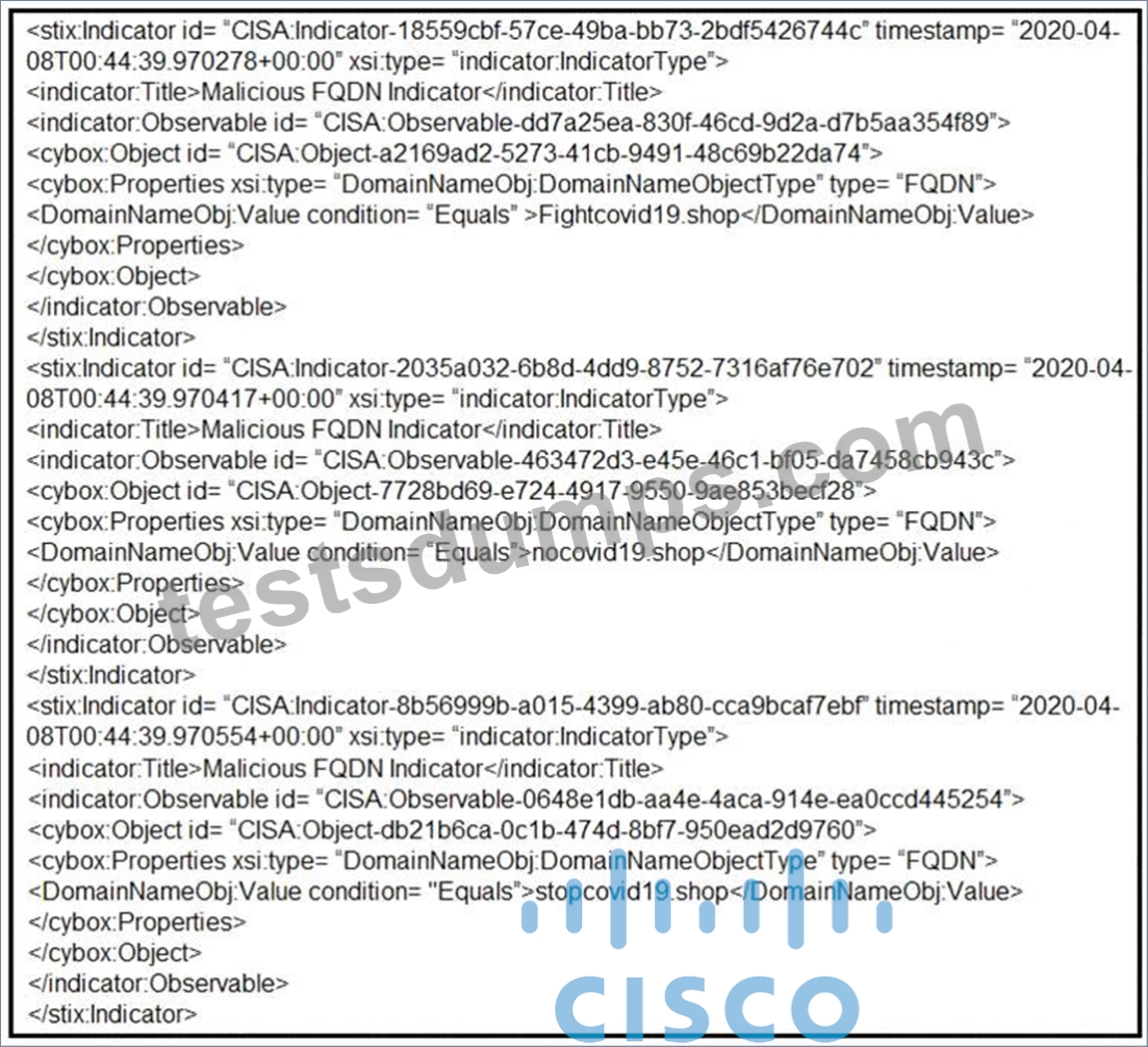
Which two actions should be taken based on the intelligence information? (Choose two.)
- A. Route traffic from identified domains to block hole.
- B. Block network access to all .shop domains
- C. Block network access to identified domains.
- D. Add a SIEM rule to alert on connections to identified domains.
- E. Use the DNS server to block hole all .shop requests.
Answer: C,D
Explanation:
The STIX intelligence feed in the exhibit identifies specific malicious domains, such as:
* fightcovid19.shop
* nocovid19.shop
* stopcovid19.shop
These are categorized as "Malicious FQDN Indicator." The recommended cybersecurity actions when such threat intelligence is received are:
* D. Block network access to identified domains: This directly prevents users or systems from communicating with known malicious infrastructure and is a critical first step in threat mitigation.
* B. Add a SIEM rule to alert on connections to identified domains: This ensures that any attempted communication with these domains is flagged for immediate review and action, enabling real-time threat detection and incident response.
Blocking all .shop domains (Option A or C) would be overbroad and potentially disruptive, as many legitimate websites also use that TLD. Option E (routing to block hole) could be valid as a DNS strategy, but B and D represent the most actionable and precise responses per standard incident response practices.
Reference: CyberOps Technologies (CBRFIR) 300-215 study guide, Chapter on "Threat Intelligence Platforms," covering how to operationalize STIX/TAXII indicators via blocking and SIEM integration.
NEW QUESTION # 50 
- A. Evaluate the artifacts in Cisco Secure Malware Analytics.
- B. Evaluate the file activity in Cisco Umbrella.
- C. Analyze the activity paths in Cisco Secure Malware Analytics.
- D. Analyze the registry activity section in Cisco Umbrella.
Answer: A
Explanation:
The correct next step in analyzing the malicious nature of the email is toevaluate the artifactsinCisco Secure Malware Analytics(formerly Threat Grid). This tool provides a comprehensive sandbox environment where behavioral indicators like file execution, registry access, and domain connections are logged and scored.
The exhibit shows:
* Remote PowerShell execution
* Executable download from a flagged domain
* SHA256 hash linked to malware
All these artifacts, as labeled in the Secure Malware Analytics output, arekey indicators of compromise, and analyzing them further can confirm whether the email was part of a malicious campaign.
Thus, the best action is:
A). Evaluate the artifacts in Cisco Secure Malware Analytics.
NEW QUESTION # 51
An attacker modifies a malicious file named TOPSECRET0523619132 by changing its file extension from a .
png to a doc in an attempt to evade detection. Which technique is being used to disguise the file?
- A. obfuscatiofi
- B. spoofing
- C. hashing
- D. steganography
Answer: A
NEW QUESTION # 52
Refer to the exhibit.
After a cyber attack, an engineer is analyzing an alert that was missed on the intrusion detection system. The attack exploited a vulnerability in a business-critical, web-based application and violated its availability.
Which two mitigation techniques should the engineer recommend? (Choose two.)
- A. address space randomization
- B. NOP sled technique
- C. heap-based security
- D. data execution prevention
- E. encapsulation
Answer: A,D
Explanation:
The alert indicates aWebDAV Stack Buffer Overflow, which is amemory corruptionattack targeting the stack, a common vector forremote code executionordenial-of-service (DoS).
To mitigate such exploits, two effective system-hardening techniques are:
* C. Address Space Layout Randomization (ASLR):Randomizes memory addresses used by system and application processes, making it difficult for attackers to predict where their malicious code will be executed.
* E. Data Execution Prevention (DEP):Prevents execution of code from non-executable memory regions such as the stack, thus stopping buffer overflow attacks from successfully executing payloads.
Both are well-established protections against stack-based buffer overflow attacks and are strongly recommended in the Cisco CyberOps Associate guide and general security best practices.
NEW QUESTION # 53
What is the goal of an incident response plan?
- A. to contain an attack and prevent it from spreading
- B. to ensure systems are in place to prevent an attack
- C. to determine security weaknesses and recommend solutions
- D. to identify critical systems and resources in an organization
Answer: A
Explanation:
The goal of an incident response plan (IRP) is to provide structured procedures for responding to cybersecurity incidents in a way that limits damage, contains the threat, and ensures business continuity. As outlined in the NIST SP 800-61 and Cisco CyberOps Associate study guide, containment and minimizing the impact of incidents is the primary goal of an IRP.
-
NEW QUESTION # 54
A threat actor attempts to avoid detection by turning data into a code that shifts numbers to the right four times. Which anti-forensics technique is being used?
- A. tunneling
- B. poisoning
- C. obfuscation
- D. encryption
Answer: C
Explanation:
Reference:
#:~:text=Obfuscation%20of%20character%20strings%20is,data%20when%20the%20code%20executes.
NEW QUESTION # 55
A security team is notified from a Cisco ESA solution that an employee received an advertising email with an attached .pdf extension file. The employee opened the attachment, which appeared to be an empty document.
The security analyst cannot identify clear signs of compromise but reviews running processes and determines that PowerShell.exe was spawned by CMD.exe with a grandparent AcroRd32.exe process. Which two actions should be taken to resolve this issue? (Choose two.)
- A. Upload the .pdf file to Cisco Threat Grid and analyze suspicious activity in depth.
- B. Check the Windows Event Viewer for security logs about the incident.
- C. Quarantine this workstation for further investigation, as this event is an indication of suspicious activity.
- D. Investigate the reputation of the sender address and temporarily block all communications with this email domain.
- E. No action is required because this behavior is standard for .pdf files.
Answer: A,C
Explanation:
The observed process tree (AcroRd32.exe#cmd.exe#powershell.exe) strongly suggestsmalicious behavior, particularly inPDF-based malware attacksleveraging embedded scripts or exploits.
* Ais correct: Submitting the suspicious PDF toCisco Threat Gridallows sandbox analysis to detect hidden malicious behaviors.
* Dis correct: The suspicious activity warrantsquarantining the hostto contain potential spread or further compromise.
NEW QUESTION # 56
Over the last year, an organization's HR department has accessed data from its legal department on the last day of each month to create a monthly activity report. An engineer is analyzing suspicious activity alerted by a threat intelligence platform that an authorized user in the HR department has accessed legal data daily for the last week. The engineer pulled the network data from the legal department's shared folders and discovered above average-size data dumps. Which threat actor is implied from these artifacts?
- A. external exfiltration
- B. privilege escalation
- C. malicious insider
- D. internal user errors
Answer: C
NEW QUESTION # 57
An employee receives an email from a "trusted" person containing a hyperlink that is malvertising. The employee clicks the link and the malware downloads. An information analyst observes an alert at the SIEM and engages the cybersecurity team to conduct an analysis of this incident in accordance with the incident response plan. Which event detail should be included in this root cause analysis?
- A. information from the email header
- B. alarm raised by the SIEM
- C. alert identified by the cybersecurity team
- D. phishing email sent to the victim
Answer: D
Explanation:
Theroot cause analysisin incident response focuses on identifying theinitial trigger or root causeof the incident to understand how it started and how to prevent recurrence. In this scenario, thephishing email sent to the victim(A) is the initial trigger that led to the employee's action of clicking the malvertising link, resulting in the malware download.
The other options represent later stages in the incident response cycle, such as detection (SIEM alert, cybersecurity team's alert) or supporting evidence (email header information), but they do not address the root cause, which is thephishing email itself.
This aligns with theCyberOps Technologies (CBRFIR) 300-215 study guide, which states that identifying theinitial vector of compromiseis critical to theroot cause analysisphase of incident response (Chapter:
Incident Response Techniques, page 410-412).
Reference:CyberOps Technologies (CBRFIR) 300-215 study guide, Chapter: Incident Response Techniques, Root Cause Analysis, page 410-412.
NEW QUESTION # 58
Refer to the exhibit.
What is occurring?
- A. The requested page was not found.
- B. An attacker attempted SQL injection.
- C. WAF detected code injection.
- D. The request was redirected.
Answer: A
Explanation:
Comprehensive and Detailed Explanation:
The log entry contains the following key elements:
* The timestamp:(04/Jan/2022:20:18:06 +0000)
* HTTP method and URI:"GET /%60%60%60%60%60%60/ HTTP/2.0"
* HTTP status code:404
* User-Agent:Mozilla/5.0 ... Firefox/95.0
The status code404indicates that the requested resource was not found on the server. This is a standard HTTP response that signifies the server could not locate the requested URI (in this case, likely due to a malformed or invalid path/\`````/, where%60is the URL-encoded form of the backtick character "").
There is no clear evidence of SQL injection, WAF detection, or redirection in this log. The use of encoded backticks may suggest probing behavior, but the log does not show a definitive attack signature.
Therefore, the correct interpretation is:
D: The requested page was not found.
NEW QUESTION # 59
An engineer must advise on how YARA rules can enhance detection capabilities. What can YARA rules be used to identify?
- A. suspicious web requests
- B. suspicious emails and possible phishing attempts
- C. network traffic patterns
- D. suspicious files that match specific conditions
Answer: D
Explanation:
YARA rulesare designed to identifyfilesthat match specific patterns, strings, or binary characteristics.
The Cisco CyberOps guide states:
"YARA helps researchers and analysts identify and classify malware samples based on textual or binary patterns".
NEW QUESTION # 60
Refer to the exhibit.
What do these artifacts indicate?
- A. An executable file is requesting an application download.
- B. A forged DNS request is forwarding users to malicious websites.
- C. The MD5 of a file is identified as a virus and is being blocked.
- D. A malicious file is redirecting users to different domains.
Answer: D
Explanation:
From the exhibit, the first artifact (PE32 executable from syracusecoffee.com) and the second artifact (HTML from qstride.com) suggest a staged malware delivery method. The executable and the HTML file are linked to different domains, often indicating redirection or multi-stage infection strategies, which is common in phishing or malvertising campaigns.
The Cisco guide explains this tactic as: "One file may appear benign but can initiate downloads or connections to external resources to fetch additional payloads or redirect users". This pattern of domain redirection strongly supports Option B.
NEW QUESTION # 61 
Refer to the exhibit. A network administrator creates an Apache log parser by using Python. What needs to be added in the box where the code is missing to accomplish the requirement?
- A. r'\d{1,3}.\d{1,3}.\d{1,3}.\d{1,3}'
- B. r'\d(1,3),\d(1.3),\d{13}.df{1,3}'
- C. r'*\b'
- D. r''\b{1-9}[0-9}\b'
Answer: A
Explanation:
The goal of the given Python code is to parse an Apache access log and extract IP addresses using regular expressions (regex). In this context, the most appropriate regex pattern to extract IPv4 addresses from log data is:
* r'\d{1,3}.\d{1,3}.\d{1,3}.\d{1,3}'
This pattern matches typical IPv4 addresses, where each octet consists of 1 to 3 digits separated by periods.
For example, it matches addresses like 192.168.1.1 or 10.0.0.123. The pattern uses:
* \d{1,3} to capture between 1 and 3 digits,
* \. to match the dot (escaped since . is a special character in regex),
* repeated 4 times with proper separation to form the full IPv4 structure.
Options A, B, and C either include incorrect syntax, improper escape sequences, or do not represent a valid IP address pattern.
This type of log analysis and pattern extraction is described in the Cisco CyberOps Associate curriculum under basic scripting and automation techniques used in log and artifact analysis.
Reference: CyberOps Technologies (CBRFIR) 300-215 study guide, Section: "Basic Python Scripting for Security Analysts" and "Log Analysis and Data Extraction using Regex."
NEW QUESTION # 62
Over the last year, an organization's HR department has accessed data from its legal department on the last day of each month to create a monthly activity report. An engineer is analyzing suspicious activity alerted by a threat intelligence platform that an authorized user in the HR department has accessed legal data daily for the last week. The engineer pulled the network data from the legal department's shared folders and discovered above average-size data dumps. Which threat actor is implied from these artifacts?
- A. external exfiltration
- B. privilege escalation
- C. malicious insider
- D. internal user errors
Answer: C
Explanation:
A "malicious insider" is someone within the organization who has authorized access but intentionally misuses that access to extract or exfiltrate data. In this case:
* The HR user has legitimate access but deviates from their normal behavior pattern (accessing legal data daily instead of monthly).
* The presence of large data dumps and the alert from a threat intelligence platform suggest intentional misuse rather than accidental behavior.
According to the Cisco CyberOps Associate guide, insider threats are identified by behavioral anomalies, especially involving sensitive data access patterns inconsistent with role-based access and historical usage profiles.
NEW QUESTION # 63
Refer to the exhibit.
Which type of code is being used?
- A. BASH
- B. Shell
- C. VBScript
- D. Python
Answer: D
Explanation:
The code in the exhibit is written in Python. Here's how we can confirm:
* The function definition uses Python syntax: def function_name(args):
* It uses the b64encode and decode functions - typical of Python's base64 module.
* Data structures such as dictionaries are used with curly braces (e.g., form_data = {entry1: enc1, ...}).
* The conditional syntax uses "if r.status_code == 200:" which is Pythonic.
* The request object "r = post(...)" and use of headers show standard use of the Python requests library.
This type of script is typical in exfiltration scenarios where encoded information is sent via a web form (in this case Google Forms), bypassing detection systems.
Reference: CyberOps Technologies (CBRFIR) 300-215 study guide, Chapter on "Working with Malware and Exploit Scripts," which includes analysis of obfuscated and encoded scripts written in Python used for data exfiltration or C2 communication.
NEW QUESTION # 64
Refer to the exhibit.
An engineer is analyzing a .LNK (shortcut) file recently received as an email attachment and blocked by email security as suspicious. What is the next step an engineer should take?
- A. Delete the suspicious email with the attachment as the file is a shortcut extension and does not represent any threat.
- B. Open the file in a sandbox environment for further behavioral analysis as the file contains a malicious script that runs on execution.
- C. Upload the file to a virus checking engine to compare with well-known viruses as the file is a virus disguised as a legitimate extension.
- D. Quarantine the file within the endpoint antivirus solution as the file is a ransomware which will encrypt the documents of a victim.
Answer: B
NEW QUESTION # 65 
Refer to the exhibit. Which type of code created the snippet?
- A. Python
- B. PowerShell
- C. Bash Script
- D. VB Script
Answer: D
Explanation:
Explanation/Reference:
NEW QUESTION # 66
A security team is notified from a Cisco ESA solution that an employee received an advertising email with an attached .pdf extension file. The employee opened the attachment, which appeared to be an empty document.
The security analyst cannot identify clear signs of compromise but reviews running processes and determines that PowerShell.exe was spawned by CMD.exe with a grandparent AcroRd32.exe process. Which two actions should be taken to resolve this issue? (Choose two.)
- A. Upload the .pdf file to Cisco Threat Grid and analyze suspicious activity in depth.
- B. Check the Windows Event Viewer for security logs about the incident.
- C. Quarantine this workstation for further investigation, as this event is an indication of suspicious activity.
- D. Investigate the reputation of the sender address and temporarily block all communications with this email domain.
- E. No action is required because this behavior is standard for .pdf files.
Answer: A,C
Explanation:
The observed process tree (AcroRd32.exe # cmd.exe # powershell.exe) strongly suggests malicious behavior
, particularly in PDF-based malware attacks leveraging embedded scripts or exploits.
* A is correct: Submitting the suspicious PDF to Cisco Threat Grid allows sandbox analysis to detect hidden malicious behaviors.
* D is correct: The suspicious activity warrants quarantining the host to contain potential spread or further compromise.
NEW QUESTION # 67
Refer to the exhibit.
According to the Wireshark output, what are two indicators of compromise for detecting an Emotet malware download? (Choose two.)
- A. Content-Type: application/octet-stream
- B. Hash value: 5f31ab113af08=1597090577
- C. Domain name: iraniansk.com
- D. filename= "Fy.exe"
- E. Server: nginx
Answer: C,D
Explanation:
From the Wireshark capture:
* A (iraniansk.com): This domain isnot a known legitimate resourceand is hosting a suspicious file named "Fy.exe," strongly indicative of amalware distribution domain.
* D (Fy.exe): TheContent-Disposition: attachment; filename="Fy.exe"header explicitly signals abinary executabledownload, a key indicator in Emotet campaigns.
WhileContent-Type: application/octet-stream(E) is typical of binary data transfers, it isnot uniqueto malware and cannot by itself serve as a strong IoC. Thenginx server (B)andcookie/hash string (C)similarly do not uniquely indicate compromise.
NEW QUESTION # 68
Refer to the exhibit.
An engineer is analyzing a TCP stream in Wireshark after a suspicious email with a URL. What should be determined about the SMB traffic from this stream?
- A. It is redirecting to a malicious phishing website
- B. It is sharing access to files and printers.
- C. It is requesting authentication on the user site.
- D. It is exploiting redirect vulnerability
Answer: B
Explanation:
The Wireshark output shows SMB protocol transactions, including NT Create AndX Response and Write AndX Response, indicating the transfer of files or objects. SMB (Server Message Block) is a protocol used for file sharing and printer access in Windows networks. The log does not indicate phishing or redirection behavior but rather normal SMB communication such as accessing files or shared resources.
-
NEW QUESTION # 69
......
Updated 300-215 Tests Engine pdf - All Free Dumps Guaranteed: https://www.testsdumps.com/300-215_real-exam-dumps.html
Latest CyberOps Professional 300-215 Actual Free Exam Questions: https://drive.google.com/open?id=1F2ZHcjMhGu9vSdCxB976JTYzZrK43ghB
