

Download Latest Health-Cloud-Accredited-Professional Dumps with Authentic Real Exam Questions
Authentic Health-Cloud-Accredited-Professional Exam Dumps PDF - Jul-2026 Updated
Salesforce Health-Cloud-Accredited-Professional (Health Cloud) exam is a certification program designed for individuals who wish to demonstrate their expertise in the Salesforce Health Cloud platform. Salesforce Health Cloud Accredited Professional certification is ideal for healthcare providers, medical professionals, and IT experts who want to expand their knowledge and skills in managing healthcare data and patient information. The Health Cloud Accredited Professional certification is recognized globally as a reliable benchmark for healthcare professionals.
NEW QUESTION # 23
Which credentials are available to track against providers with standard Health Cloud? (Choose two.)
- A. Business License
- B. Board Certification
- C. Facility Relationship
- D. Specialties
Answer: B,D
Explanation:
Reference and details below.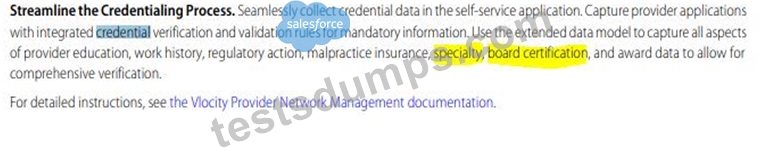
NEW QUESTION # 24
Which two fields are optional when creating a new Care plan task? (Choose Two)
- A. Due Date
- B. Task Owner
- C. Problem
- D. Goal
- E. Status
Answer: A,D
NEW QUESTION # 25
A pharma customer requires a scheduling tool to book infusions with multiple steps as part of its Health Cloud implementation. It needs a solution for care coordinators to book appointments without having to manually check availability and resources themselves.
Which solution should a consultant recommend?
- A. Intelligent Appointment Management
- B. Salesforce Scheduler
- C. Advanced Therapy Management
- D. Procedure Scheduling
Answer: A
Explanation:
A is correct because Intelligent Appointment Management (IAM) is a solution for care coordinators to book appointments without having to manually check availability and resources themselves. IAM aggregates multiple scheduling engines, such as Salesforce Scheduler or Electronic Health Record (EHR) scheduling engines, or both, so that schedulers and patients can see all available appointments in one place. IAM also supports complex appointment types, such as infusions, that require multiple steps or resources.
NEW QUESTION # 26
Bloomington Caregivers has reviewed the functionality of Integrated Care Management and decided to upgrade from the legacy Care Plans.
Which two statements are true with respect to Integrated Care Management?
Choose 2 answers
- A. Integrated Care Management leverages OmniStudio and the Discovery Framework to provide recommendations for what to add to a care plan based on the assessment.
- B. Integrated Care Management uses a standard object CarePlan; the Case object Is no longer used.
- C. Existing Care Plan Template records built In the legacy process can be used in the Integrated Care Management process; no data migration is required.
- D. Integrated Care Management is only made available by enabling the Enhanced Care Management setting in Salesforce Setup.
Answer: A,D
Explanation:
Bloomington Caregivers is transitioning from legacy Care Plans to Integrated Care Management (ICM) in Salesforce Health Cloud to enhance care coordination and patient outcomes. Understanding the features and setup of ICM is crucial for a successful transition.
Enabling Integrated Care Management (Answer C):
Enhanced Care Management Setting:
Purpose: Activating the Enhanced Care Management setting in Salesforce Setup enables Integrated Care Management features within Health Cloud.
Implementation Steps:
Navigate to Setup: In Salesforce, go to Setup.
Search for Health Cloud Settings: Enter "Health Cloud" in the Quick Find box and select Health Cloud Settings.
Enable Enhanced Care Management: Locate the Enhanced Care Management option and toggle it to enable.
Reference:
Leveraging OmniStudio and Discovery Framework (Answer D):
OmniStudio Integration:
Purpose: ICM utilizes OmniStudio, a suite of declarative tools, to create guided workflows and automate complex business processes, enhancing the efficiency of care plan management.
Features:
OmniScripts: Guide users through complex processes with interactive scripts.
DataRaptors: Extract, transform, and load data to and from Salesforce objects seamlessly.
Discovery Framework Integration:
Purpose: The Discovery Framework facilitates the creation of assessments that gather patient information, which can be mapped to care plan recommendations, ensuring personalized and effective care strategies.
Implementation Steps:
Create Assessments: Develop assessments to collect relevant patient data.
Map Responses to Recommendations: Link assessment responses to specific care plan recommendations.
Set Up Decision Tables: Configure decision tables to process assessments and generate tailored care plans.
Additional Considerations:
Data Model Alignment:
ICM aligns with FHIR R4 and USCDI standards, enhancing interoperability with external healthcare systems.
Care Plan Elements:
ICM introduces enhanced care plan elements, including problems, goals, and interventions, structured to meet industry standards.
Conclusion:
By enabling the Enhanced Care Management setting and leveraging OmniStudio alongside the Discovery Framework, Bloomington Caregivers can transition to Integrated Care Management. This upgrade offers advanced tools for creating personalized, assessment-driven care plans, thereby improving patient care coordination and outcomes.
NEW QUESTION # 27
An administrator for Health Cloud wants to ensure that the files in their full sandbox instance are encrypted.
Which encryption solution supports the encryption of files in this scenario?
- A. Industry Data Security
- B. Classic Encryption
- C. Salesforce Shield
- D. salesforce Data Mask
Answer: C
Explanation:
Step-by-Step
Requirement:
Encrypt files in a full sandbox instance.
Salesforce Shield Platform Encryption:
Provides encryption of files and attachments at rest across Salesforce environments (including sandboxes).
"Use Shield Platform Encryption to encrypt files and attachments stored in Salesforce, including those in sandbox environments."
- Salesforce Shield Platform Encryption Guide
Other Options:
Classic Encryption: Only encrypts a limited set of standard fields, not files or attachments.
Salesforce Data Mask: Masks data for sandbox use, but does not encrypt files for runtime.
Industry Data Security: Not a Salesforce product for file encryption.
Reference:
Shield Platform Encryption Guide
NEW QUESTION # 28
A provider wants to set up a Contact Center leveraging Health Cloud to enable its patients to set up appointments, get answers to their billing questions, and update their plan information.
Which group of people should a consultant work with to identify pain points and define project requirements?
- A. (Persona) Care coordinator
(Stakeholder) Sales administrator
(Stakeholder) Tableau developer - B. (Persona) Contact Center agent
(Stakeholder) Salesforce administrator
(Stakeholder) Integration architect - C. (Persona) Contact Center agent
(Stakeholder) Tableau developer
(Stakeholder) MuleSeft developer - D. (Persona) General physician
(Stakeholder) Salesforce administrator
(Stakeholder) Marketing Cloud administrator
Answer: B
Explanation:
Step-by-Step
Understanding the Scenario:
The provider aims to build a Contact Center using Health Cloud for patients to:
Set up appointments
Get billing answers
Update plan information
Salesforce's Best Practices for Requirements Gathering:
Salesforce Health Cloud documentation emphasizes collaborating with end users and technical stakeholders to uncover pain points and define requirements.
Extract from Health Cloud Admin Guide:
"Successful Health Cloud projects start with workshops that bring together key personas, such as contact center agents and care coordinators, with technical stakeholders including Salesforce admins and integration architects. These sessions surface pain points, business needs, and integration requirements."
- Reference: Administer Health Cloud - Implementation Best Practices
Who Should Be Involved?
Contact Center agent (Persona):
Directly understands patient needs and pain points during calls and chats.
Can highlight workflow, usability, and feature needs.
Salesforce administrator (Stakeholder):
Understands platform capabilities, permissions, and how features will be implemented or configured.
Integration architect (Stakeholder):
Critical for connecting Health Cloud to other systems (e.g., EHR, billing, insurance).
Ensures technical feasibility for integrations (e.g., real-time eligibility checks, appointment scheduling with external systems).
Why Other Answers Are Not Correct:
B: General physician and Marketing Cloud admin are not core to Contact Center workflows or technical design for scheduling/billing.
C: Sales administrator and Tableau developer focus on sales or analytics, not operational or integration workflows for Contact Centers.
D: Tableau developer and MuleSoft developer are more technical roles but not typically involved in initial workflow and requirements gathering at the Contact Center user level.
Official Document Extract:
From Salesforce Implementation Guides:
"It is essential to involve actual end users (such as agents) and platform administrators in requirements workshops, and to include an integration architect for designing connected experiences."
- Reference: Administer Health Cloud - Implementation Best Practices
Reference:
Administer Health Cloud - Implementation Best Practices
NEW QUESTION # 29
A pharma company wants the ability to:
* Upload a patient's insurance card, including automatic Member Plan record creation
* Run a benefits verification check
* Schedule on behalf of the patient with a provider
Which set of Health Cloud capabilities should enable the company to build this business process?
- A. Utilization Management, Care Management, Intelligent Document Automation, Intelligent Appointment Management
- B. Virtual Care, Intelligent Appointment Management, Intelligent Document Automation, Intelligent Document Reader
- C. Intelligent Appointment Management, Benefits Verification, Intelligent Document Automation, eFax Integration
- D. Inte,l'9ent Document Automation, Intelligent Appointment Management, Intelligent Document Reader, Benefits Verification
Answer: D
Explanation:
The business process requires a combination of capabilities for handling patient insurance cards, benefits verification, and appointment scheduling. The following Health Cloud capabilities are recommended:
Intelligent Document Automation:
Automates the processing of uploaded documents, such as insurance cards.
Intelligent Document Reader:
Reads data from documents and creates corresponding records (e.g., Member Plan records).
Benefits Verification:
Runs real-time verification checks on insurance plans and coverage.
Intelligent Appointment Management:
Facilitates scheduling appointments on behalf of the patient with the provider.
Why Other Options Are Incorrect:
A & B: These options exclude critical elements like Intelligent Document Reader.
D: Utilization Management and Care Management are unrelated to the stated requirements.
Reference:
Intelligent Document Automation Overview
Intelligent Appointment Management Overview
Benefits Verification Overview
NEW QUESTION # 30
Which of the following Salesforce and Health Cloud objects can be used to represent Provider and their relationship in a Provider Managementdata model? (Choose Three.)
- A. Contact
- B. Lead
- C. Healthcare Provider
- D. Case
- E. Healthcare Practitioner Facility
Answer: A,C,E
Explanation:
Explanation
Reference and details below.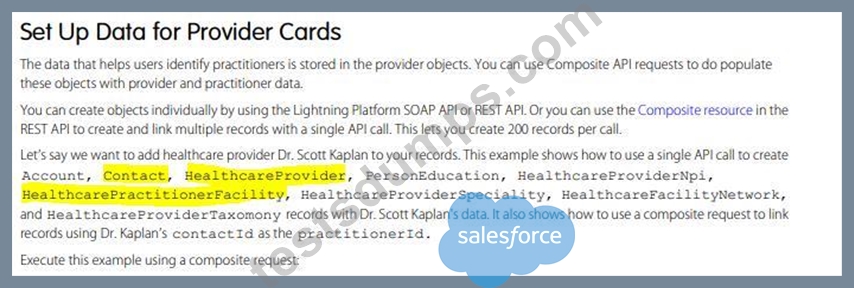
NEW QUESTION # 31
A company based In the United States requires a way to track medications that patients take in a standardized format and detect potential drug-to-drug Interactions.
Which two Health Cloud solutions should a consultant recommend?
Choose 2 answers
- A. Medication Administration
- B. Medication Review
- C. Medication Audit
- D. Medication Reconciliation
Answer: B,D
Explanation:
To track medications and detect potential drug-to-drug interactions in a standardized format, Salesforce Health Cloud offers features designed for healthcare organizations to manage medication data effectively.
Correct Features Explanation:
Medication Reconciliation:
This feature enables the accurate tracking of patient medications across different points of care. It ensures all prescribed and over-the-counter medications are recorded in a standardized format, preventing duplications, omissions, or errors.
By reconciling medications, healthcare providers can identify potential drug-to-drug interactions and avoid adverse drug events.
Medication Review:
This involves reviewing the patient's entire medication list to assess safety, appropriateness, and effectiveness.
Healthcare providers can use this review process to flag potential drug interactions, dosage inconsistencies, and other risks, thereby ensuring comprehensive medication management.
Why Other Options Are Incorrect:
A . Medication Audit:
While this could involve reviewing medication-related data, it is not a standard Health Cloud feature designed for drug-to-drug interaction detection or medication tracking.
D . Medication Administration:
This feature focuses on the administration of drugs to patients, such as documenting doses and timing, and does not handle tracking or interaction detection in a standardized way.
Key Benefits of the Correct Features:
Ensuring Patient Safety: Tracks and reconciles medications to avoid harmful drug interactions.
Standardized Format: Maintains consistent records, compliant with healthcare regulations like HIPAA and FHIR standards.
Improved Coordination: Enables care teams to collaborate effectively in managing patient medications.
Reference:
Administer Health Cloud
Salesforce Health Cloud Medication Management Features Documentation
Salesforce FHIR Compliance Guide for Standardized Health Data
NEW QUESTION # 32
A call center agent at Bloomington Caregivers wants the ability to look up providers by location and specialty, to schedule an appointment on behalf of their patients.
Which two capabilities should a consultant recommend to enable this requirement?
Choose 2 answers
- A. Intelligent Appointment Management
- B. provider Search
- C. Integrated Care Management
- D. Experience Cloud for Health Cloud
Answer: A,B
Explanation:
Call center agents at Bloomington Caregivers require tools to streamline provider lookup and appointment scheduling for patients. Salesforce Health Cloud offers specific capabilities tailored to address these needs.
* Purpose:Provider Search enables users to locate healthcare providers based on specific criteria such as location, specialty, and availability. This functionality is essential for call center agents who need to identify and select suitable providers for patients.
* Features:
* Search by provider name, specialty, location, or other attributes.
* Filter and sort results to narrow down the provider list.
* Integration with the Salesforce Health Cloud data model to access real-time provider information.
* Implementation Steps:
* Configure Provider Records: Ensure all providers are set up correctly within Salesforce, including their specialties, locations, and other attributes.
* Enable Provider Search: Add the Provider Search component to the appropriate Lightning pages or record layouts.
Reference:
Provider Management Overview
Configuring Provider Search
2. Intelligent Appointment Management (Answer B):Purpose:Intelligent Appointment Management streamlines the scheduling process by integrating provider availability, patient preferences, and other factors.
It helps agents book appointments efficiently while minimizing scheduling conflicts.
Features:
Allows booking appointments based on provider availability.
Enables real-time synchronization with provider schedules.
Offers advanced scheduling logic to ensure compatibility with patient needs.
Implementation Steps:
Enable Salesforce Scheduler: Set up Salesforce Scheduler to integrate appointment booking with Health Cloud.
Configure Appointment Rules: Define scheduling policies, including time slots, duration, and patient-provider matching criteria.
Reference:
Salesforce Scheduler for Health Cloud
Why Other Options Are Less Relevant:C. Integrated Care Management:Integrated Care Management focuses on managing care plans, assessments, and interventions. It is not designed for provider lookup or appointment scheduling.
D: Experience Cloud for Health Cloud:Experience Cloud is used to create external portals for patient and provider access. While it can complement scheduling systems, it is not directly related to call center agent workflows.
Conclusion:By implementing Provider Search and Intelligent Appointment Management, Bloomington Caregivers can empower their call center agents to efficiently locate providers and schedule appointments, improving patient satisfaction and operational efficiency.
References for Further Reading:
Salesforce Health Cloud Provider Management
Salesforce Scheduler Setup
NEW QUESTION # 33
A consultant is implementing Identity Verification for their customer's customer service representatives and needs to add a new search parameter.
Which record should the consultant configure to accomplish this?
- A. Identity Verification Process Detail
- B. Identity Verification Parameter Item
- C. Verification Search Feature
- D. Linked Identity Search Detail
Answer: B
Explanation:
In Salesforce Health Cloud's Identity Verification framework, you can configure which search parameters (such as date of birth, SSN, phone number, etc.) are used by customer service representatives to verify a member or patient's identity.
To add a new search parameter, you configure an Identity Verification Parameter Item record.
Identity Verification Parameter Item → Defines the actual search fields that will be used in the verification process.
These parameter items are tied to the Identity Verification Process Detail to determine how the verification is performed.
Why not the others?
A . Verification Search Feature - This controls whether identity verification search is enabled, but not the specific search parameters.
B . Identity Verification Process Detail - This defines the steps and rules of the verification process, but doesn't store the search fields themselves.
D . Linked Identity Search Detail - Used to configure linked identities across systems, not to add new search parameters.
Salesforce Health Cloud Reference:
* Salesforce Help - Identity Verification in Health Cloud
"To configure the search fields that agents use for member or patient identity verification, create and manage Identity Verification Parameter Item records." Salesforce Health Cloud Identity Verification Documentation
NEW QUESTION # 34
What are three requirements for implementing patients or members in Health Cloud?
Choose 3 answers
- A. Ensure the Parent Contact object is blank.
- B. Ensure the Account is the Parent to Household Accounts.
- C. Ensure 1-to-1 Account to Contact relationship.
- D. Ensure the Parent Account field is blank.
- E. Ensure the Person Account object is used.
Answer: B,C,E
Explanation:
Implementing patients or members in Health Cloud requires careful configuration to accurately represent individual relationships and household structures.
1. Ensure the Account is the Parent to Household Accounts (Answer C):
* Purpose: In Health Cloud, modeling household relationships is essential for understanding the familial and support networks of patients. By setting the Account as the parent to Household Accounts, you can effectively represent and manage these relationships.
* Implementation Steps:
* Create a Household Account to represent the family or support group.
* Associate individual Person Accounts (patients) as members of this Household Account.
* Use the Account Hierarchy to visualize and manage these relationships.
Reference: Setting up household structures is a recommended practice in Health Cloud to manage patient relationships.
Salesforce
2. Ensure the Person Account Object is Used (Answer D):
Purpose: Person Accounts in Salesforce combine the attributes of accounts and contacts into a single record, suitable for representing individual patients or members. This structure simplifies data management and aligns with Health Cloud's patient-centric model.
Implementation Steps:
Ensure that Person Accounts are enabled in your Salesforce org.
Configure page layouts and record types to support Person Accounts.
Migrate existing individual records to Person Accounts if necessary.
Reference: Utilizing Person Accounts is essential for representing patients in Health Cloud.
Confianza Salesforce Partner
3. Ensure 1-to-1 Account to Contact Relationship (Answer E):
Purpose: Maintaining a one-to-one relationship between accounts and contacts ensures data integrity and simplifies the management of individual patient records. This setup is particularly important when Person Accounts are not used, as it emulates the combined record structure.
Implementation Steps:
For each Contact, create a corresponding Account to maintain a 1:1 relationship.
Implement automation (e.g., using Salesforce Flow) to enforce this relationship during record creation.
Regularly audit records to ensure compliance with the 1:1 relationship model.
Reference: Maintaining a 1:1 Account to Contact relationship is a best practice in Health
NEW QUESTION # 35
Users need to analyze their patient or member referrals through a prebuilt dashboard that includes reports on important aspects of their referral management.
What should a consultant do in this case?
- A. Install the unmanaged extension package that delivers Health Cloud Reports for Patient Referral Management.
- B. Add extra picklist values to Account record type and add fields on the page layout for patient referral data for CRM Analytics to generate a Patient Referral Management report.
- C. Upload a Provider Referral Dashboard Template and enable the action bar so that users can generate a Patient referral Management report.
- D. Install the add-on package that delivers Health Cloud Reports for Utilization Management and Health Cloud (or Patient Referral Management.
Answer: A
Explanation:
According to the Salesforce documentation1, the Health Cloud Reports for Patient Referral Management is an unmanaged extension package that provides a prebuilt dashboard with reports on important aspects of referral management, such as referral status, referral source, referral age, and referral efficiency. The package also includes custom fields, custom objects, and custom report types to support the dashboard. To use this package, a consultant should install it in their org and assign the appropriate permissions to the users who need to access the dashboard. The package is compatible with Health Cloud and CRM Analytics.
Reference:
1: Provide Referral Management Reports | Health Cloud Administration | Salesforce Developers
NEW QUESTION # 36
How Can you restrict access to an entire patient / member list or to specific columns of that list? (Choose two)
- A. Permission Sets
- B. List View Permissions
- C. Field Level Security
- D. Sharing setting
Answer: C,D
Explanation:
Reference and details below.
NEW QUESTION # 37
Where can a Salesforce administrator configuring different levels of access to patients' care plans, configure team members different levels of access to cases to ensure sensitive data is not shared with the wrong groups?
- A. Case Team Roles
- B. Permission Set Groups
- C. Permission Sets
- D. Profiles
- E. Contact Roles on case
Answer: A
Explanation:
Reference and details below.
NEW QUESTION # 38
Bloomington Caregivers would like to display patient Information from both Salesforce standard objects and data from an external system.
Which three Health Cloud features should a consultant recommend the company use to display this on the patient record page?
Choose 3 answers
- A. FlexCards
- B. Salesforce Flows
- C. Visualforce Pages
- D. DataRaptors
- E. Integration Procedures
Answer: A,D,E
Explanation:
To display patient information from both Salesforce standard objects and external systems on the patient record page in Health Cloud, the most efficient approach involves leveraging declarative tools from OmniStudio, such as Integration Procedures, FlexCards, and DataRaptors. These tools enable seamless integration and visualization of data across systems.
* Purpose:Integration Procedures are server-side processes used to retrieve, transform, and orchestrate data from Salesforce and external systems. They are ideal for connecting to external APIs or databases to fetch real-time patient data.
* Key Features:
* Retrieve data from multiple sources, including Salesforce objects and external APIs.
* Perform transformations and calculations before presenting the data.
* Execute multiple actions in a single server call for improved performance.
* Implementation Steps:
* Design Integration Procedure: Configure actions to fetch data from standard Salesforce objects and external systems via REST or SOAP API.
* Connect External Systems: Use the External Services framework or Apex adapters to call external APIs.
* Output Data: Structure the data to be consumed by a FlexCard or a Lightning Web Component (LWC).
Reference:
Integration Procedures Overview
2. FlexCards (Answer D):Purpose:FlexCards are reusable, lightweight UI components that display data from Salesforce and external systems. They provide a framework for creating dynamic and interactive visualizations on record pages.
Key Features:
Aggregate data from multiple sources into a single, cohesive view.
Include actions like navigation, editing, or triggering Integration Procedures.
Display related data in context using customizable layouts.
Implementation Steps:
Design the FlexCard: Use the FlexCard Designer in OmniStudio to build the component with fields and actions.
Bind Data Sources: Link the FlexCard to the data fetched by the Integration Procedure.
Deploy on Patient Record Page: Add the FlexCard to the Lightning App Builder for the patient record page.
Reference:
FlexCards Overview
3. DataRaptors (Answer E):Purpose:DataRaptors are declarative tools used to extract, transform, and load data to and from Salesforce objects. They handle data processing between the database and UI components like FlexCards.
Key Features:
Perform CRUD operations on Salesforce data.
Transform data using formulas, mappings, and default values.
Simplify interactions with Salesforce objects for components like FlexCards.
Implementation Steps:
Configure DataRaptors: Set up DataRaptor Extracts to pull data from Salesforce standard objects and DataRaptor Loads to save updates.
Integrate with FlexCards: Use the output of DataRaptors as input to FlexCards for dynamic data presentation.
Reference:
DataRaptors Overview
Why Other Options Are Less Relevant:A. Salesforce Flows:While Flows are powerful for automation and guided processes, they are not optimized for displaying real-time, integrated data from external systems on a record page.
C: Visualforce Pages:Visualforce is a legacy framework with limited flexibility compared to modern tools like FlexCards and LWCs. It is not recommended for new implementations in Health Cloud.
Conclusion:By combining Integration Procedures, FlexCards, and DataRaptors, Bloomington Caregivers can efficiently display patient information from Salesforce standard objects and external systems on the patient record page. This approach ensures a seamless user experience and streamlined data integration.
References for Further Reading:
OmniStudio Guide
Data Integration in OmniStudio
NEW QUESTION # 39
Which of the following capabilities of provide search would a customer service agent use to help prospective and returning patients for the right provider? (Choose threE.
- A. Use custom fields defined in any entity within the provider data model in health cloud as part of search experience.
- B. Use custom fields defined in health care provider and health care practitioner facility entities as part of search experience.
- C. Use provider search in an unauthenticated community page.
- D. Use provider search in an authenticated community page
- E. Connect the list of fields displayed in the search panel and search results.
Answer: B,D,E
Explanation:
According to the Salesforce documentation, the following capabilities of provider search would a customer service agent use to help prospective and returning patients find the right provider:
Use custom fields defined in healthcare provider and healthcare practitioner facility entities as part of search experience. The provider search allows customer service agents to use custom fields defined in healthcare provider and healthcare practitioner facility entities as part of the search criteria or filters. This helps them narrow down their search results based on specific attributes or preferences.
Use provider search in an authenticated community page. The provider search allows customer service agents to use provider search in an authenticated community page where they can log in with their credentials and access more features and information than an unauthenticated community page.
Control the list of fields displayed in the search panel and search results. The provider search allows customer service agents to customize which fields are displayed in the search panel and search results for different types of providers or facilities. This helps them find the most relevant information quickly and easily.
NEW QUESTION # 40
Which format is acceptable for intelligent document automation upload?
- A. .CSV
- B. .DOC
- C. .MP4
- D. .PNG
Answer: D
NEW QUESTION # 41
......
To become a Salesforce Health Cloud Accredited Professional, candidates must demonstrate a thorough understanding of the platform's capabilities and have hands-on experience working with it. Health-Cloud-Accredited-Professional exam consists of 60 multiple-choice questions and must be completed within 90 minutes. Successful candidates will receive a badge and certificate, which they can use to demonstrate their expertise to current and potential employers. Salesforce Health Cloud Accredited Professional certification is highly valuable for healthcare professionals who want to stay ahead of the curve and provide the best possible care to their patients.
Salesforce Health Cloud Accredited Professional Certification Exam is a valuable credential for healthcare professionals who work with the Health Cloud platform. By earning this certification, professionals can demonstrate their expertise and knowledge of the Health Cloud platform to potential employers and clients. Additionally, the certification can help professionals stay up-to-date with the latest trends and developments in the healthcare industry, and can help them advance their careers in this rapidly-evolving field.
Health-Cloud-Accredited-Professional Dumps for success in Actual Exam: https://www.testsdumps.com/Health-Cloud-Accredited-Professional_real-exam-dumps.html
Health-Cloud-Accredited-Professional Dumps Special Discount for limited time Try FOR FREE: https://drive.google.com/open?id=1WNiBwvl0SKrrypQoSHytYuc_vFPyxFzj
