

[May 22, 2026] Download Free Cisco 300-740 Real Exam Questions
Pass Your Exam With 100% Verified 300-740 Exam Questions
NEW QUESTION # 64
The main benefit of integrating threat intelligence into cloud security is:
- A. Enhancing the ability to identify and respond to emerging threats
- B. Decreasing the need for secure domains
- C. Reducing the effectiveness of security operations
- D. Increasing the complexity of security architectures
Answer: A
NEW QUESTION # 65 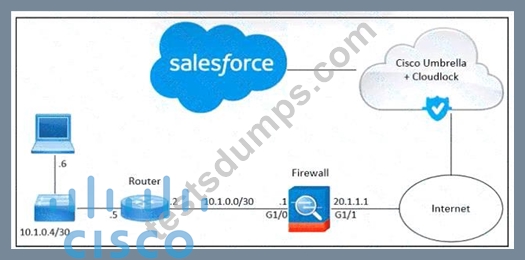
Refer to the exhibit. An engineer must integrate Cisco Cloudlock with Salesforce in an organization. Despite the engineer's successful execution of the Salesforce integration with Cloudlock, the administrator still lacks the necessary visibility. What should be done to meet the requirement?
- A. From Cloudlock, configure the service parameters.
- B. From Cloudlock, enable the View All Data permission.
- C. From Salesforce, configure the service parameters.
- D. From Salesforce, enable the View All Data permission.
Answer: B
Explanation:
After Cloudlock is integrated with Salesforce, full visibility into objects and data requires that Cloudlock has the "View All Data" permission enabled on the connected Salesforce account. This permission allows the Cloudlock API connection to access all user data, regardless of individual field-level or sharing rules. Without it, Cloudlock will be limited in its visibility scope.
As per SCAZT (Section 4: Application and Data Security, Pages 86-89), integration with SaaS platforms like Salesforce must include enabling comprehensive data visibility to perform effective risk analysis and policy enforcement.
Reference: Designing and Implementing Secure Cloud Access for Users and Endpoints (SCAZT), Section 4, Pages 86-89
NEW QUESTION # 66 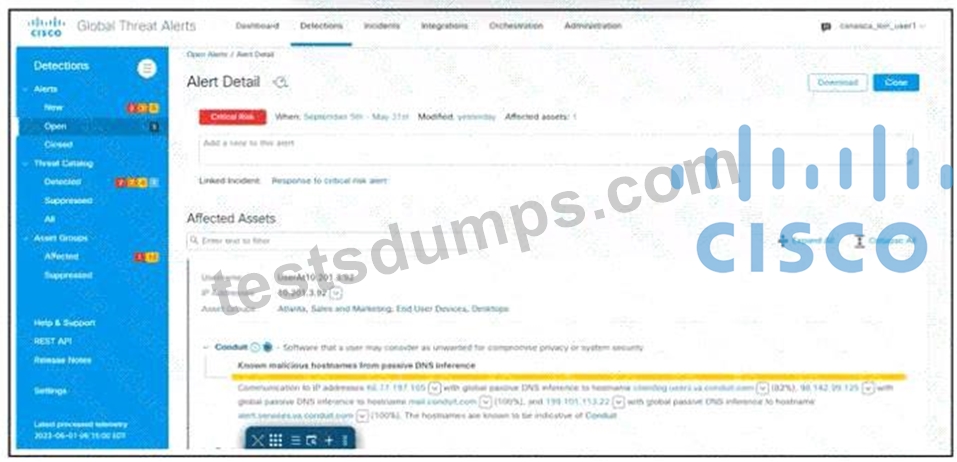
Refer to the exhibit. An engineer is investigating the critical alert received in Cisco Secure Network Analytics. The engineer confirms that the incident is valid. Which two actions must be taken? (Choose two.)
- A. Uninstall the Conduit software.
- B. Quarantine the host
- C. Inform the incident management team.
- D. Block IP address 66.77.197.165
- E. Shut down the host.
Answer: B,C
Explanation:
The alert identifies known malicious communication from a host with Conduit software installed. Conduit is flagged as spyware/malware by Cisco Secure Analytics.
A: Alerting the incident response team is standard procedure when high-priority threats are confirmed.
E: Quarantining the host via endpoint isolation (e.g., Secure Endpoint or network-based access control) is a critical action to prevent lateral movement.
Blocking the IP alone (B) does not stop internal damage. Shutting down the host (D) prematurely removes forensic evidence. Uninstalling the software (C) should occur later during recovery after analysis.
Reference: Designing and Implementing Secure Cloud Access for Users and Endpoints (SCAZT), Section 6, Pages 114-117
NEW QUESTION # 67
Which types of algorithm does a web application firewall use for zero-day DDoS protection?
- A. Adaptive and behavioral-based
- B. Reactive and heuristic-based
- C. Stochastic and event-based
- D. Correlative and feedback-based
Answer: A
Explanation:
According to the SCAZT documentation, web application firewalls (WAFs) designed to protect against zero- day Distributed Denial of Service (DDoS) attacks leverage adaptive and behavioral-based algorithms.
These algorithms dynamically analyze traffic patterns, baseline normal behavior, and detect anomalies that could indicate novel or zero-day attacks. Unlike signature-based detection, adaptive and behavioral methods adjust in real-time to emerging threats, learning from ongoing traffic without relying on pre-defined rules.
This proactive approach enables rapid detection and mitigation of unknown DDoS vectors, critical for cloud and network security where threats evolve constantly.
Reference: Designing and Implementing Secure Cloud Access for Users and Endpoints (SCAZT) Study Guide, Section 3: Network and Cloud Security, Pages 75-77.
NEW QUESTION # 68
The benefits of utilizing visibility and logging tools such as SIEM include:
- A. Decreased need for encryption
- B. Centralized logging and analysis of security data
- C. Increased manual workload for security teams
- D. Improved incident detection and response times
Answer: B,D
NEW QUESTION # 69
A network administrator uses Cisco Umbrella to protect internal users from malicious content. A customer is using an IPsec tunnel to connect to an Umbrella Organization. The administrator was informed about a zero- day vulnerability that infects user machines and uploads sensitive data through the RDP port. The administrator must ensure that no users are connected to the internet using the RDP protocol. Which Umbrella configuration must the administrator apply?
- A. Web policy to block Remote Desktop Manager application type
- B. Data loss prevention policy to block all file uploads with RDP application mime type
- C. Firewall policy and set port 3389 to be blocked for all outgoing traffic
- D. DNS policy to block Remote Desktop Manager application type
Answer: C
Explanation:
The Remote Desktop Protocol (RDP) uses TCP port 3389. Cisco Umbrella includes a cloud-delivered firewall that can be used to block outbound traffic by port. In this case, since the RDP communication needs to be prevented regardless of application name resolution, the best approach is to use a Firewall policy in Umbrella to block port 3389 traffic across the tunnel.
Reference: Designing and Implementing Secure Cloud Access for Users and Endpoints (SCAZT), Section 3:
Network and Cloud Security, Pages 72-75.
NEW QUESTION # 70
Which of the following is a use case for visibility and assurance automation?
- A. Reducing the accuracy of threat detection
- B. Automating the response to security incidents
- C. Decreasing the speed of security operations
- D. Increasing manual intervention in security processes
Answer: B
NEW QUESTION # 71
DISA's role in cloud security architecture involves:
- A. Ensuring cloud services are accessible worldwide
- B. Providing entertainment services
- C. Setting standards for defense-related IT and cybersecurity
- D. Managing cloud storage solutions
Answer: C
NEW QUESTION # 72
Cisco Secure Firewall provides advanced threat defense capabilities through:
- A. Only allowing traffic from trusted IP addresses
- B. Focusing solely on internal traffic and ignoring external threats
- C. Implementing basic firewall rules that do not adapt over time
- D. Integrating with other security solutions for comprehensive protection
Answer: D
NEW QUESTION # 73
Security audit reports are crucial for:
- A. Identifying compliance gaps and areas lacking sufficient security controls
- B. Eliminating the need for security policies
- C. Promoting a false sense of security
- D. Reducing the overall security budget
Answer: A
NEW QUESTION # 74
An organization is distributed across several sites. Each site is connected to the main HQ using site-to-site VPNs implemented using Secure Firewall Threat Defense. Which functionality must be implemented if the security manager wants to send SaaS traffic directly to the internet?
- A. Multi-instances
- B. IPsec tunnels
- C. ECMP routing
- D. Policy-based routing
Answer: D
Explanation:
Policy-Based Routing (PBR) enables routing decisions based on criteria such as source IP, destination IP, or application. To send SaaS traffic (e.g., Office 365, Salesforce) directly to the internet rather than over a site-to- site VPN, PBR must be configured at each site firewall. According to SCAZT Section 1 (Cloud Security Architecture, Pages 18-20), this approach enables secure local internet breakout-commonly used in direct internet access (DIA) architectures.
Reference: Designing and Implementing Secure Cloud Access for Users and Endpoints (SCAZT), Section 1, Pages 18-20
NEW QUESTION # 75 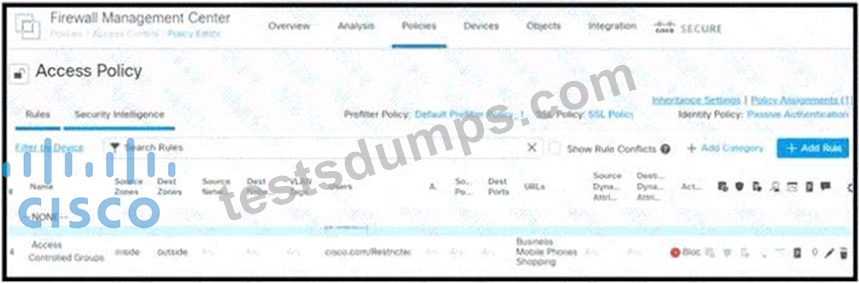
Refer to the exhibit. An engineer must create a policy in Cisco Secure Firewall Management Center to prevent restricted users from being able to browse any business or mobile phone shopping websites. The indicated policy was applied; however, the restricted users still can browse on the mobile phone shopping websites during business hours. What should be done to meet the requirement?
- A. Set Time Range for rule 4 of Access Controlled Groups to All.
- B. Set Dest Networks to Business Mobile Phones Shopping.
- C. Move rule 4 Access Controlled Groups to the top.
- D. Set Dest Zones to Business Mobile Phones Shopping.
Answer: C
Explanation:
In Cisco Secure Firewall Management Center (FMC), access control policies are processed top-down- meaning the first matching rule is applied, and the remaining are ignored. Based on the exhibit, Rule 4 (Access Controlled Groups) is likely being shadowed by a broader rule above it that permits web traffic. To ensure restricted users are denied access to mobile phone shopping categories, Rule 4 must be moved to the top of the rule hierarchy.
Cisco SCAZT (Section 5: Visibility and Assurance, Pages 94-97) describes best practices for rule ordering and inspection logic. Moving the specific block rule (Rule 4) higher ensures it's enforced before general allow rules are evaluated.
Reference: Designing and Implementing Secure Cloud Access for Users and Endpoints (SCAZT), Section 5, Pages 94-97
NEW QUESTION # 76
Zero-trust network access is based on the principle of:
- A. Using traditional perimeter-based security models
- B. Never verifying user or device identity
- C. Trusting no one and verifying everything
- D. Trusting all devices inside the network
Answer: C
NEW QUESTION # 77
The SAFE architectural framework's Key structure is beneficial for:
- A. Designing network topologies
- B. Only specifying the types of security devices to be used
- C. Limiting the security focus to user authentication
- D. Providing a holistic view of network security based on specific areas and domains
Answer: D
NEW QUESTION # 78
Multifactor authentication enhances security by requiring:
- A. Only a simple password
- B. A username only for identification
- C. A single security question
- D. Multiple verification methods before granting access
Answer: D
NEW QUESTION # 79
Policies derived from security audit reports often lead to:
- A. Strengthening of security measures and protocols
- B. Ignoring recommendations for improvements
- C. Dismantling existing security infrastructure
- D. Focusing solely on external audit compliance
Answer: A
NEW QUESTION # 80
Automated response actions based on telemetry reports can include:
- A. Removing all forms of access control
- B. Blocking IP addresses associated with malicious activity
- C. Decreasing the sensitivity of intrusion detection systems
- D. Unconditionally trusting all internal network traffic
Answer: B
NEW QUESTION # 81
What is a primary function of the Cisco Extended Detection and Response (XDR) solution?
- A. To limit visibility into network traffic
- B. To decrease network performance
- C. To provide comprehensive threat detection, investigation, and response across multiple security layers
- D. To simplify hacker access
Answer: C
NEW QUESTION # 82 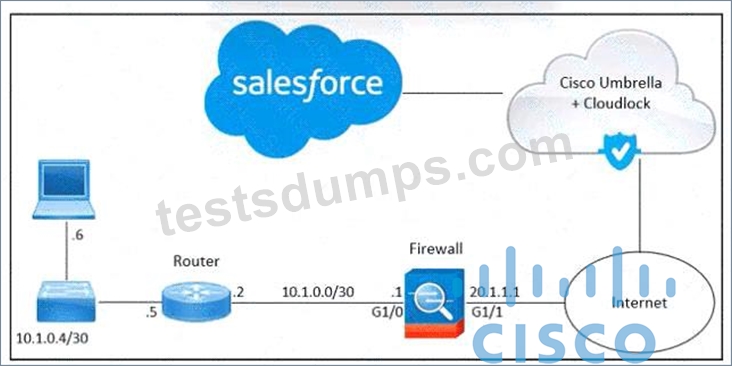
Refer to the exhibit. An engineer must enable access to Salesforce using Cisco Umbrella and Cisco Cloudlock. These actions were performed:
* From Salesforce, add the Cloudlock IP address to the allow list
* From Cloudlock, authorize Salesforce
However, Salesforce access via Cloudlock is still unauthorized. What should be done to meet the requirements?
- A. From the Salesforce admin page, grant API access to Cloudlock.
- B. From the Cloudlock dashboard, grant API access to Salesforce.
- C. From the Cloudlock dashboard, grant network access to Salesforce.
- D. From the Salesforce admin page, grant network access to Cloudlock
Answer: D
Explanation:
When integrating Cisco Cloudlock with SaaS platforms like Salesforce, two core authorizations are required:
network access and API authorization. In the scenario, Cloudlock has been authorized in Salesforce, and its IP has been allow-listed. However, if access is still denied, the most likely cause is that Salesforce has not been configured to accept traffic from Cloudlock's IP range - a process handled from the Salesforce admin panel.
To resolve the issue, network access must be explicitly granted to Cloudlock from within Salesforce. This ensures that Salesforce accepts requests initiated by Cloudlock for monitoring and enforcement.
Reference: Designing and Implementing Secure Cloud Access for Users and Endpoints (SCAZT), Section 4:
Application and Data Security, Pages 85-87.
Also supported by Cisco Cloudlock for Salesforce Deployment Guide.
NEW QUESTION # 83
......
Cisco 300-740 Exam Syllabus Topics:
| Topic | Details |
|---|---|
| Topic 1 |
|
| Topic 2 |
|
| Topic 3 |
|
| Topic 4 |
|
| Topic 5 |
|
| Topic 6 |
|
| Topic 7 |
|
| Topic 8 |
|
300-740 Dumps 100 Pass Guarantee With Latest Demo: https://www.testsdumps.com/300-740_real-exam-dumps.html
300-740 Dumps PDF - 300-740 Real Exam Questions Answers: https://drive.google.com/open?id=1l1kVqwKRbu3Rkfm0grOtU5qhgKiWiO_y
