

Pass Your VMA Exam at the First Try with 100% Real Exam Questions
New SAVE International VMA Dumps & Questions Updated on 2026
NEW QUESTION # 19
Which of the following is the risk response strategy for opportunities that seek to increase the probability of an opportunity occurring and/or the magnitude of results being beneficial?
- A. Enhance
- B. Exploit
- C. Share
- D. Mitigate
Answer: A
Explanation:
Risk management in Value Methodology (VM) includes strategies for both threats and opportunities, particularly during the Implementation Planning phase, as taught in the VMF 1 course (Core Competency #8:
Implementation Planning). According to SAVE International's Value Methodology Standard, which aligns with project management best practices (e.g., PMI's PMBOK, as noted in Question 28), risk response strategies for opportunities include:
* Exploit: Ensure the opportunity is realized by taking actions to make it certain (e.g., assigning the best resources).
* Share: Partner with others to increase the likelihood or benefit of the opportunity (e.g., joint ventures).
* Enhance: Increase the probability of the opportunity occurring and/or the magnitude of its beneficial results (e.g., by improving conditions or amplifying benefits).
* Accept: Take no action to influence the opportunity.
The question specifically asks for the strategy that seeks to "increase the probability of an opportunity occurring and/or the magnitude of results being beneficial," which directly matches the definition ofEnhance.
For example, in a VM study, enhancing an opportunity might involve marketing a new feature to increase its adoption rate (probability) or improving its design to maximize savings (magnitude).
* Option A (Exploit) is incorrect because exploiting ensures the opportunity happens, not necessarily increasing its probability or magnitude.
* Option B (Share) is incorrect because sharing involves collaboration, not directly increasing probability or magnitude.
* Option C (Mitigate) is incorrect because mitigation applies to threats, not opportunities.
* Option D (Enhance) is correct, as it focuses on increasing the probability and/or magnitude of an opportunity's benefits.
:
SAVE International, VMF 1 Core Competency #8 (Implementation Planning), detailing risk response strategies for opportunities, including Enhance.
SAVE International, "Value Methodology Standard," section on risk management, referencing strategies like Enhance for opportunities (consistent with Question 28).
NEW QUESTION # 20
If an organization invests $160,000 in a new software system that improves analysis and reduces annual costs by $3,000 per year, the payback period would be approximately:
- A. 56 years
- B. 50 years
- C. 45 years
- D. 53 years
Answer: D
Explanation:
In Value Methodology, cost analysis often involves financial metrics like the payback period to evaluate the economic feasibility of alternatives, as taught in the VMF 1 course (Core Competency #4: Cost Analysis).
According to SAVE International's Value Methodology Standard, the payback period is "the time required for the cumulative savings or benefits from an investment to equal the initial cost, calculated as Initial Investment ÷ Annual Savings." Here, the organization invests $160,000 in a software system that saves
$3,000 per year.
* Payback Period = Initial Investment ÷ Annual Savings
* Payback Period = $160,000 ÷ $3,000 = 53.333 years
* Rounding to the nearest whole number, the payback period is approximately 53 years.
The question does not specify adjustments for the time value of money (e.g., discounting), which aligns with the simple payback method commonly used in VM for straightforward analysis.
* Option A (45 years) is incorrect because 160,000 ÷ 3,000 = 53.333, not 45.
* Option B (50 years) is incorrect because it underestimates the payback period (53.333 years).
* Option C (53 years) is correct, as it matches the calculated payback period when rounded.
* Option D (56 years) is incorrect because it overestimates the payback period.
:
SAVE International, VMF 1 Core Competency #4 (Cost Analysis), which includes calculating payback periods for economic evaluation in VM studies.
SAVE International, "Value Methodology Standard," section on cost analysis, referencing the simple payback method for assessing alternatives.
NEW QUESTION # 21
The VM is defined by SAVE International as a:
- A. Structured process
- B. Systematic process
- C. Specialized process
- D. Sequential process
Answer: B
Explanation:
Value Methodology (VM) is defined by SAVE International in its Value Methodology Standard as "a systematic processthat uses a structured Job Plan to improve the value of projects, products, or processes by analyzing their functions and identifying opportunities to achieve required functions at the lowest total cost without compromising quality or performance." The term "systematic" emphasizes the methodical, disciplined approach of VM, which follows a defined sequence of phases (the VM Job Plan) and uses specific tools like Function Analysis and cost modeling to ensure consistency and effectiveness.
* Option A (Structured process) is partially correct, as VM is structured, but "systematic" is the precise term used by SAVE International to describe the methodology's comprehensive and methodical nature.
* Option B (Specialized process) is incorrect because VM is a general methodology applicable across industries, not limited to a specific domain.
* Option C (Systematic process) is correct, directly matching SAVE International's definition of VM.
* Option D (Sequential process) is incorrect because, while the VM Job Plan is sequential, the definition of VM focuses on its systematic nature, not just the sequence.
:
SAVE International, "Value Methodology Standard and Body of Knowledge," available athttps://www.value- eng.org, defining VM as a systematic process.
SAVE International, "Value Methodology Associate (VMA) Certification,"https://www.value-eng.org/page
/VMA, referencing VMF 1 Core Competency #1 (Value Methodology Overview).
NEW QUESTION # 22
What is the correct sequence of the last four phases of the Value Methodology Job Plan?
- A. Development, Evaluation, Presentation, and Implementation
- B. Development, Presentation, Evaluation, and Implementation
- C. Evaluation, Development, Presentation, and Implementation
- D. Evaluation, Development, Implementation, and Presentation
Answer: C
Explanation:
The Value Methodology (VM) Job Plan, as outlined in the VMF 1 course and SAVE International's Value Methodology Standard, consists of six phases: Information, Function Analysis, Creative, Evaluation, Development, and Presentation. This was established in Question 1, where the VM Job Plan was confirmed to have six phases. The last four phases, therefore, are: Creative, Evaluation, Development, and Presentation.
However, the options include "Implementation," which is not a formal phase in the standard VM Job Plan but is often considered a post-study activity (e.g., in the post-study phase, where recommendations are implemented). For the purposes of the VMA exam, which focuses on the VMF 1 curriculum, Implementation is sometimes treated as an extension of the Presentation Phase, where the team ensures stakeholder buy-in and facilitates the transition to implementation.
Thus, the correct sequence of the last four phases, interpreting Implementation as the post-Presentation activity, is:
* Creative(third phase, but the first of the last four).
* Evaluation(fourth phase): Assess ideas for feasibility and value improvement.
* Development(fifth phase): Refine selected ideas into actionable proposals.
* Presentation(sixth phase): Present recommendations to stakeholders for approval and implementation.
* Implementation: Follows Presentation as a post-study activity to execute the recommendations.
* Option A (Development, Presentation, Evaluation, and Implementation) is incorrect because Evaluation must precede Development-ideas are evaluated before being developed into proposals.
* Option B (Evaluation, Development, Presentation, and Implementation) is correct, as it follows the VM Job Plan's sequence and includes Implementation as the post-study step.
* Option C (Evaluation, Development, Implementation, and Presentation) is incorrect because Presentation (delivering recommendations) must occur before Implementation.
* Option D (Development, Evaluation, Presentation, and Implementation) is incorrect because Development cannot precede Evaluation in the VM Job Plan.
:
SAVE International, "Value Methodology Standard and Body of Knowledge," available athttps://www.value- eng.org, detailing the six phases of the VM Job Plan.
SAVE International, VMF 1 Core Competency #3 (Value Methodology Job Plan), outlining the sequence of phases, with Implementation as a post-study activity.
NEW QUESTION # 23
Function E is the:
- A. Required Secondary Function
- B. Secondary Function
- C. Basic Function
- D. Higher Order Function
Answer: D
Explanation:
The diagram provided is a Function Analysis System Technique (FAST) diagram, a key tool in Value Methodology's Function Analysis phase, as taught in the VMF 1 course (Core Competency #2). FAST diagrams map the relationships between functions of a system, with the horizontal axis showing the "how- why" logic (critical path) and the vertical axis showing supporting functions. Functions are classified as basic, secondary, required secondary, or higher-order based on their position and role in the diagram. According to SAVE International's Value Methodology Standard, "the basic function is the primary purpose of the system, typically found on the critical path; higher-order functions are the reasons why the basic function exists, located to the left of the basic function; secondary functions support the basic function and are often vertical; and required secondary functions are necessary to achieve the basic function." In the FAST diagram:
* The critical path (horizontal, marked by Y in an earlier question) runs from E to F to G to J to L to M to N to O, representing the main sequence of functions.
* Scope lines (B and D) define the study's boundaries, as identified in Question 15.
* Function E is positioned at the far left of the critical path, just inside the left scope line (B).
In FAST diagramming:
* Thebasic functionis the primary purpose of the system, typically located near the center or right of the critical path within the scope lines. Here, it would likely be a function like J or L, which is central to the system's purpose.
* Thehigher-order functionis the reason "why" the basic function exists and is located to the left of the basic function, often at or near the left scope line. Function E, being the leftmost function on the critical path, answers "why" the subsequent functions (F, G, etc.) exist, making it the higher-order function.
* Secondary functions(e.g., S, T, U, K) are vertical, supporting the critical path, and are not on the main horizontal sequence.
* Required secondary functionsare secondary functions essential to the basic function, but E is on the critical path, not a vertical supporting function.
Thus, Function E, as the leftmost function on the critical path, is thehigher-order function, representing the overarching objective or need that the system fulfills.
* Option A (Secondary Function) is incorrect because secondary functions are off the critical path (e.g., S, T, K), while E is on the critical path.
* Option B (Required Secondary Function) is incorrect because E is not a secondary function; it is on the main path, not a supporting vertical function.
* Option C (Basic Function) is incorrect because the basic function is typically more central on the critical path, not at the far left.
* Option D (Higher Order Function) is correct, as E's position at the left of the critical path indicates it is the higher-order function, answering "why" the system exists.
:
SAVE International, VMF 1 Core Competency #2 (Function Analysis), which includes the use of FAST diagrams to classify functions as basic, secondary, or higher-order.
SAVE International, "Value Methodology Standard," section on Function Analysis, describing FAST diagramming conventions, including the positioning of higher-order functions to the left of the basic function.
NEW QUESTION # 24
One of the main purposes of the Miles Value Foundation is to:
- A. Improve VM programs
- B. Conduct VM training
- C. Promote VM education
- D. Manage VM certification
Answer: C
Explanation:
The Miles Value Foundation, established to honor Lawrence D. Miles (the founder of Value Engineering
/Value Methodology), focuses on advancing the field of Value Methodology. According to SAVE International's documentation, the Miles Value Foundation's primary purpose is to "promote education and research in Value Methodology to expand its application and understanding globally." The Foundation supports initiatives like scholarships, educational resources, and outreach to increase awareness and knowledge of VM, aligning with its mission to promote VM education.
* Option A (Improve VM programs) is incorrect because the Foundation's focus is on education and research, not directly improving specific VM programs, which is more the role of organizations like SAVE International.
* Option B (Manage VM certification) is incorrect because VM certification is managed by SAVE International, not the Miles Value Foundation.
* Option C (Promote VM education) is correct, as it directly aligns with the Foundation's mission to advance VM through education and research.
* Option D (Conduct VM training) is incorrect because, while the Foundation may support training indirectly, its primary role is promoting education, not directly conducting training programs.
:
SAVE International, "About the Miles Value Foundation," available athttps://www.value-eng.org/page
/AboutVE, detailing the Foundation's mission to promote VM education.
SAVE International, VMF 1 Core Competency #1 (Value Methodology Overview), which includes the history and supporting organizations of VM.
NEW QUESTION # 25
Which of the following best describes a VM study?
- A. An analysis of a completed project design by a VM team
- B. A structured effort by a multidisciplinary team using the VM
- C. A workshop that applies the VM facilitated by a CVS
- D. An improvement process similar to Lean Six Sigma
Answer: B
Explanation:
A Value Methodology (VM) study is a core concept in the VMF 1 course (Core Competency #1: Value Methodology Overview). According to SAVE International's Value Methodology Standard, a VM study is defined as "a structured effort by a multidisciplinary team using the Value Methodology to identify the functions of a project or process, establish a worth for each function, and develop alternatives to achieve those functions at the lowest overall cost while maintaining performance." This definition emphasizes the structured nature of the VM Job Plan, the use of a multidisciplinary team (as noted in Question 24), and the focus on improving value through systematic analysis. This aligns with the description in Question 4, where a VM study was described as a structured effort using the VM process, but here the emphasis on a multidisciplinary team is key.
* Option A (An analysis of a completed project design by a VM team) is incorrect because VM studies are not limited to completed designs; they can be applied at any stage of the project lifecycle, with the greatest impact early on (as noted in Questions 21 and 25).
* Option B (An improvement process similar to Lean Six Sigma) is incorrect because, while VM shares goals with Lean Six Sigma (e.g., improving efficiency), it is a distinct methodology focused on function analysis and value optimization, not process variation reduction.
* Option C (A workshop that applies the VM facilitated by a CVS) is incorrect because, while VM studies are often conducted as workshops and may be facilitated by a Certified Value Specialist (CVS), a CVS is not required (as clarified in Question 4), and "workshop" is too narrow a description for a VM study.
* Option D (A structured effort by a multidisciplinary team using the VM) is correct, as it best captures the essence of a VM study per SAVE International's definition, emphasizing the structured process and multidisciplinary team.
:
SAVE International, "Value Methodology Standard and Body of Knowledge," available athttps://www.value- eng.org, defining a VM study as a structured effort by a multidisciplinary team.
SAVE International, VMF 1 Core Competency #1 (Value Methodology Overview), emphasizing the structured, team-based nature of VM studies (consistent with Question 4).
NEW QUESTION # 26
What is the objective of the Creativity Phase?
- A. Generate improvement ideas
- B. Develop improvement ideas
- C. Select improvement ideas
- D. Prioritize improvement ideas
Answer: A
Explanation:
The Creativity Phase (also known as the Creative Phase) is the third phase of the Value Methodology (VM) Job Plan, as taught in the VMF 1 course (Core Competency #6: Creative Thinking and Idea Generation).
According to SAVE International's Value Methodology Standard, "the objective of the Creativity Phase is to generate a large quantity of improvement ideas through brainstorming and other creative techniques, focusing on alternative ways to perform the functions identified in the Function Analysis Phase." This phase emphasizes divergent thinking to produce as many ideas as possible without judgment, as supported by the ground rules discussed in Question 10 (e.g., encouraging openness, freewheeling, and recording ideas). The generated ideas are then evaluated in the next phase (Evaluation Phase).
* Option A (Develop improvement ideas) is incorrect because development occurs in the Development Phase, where selected ideas are refined into actionable proposals, not in the Creativity Phase.
* Option B (Select improvement ideas) is incorrect because selection occurs in the Evaluation Phase, not Creativity.
* Option C (Prioritize improvement ideas) is incorrect because prioritization also occurs in the Evaluation Phase (as noted in Question 33 with the coarse-medium-fine filters).
* Option D (Generate improvement ideas) is correct, as it matches the primary objective of the Creativity Phase in the VM Job Plan.
:
SAVE International, "Value Methodology Standard and Body of Knowledge," available athttps://www.value- eng.org, detailing the Creativity Phase's objective to generate ideas.
SAVE International, VMF 1 Core Competency #6 (Creative Thinking and Idea Generation), emphasizing idea generation as the goal of the Creativity Phase.
NEW QUESTION # 27
Which of the following defines the nominal rate of increase in the value of money over time, after subtracting for inflation?
- A. Return on Investment (ROI)
- B. Simple Payback (or Breakeven Point)
- C. Discount Rate
- D. Present Worth (or Net Present Value)
Answer: C
Explanation:
In the context of Value Methodology, cost analysis often involves financial concepts to evaluate the economic impact of alternatives, including understanding the time value of money. The VMF 1 course, under Core Competency #4 (Cost Analysis), includes basic financial metrics relevant to value studies, such as discounting cash flows to assess long-term value. The nominal rate of increase in the value of money over time, after subtracting for inflation, refers to thereal discount rate. In financial terms, as per standard economic principles taught in VMF 1, the discount rate is the rate used to discount future cash flows to their present value, and thereal discount rateis the nominal discount rate adjusted for inflation (i.e., real discount rate = nominal discount rate # inflation rate). This measures the true increase in the value of money over time, excluding inflationary effects.
* Option A (Simple Payback or Breakeven Point) is incorrect because payback measures the time required to recover an investment, not the rate of increase in money's value.
* Option B (Return on Investment or ROI) is incorrect because ROI measures the profitability of an investment as a percentage, not the rate of increase in money's value over time.
* Option C (Discount Rate) is correct because the real discount rate, after subtracting inflation, defines the nominal rate of increase in the value of money over time, as used in financial analyses within VM studies.
* Option D (Present Worth or Net Present Value) is incorrect because NPV is the result of discounting future cash flows to their present value using a discount rate, not the rate itself.
:
SAVE International, VMF 1 Core Competency #4 (Cost Analysis), which includes financial concepts like discounting and the time value of money in value studies.
SAVE International, "Value Methodology Standard," section on cost analysis, referencing economic evaluation techniques such as discounting for long-term cost analysis.
NEW QUESTION # 28
Ground rules that support creative brainstorming include:
- A. Encouraging openness to ideas, freewheeling, and recording good ideas.
- B. Focusing on quality ideas, discussing their merits, and maintaining momentum.
- C. Focusing on prioritized functions, deferring judgment, and improving ideas.
- D. Requesting idea clarification, discussing cost impacts, and considering performance.
Answer: A
Explanation:
Creative Thinking and Idea Generation is a key focus of the Creative Phase in the Value Methodology (VM) Job Plan, as taught in the VMF 1 course (Core Competency #6). SAVE International's Value Methodology Standard outlines that the Creative Phase involves "generating a large quantity of ideas through brainstorming, encouraging creativity without judgment." The ground rules for effective brainstorming, as per VMF 1, include: encouraging openness to all ideas (no criticism), promoting freewheeling (wild ideas are welcome), and recording good ideas to ensure they are captured for later evaluation. These rules are designed to maximize idea quantity and foster a creative environment.
* Option A (Encouraging openness to ideas, freewheeling, and recording good ideas) is correct, as it directly aligns with VMF 1's brainstorming ground rules for the Creative Phase.
* Option B (Focusing on prioritized functions, deferring judgment, and improving ideas) is partially correct-deferring judgment is a rule, but focusing on prioritized functions and improving ideas occurs in the Evaluation Phase, not during brainstorming.
* Option C (Focusing on quality ideas, discussing their merits, and maintaining momentum) is incorrect because focusing on quality and discussing merits involves judgment, which is discouraged during brainstorming.
* Option D (Requesting idea clarification, discussing cost impacts, and considering performance) is incorrect because these actions involve evaluation and analysis, which occur in the Evaluation Phase, not during Creative brainstorming.
:
SAVE International, "Value Methodology Standard and Body of Knowledge," available athttps://www.value- eng.org, section on the Creative Phase, outlining brainstorming ground rules.
SAVE International, VMF 1 Core Competency #6 (Creative Thinking and Idea Generation), emphasizing openness, freewheeling, and recording ideas during brainstorming.
NEW QUESTION # 29
The Value Methodology is:
- A. A cost reduction exercise to improve value.
- B. A step-by-step design review to improve value.
- C. An eight-phase process to improve value.
- D. A suggestion program to improve value.
Answer: B
Explanation:
Value Methodology (VM), as defined by SAVE International in the Value Methodology Fundamentals 1 (VMF 1) course, is a systematic, step-by-step approach to improve the value of a project, product, or process by optimizing the function-to-cost ratio. According to SAVE International's Value Methodology Standard, VM is described as "a systematic and structured approach for improving projects, products, and processes...
to achieve the optimum balance between function, performance, quality, safety, and cost." The VM Job Plan, a core component of VM, involves a step-by-step process (six phases: Information, Function Analysis, Creative, Evaluation, Development, and Presentation) that can be likened to a design review because it evaluates and enhances the design or process to improve value.
* Option A (suggestion program) is incorrect because VM is not merely about collecting suggestions; it is a structured methodology with defined phases and tools like function analysis.
* Option B (cost reduction exercise) is incorrect because VM focuses on improving value, not just reducing costs-cost reduction may occur, but only if it does not compromise essential functions.
* Option C (step-by-step design review) aligns with VM's systematic nature, as the Job Plan reviews and improves designs or processes through structured phases, making it the best fit.
* Option D (eight-phase process) is incorrect because the VM Job Plan has six phases, not eight, as established in SAVE International's standards.
NEW QUESTION # 30
"When" is represented by which of the following letters?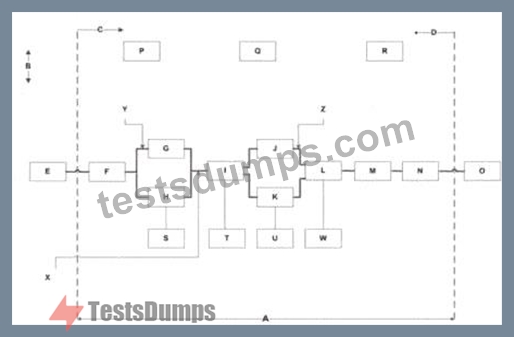
- A. A
- B. B
- C. D
- D. C
Answer: A
Explanation:
The diagram provided is a Function Analysis System Technique (FAST) diagram, a key tool in Value Methodology's Function Analysis phase, as taught in the VMF 1 course (Core Competency #2). FAST diagrams map the relationships between functions of a system, with specific directions indicating the logic of the functions:
* The horizontal axis represents the "how-why" logic (critical path), where moving left answers "why" and moving right answers "how."
* The vertical axis represents the "when" direction, indicating functions that occur simultaneously or continuously while the critical path functions are performed (e.g., all-the-time functions, as noted in Question 27).
According to SAVE International's Value Methodology Standard, "in a FAST diagram, the 'when' direction is shown by vertical relationships, indicating functions that are concurrent or supporting the critical path." In the diagram:
* The critical path (horizontal, marked by Y in Question 3) runs from E to F to G to J to L to M to N to O.
* Scope lines are labeled B (left) and D (right), as identified in Question 30.
* Vertical arrows (e.g., Z in Question 3, pointing to J-K) indicate the "when" direction, showing functions that occur simultaneously with the critical path functions.
* Ais a horizontal line at the bottom of the diagram, but in FAST diagramming, the vertical axis (and its bounding lines) is associated with the "when" direction. The options (A, B, C, D) include A as the bottom horizontal line, which, in some FAST diagram interpretations, can be seen as marking the boundary of the "when" direction (vertical relationships).
* C(noted in Question 30) is an arrow pointing left, representing the "why" direction, not "when." Given the options,Ais the closest representation of the "when" direction, as it aligns with the vertical axis's boundary, which defines the space where "when" relationships (simultaneous functions) are shown. In standard FAST diagramming, the "when" direction is vertical, and A, as the bottom horizontal line, frames the vertical space where these relationships are depicted (e.g., S, T, U, K).
* Option A (A) is correct, as it represents the boundary of the vertical axis, which is associated with the
"when" direction in FAST diagrams.
* Option B (B) is incorrect because B is a scope line (left vertical), which defines the study's boundary, not the "when" direction.
* Option C (C) is incorrect because C is an arrow indicating the "why" direction (left), not "when."
* Option D (D) is incorrect because D is the right scope line, not related to the "when" direction.
:
SAVE International, VMF 1 Core Competency #2 (Function Analysis), defining the "when" direction in FAST diagrams as vertical, indicating simultaneous functions.
SAVE International, "Value Methodology Standard," section on Function Analysis, describing FAST diagramming conventions, including the "when" direction as vertical relationships.
NEW QUESTION # 31
Which of the following is most relevant to the Evaluation Phase?
- A. Constraints
- B. Return on Investment
- C. Cost Model
- D. Weighting
Answer: D
Explanation:
The Evaluation Phase of the Value Methodology (VM) Job Plan, as outlined in the VMF 1 course and SAVE International's Value Methodology Standard, involves assessing ideas generated during the Creative Phase to select the most viable ones for further development. According to VMF 1 Core Competency #7 (Evaluation and Selection of Alternatives), the Evaluation Phase focuses on "evaluating ideas based on criteria such as cost, performance, feasibility, and alignment with project goals, often using tools like weighted evaluation matrices."Weightingrefers to assigning weights to evaluation criteria (e.g., cost savings, quality, risk) to prioritize ideas systematically, making it the most relevant to this phase.
* Option A (Return on Investment) is incorrect because ROI is a financial metric typically calculated during the Development Phase when modeling the cost and benefits of selected ideas, not during Evaluation.
* Option B (Cost Model) is incorrect because cost models are developed in the Development Phase to detail the financial impact of selected ideas, though rough cost estimates may be considered in Evaluation.
* Option C (Weighting) is correct, as weighting criteria in tools like a weighted evaluation matrix is a key activity in the Evaluation Phase to rank and select ideas.
* Option D (Constraints) is incorrect because identifying constraints occurs primarily in the Information Phase, though they may be considered during Evaluation as part of feasibility analysis.
:
SAVE International, "Value Methodology Standard and Body of Knowledge," available athttps://www.value- eng.org, detailing the Evaluation Phase and the use of weighted evaluation matrices.
SAVE International, VMF 1 Core Competency #7 (Evaluation and Selection of Alternatives), emphasizing weighting criteria for idea selection.
NEW QUESTION # 32
Which function represents the specific goals or needs for which the subject scope exists?
- A. Lower Order
- B. Secondary
- C. Higher Order
- D. Basic
Answer: C
Explanation:
In Value Methodology's Function Analysis, functions are classified based on their role in the system, as taught in the VMF 1 course (Core Competency #2). According to SAVE International's Value Methodology Standard, thehigher-order function"represents the specific goals or needs for which the subject scope exists-it answers 'why' the system or project is needed." In a FAST diagram, the higher-order function is located to the left of the basic function, just inside the left scope line, as seen in Question 18 (Function E). It defines the overarching objective or customer need that justifies the existence of the system (e.g., for a car, the higher-order function might be "provide mobility," while the basic function is "transport passengers").
* Option A (Basic) is incorrect because the basic function is the primary purpose of the system within the scope (e.g., "transport passengers"), not the overarching goal.
* Option B (Lower Order) is incorrect because "lower-order" is not a standard term in VM; it may refer to functions to the right of the basic function, which are more specific, not goal-oriented.
* Option C (Higher Order) is correct, as it represents the specific goals or needs for which the subject scope exists, per VM standards.
* Option D (Secondary) is incorrect because secondary functions support the basic function and do not represent the overarching goals.
:
SAVE International, VMF 1 Core Competency #2 (Function Analysis), defining higher-order functions as the goals or needs of the system.
SAVE International, "Value Methodology Standard," section on Function Analysis, describing the role of higher-order functions in FAST diagrams.
NEW QUESTION # 33
Y is pointing to the
- A. Critical Logic Path
- B. "AND" Gate
- C. "OR" Gate
- D. Minor Logic Path
Answer: A
Explanation:
The diagram provided is a Function Analysis System Technique (FAST) diagram, a key tool in Value Methodology's Function Analysis phase, as taught in the VMF 1 course. FAST diagrams map the relationships between functions of a system, showing "how" and "why" relationships to identify the critical logic path (the primary sequence of functions that achieve the system's basic function) and minor logic paths (supporting functions). In FAST diagramming, functions are represented by boxes (e.g., G, H, J, K), and their relationships are shown with arrows.
* Yis a red arrow connecting function G to function J, running horizontally across the diagram. In FAST diagrams, the horizontal path from left to right represents thecritical logic path, which answers the question "how" each function is achieved to fulfill the system's primary purpose. Here, the path from E to F to G to J to L to M to N to O is the main sequence of functions, indicating the critical logic path.
* Z(another red arrow) points to a vertical connection between J and K, which represents a minor logic path-supporting functions that occur simultaneously or are secondary to the main path.
* Option A ("AND" Gate) and Option D ("OR" Gate) are incorrect because FAST diagrams use logic gates to show relationships between functions (e.g., AND for concurrent functions, OR for alternatives), but Y is an arrow on the main path, not a gate. Gates are typically symbols (e.g., triangles or diamonds) at junctions, not arrows.
* Option B (Minor Logic Path) is incorrect because minor logic paths are vertical connections in FAST diagrams (e.g., Z pointing to J-K), not the horizontal path that Y indicates.
* Option C (Critical Logic Path) is correct because Y lies on the main horizontal path, which represents the critical sequence of functions in a FAST diagram.
:
SAVE International, VMF 1 Core Competency #2 (Function Analysis), which includes the use of FAST diagrams to map critical and minor logic paths.
SAVE International, "Value Methodology Standard," section on Function Analysis, describing FAST diagramming conventions (horizontal for critical path, vertical for minor paths).
NEW QUESTION # 34
Risks associated with a project, product, or process typically impact:
- A. Resources, regulations, or time
- B. Time, function, or attributes
- C. Cost, requirements, or results
- D. Schedule, cost, or performance
Answer: D
Explanation:
Risk management is a critical aspect of Implementation Planning in Value Methodology (VM), as it ensures that VM proposals can be successfully executed, as taught in the VMF 1 course (Core Competency #8:
Implementation Planning). According to SAVE International's Value Methodology Standard, "risks associated with a project, product, or process typically impact schedule, cost, or performance." This is often referred to as the "project management triangle" or "triple constraint," a fundamental concept in project management that VM adopts when assessing risks during the Development and Presentation Phases.
* Schedule: Risks that cause delays (e.g., late delivery of materials).
* Cost: Risks that increase expenses (e.g., unexpected cost overruns).
* Performance: Risks that affect quality or functionality (e.g., a proposed solution failing to meet requirements).
The VMF 1 curriculum emphasizes that VM teams must identify and mitigate risks in these three areas to ensure the feasibility of their recommendations, making this the most relevant framework for understanding risk impacts in a VM context.
* Option A (Schedule, cost, or performance) is correct, as it directly aligns with the standard risk impact areas in VM and project management.
* Option B (Cost, requirements, or results) is incorrect because, while cost is relevant, "requirements" and "results" are less specific than "schedule" and "performance" in the context of VM risk management.
* Option C (Resources, regulations, or time) is incorrect because, while time (schedule) is relevant, resources and regulations are more specific factors that contribute to broader impacts on schedule, cost, or performance.
* Option D (Time, function, or attributes) is incorrect because, while time (schedule) is relevant,
"function" and "attributes" are not standard risk impact categories in VM; performance is the broader term used.
:
SAVE International, "Value Methodology Standard and Body of Knowledge," available athttps://www.value- eng.org, section on risk management, referencing the impact of risks on schedule, cost, and performance.
SAVE International, VMF 1 Core Competency #8 (Implementation Planning), emphasizing the project management triangle (schedule, cost, performance) in risk assessment.
NEW QUESTION # 35
When transforming the VM study subject's cost information, the potential for achieving major savings is:
- A. Enhanced when outputs are included in calculations
- B. Improved when costs are aligned with scope increases
- C. Greatest during the early phases of the project lifecycle
- D. Increased when the VM proposals improve performance
Answer: C
Explanation:
Transforming cost information in a Value Methodology (VM) study involves analyzing and optimizing costs to improve value, often through cost models or financial analysis, as taught in the VMF 1 course (Core Competency #1: Value Methodology Overview). According to SAVE International's Value Methodology Standard, "the potential for achieving major savings is greatest during the early phases of the project lifecycle, such as planning or conceptual design, when decisions about scope, design, and requirements are made." This principle is based on the "cost influence curve," which shows that the ability to influence costs is highest early in the project, before costs are locked in by detailed design or implementation. Applying VM early allows the team to make fundamental changes (e.g., rethinking functions or materials) that yield significant savings, whereas later phases (e.g., construction or operation) offer less flexibility and higher change costs.
* Option A (Greatest during the early phases of the project lifecycle) is correct, as it aligns with VM's emphasis on early intervention for maximum cost savings, as seen in Question 21.
* Option B (Increased when the VM proposals improve performance) is incorrect because, while performance improvements can enhance value, the greatest potential for savings is tied to timing, not performance.
* Option C (Enhanced when outputs are included in calculations) is incorrect because including outputs may improve analysis accuracy, but it does not directly address the timing of savings potential.
* Option D (Improved when costs are aligned with scope increases) is incorrect because scope increases often raise costs, whereas VM aims to reduce costs while maintaining or improving function.
:
SAVE International, "Value Methodology Standard and Body of Knowledge," available athttps://www.value- eng.org, emphasizing early application of VM for major savings.
SAVE International, VMF 1 Core Competency #1 (Value Methodology Overview), highlighting the cost influence curve and early intervention benefits.
NEW QUESTION # 36
During the life cycle of a project or product, the greatest possibility to influence impacts and costs takes place during:
- A. Operating
- B. Maintaining
- C. Organizing
- D. Planning
Answer: D
Explanation:
Value Methodology emphasizes applying VM early in a project or product lifecycle to maximize its impact on costs and outcomes, as taught in the VMF 1 course (Core Competency #1: Value Methodology Overview).
According to SAVE International's Value Methodology Standard, "the greatest opportunity to influence a project's impacts and costs occurs during the planning phase, when decisions about design, scope, and requirements are made." Early intervention allows the VM team to optimize functions and reduce costs before they are locked in by detailed design or implementation. This principle is often illustrated by the "cost influence curve," which shows that the ability to influence costs decreases as the project progresses, while the cost to make changes increases.
* Option A (Operating) is incorrect because, during operation, most costs are already incurred, and changes are costly and limited in impact.
* Option B (Planning) is correct, as it is the phase where VM can most effectively influence design and cost decisions, per VM standards.
* Option C (Organizing) is incorrect because organizing is a management function, not a distinct lifecycle phase for applying VM.
* Option D (Maintaining) is incorrect because maintenance occurs late in the lifecycle, when cost influence is minimal.
:
SAVE International, "Value Methodology Standard and Body of Knowledge," available athttps://www.value- eng.org, emphasizing early application of VM in the planning phase.
SAVE International, VMF 1 Core Competency #1 (Value Methodology Overview), highlighting the cost influence curve and the importance of early VM intervention.
NEW QUESTION # 37
The original VM Job Plan was based on a problem-solving approach. Which is the correct order of the four steps comprising this approach?
- A. Hypothesis, Experimentation, Observation, Conclusion
- B. Observation, Hypothesis, Experimentation, Conclusion
- C. Hypothesis, Observation, Experimentation, Conclusion
- D. Observation, Experimentation, Hypothesis, Conclusion
Answer: B
Explanation:
The original Value Methodology (VM) Job Plan, developed by Lawrence D. Miles in the 1940s, was rooted in a problem-solving approach inspired by the scientific method. As outlined in the VMF 1 course (Core Competency #1: Value Methodology Overview), Miles adapted a systematic problem-solving framework to create the VM Job Plan, which later evolved into the six-phase process used today (Information, Function Analysis, Creative, Evaluation, Development, Presentation). The original problem-solving approach, as described in SAVE International's historical documentation of VM, follows the scientific method's four steps:
Observation, Hypothesis, Experimentation, and Conclusion.
* Observation: Observe the problem or system (e.g., high costs, inefficiencies) to understand the current state, aligning with the Information Phase.
* Hypothesis: Form a hypothesis about how to improve value (e.g., identifying key functions or alternatives), similar to Function Analysis and Creative Phases.
* Experimentation: Test the hypothesis by developing and evaluating alternatives, akin to the Evaluation and Development Phases.
* Conclusion: Draw conclusions and implement solutions, corresponding to the Presentation Phase.
This order-Observation, Hypothesis, Experimentation, Conclusion-is the standard sequence of the scientific method, which Miles used as the foundation for VM's systematic approach to problem-solving.
* Option A (Hypothesis, Observation, Experimentation, Conclusion) is incorrect because observation must come first to identify the problem.
* Option B (Observation, Experimentation, Hypothesis, Conclusion) is incorrect because hypothesizing should precede experimentation.
* Option C (Hypothesis, Experimentation, Observation, Conclusion) is incorrect because observation must come before forming a hypothesis.
* Option D (Observation, Hypothesis, Experimentation, Conclusion) is correct, as it matches the scientific method's order, which underpins the original VM Job Plan.
:
SAVE International, "Value Methodology Standard and Body of Knowledge," available athttps://www.value- eng.org, historical section on the origins of VM and its problem-solving roots.
SAVE International, VMF 1 Core Competency #1 (Value Methodology Overview), detailing the history of the VM Job Plan and its basis in the scientific method.
NEW QUESTION # 38
What is a function of a teacup?
- A. Contain tea
- B. Provide container
- C. Allow drinking
- D. Contain liquid
Answer: D
Explanation:
Function Analysis in Value Methodology involves identifying and classifying functions using verb-noun combinations, as taught in the VMF 1 course (Core Competency #2). The basic function of an item is its primary purpose-what it must do to fulfill its intended use, defined in broad, measurable terms. According to SAVE International's Value Methodology Standard, "functions should be expressed at a level that captures the core purpose of the item, avoiding overly specific or secondary actions." For a teacup, the basic function is the most fundamental action it performs. A teacup's primary purpose is tocontain liquid, as this captures the essential role of holding a liquid (e.g., tea, water, or any beverage), which applies to all teacups regardless of the specific liquid or use.
* Option A (Provide container) is incorrect because "provide container" is not a standard verb-noun function format and is too vague; the teacup itself is the container, and the function is what it does (contain liquid).
* Option B (Allow drinking) is incorrect because allowing drinking is a secondary function or outcome; the teacup must first contain liquid before drinking can occur, and not all uses involve drinking (e.g., holding liquid for soaking).
* Option C (Contain tea) is incorrect because, while a teacup often contains tea, this is too specific; a teacup can hold other liquids (e.g., coffee, water), so the basic function is broader.
* Option D (Contain liquid) is correct, as it defines the basic function of a teacup in the most fundamental terms, encompassing all potential uses, similar to how a pen's function was defined as "mark surface" in Question 38.
:
SAVE International, VMF 1 Core Competency #2 (Function Analysis), which includes defining basic functions using verb-noun combinations.
SAVE International, "Value Methodology Standard," section on Function Analysis, emphasizing the identification of basic functions as the core purpose of an item (consistent with Question 38).
NEW QUESTION # 39
A Random Function Identification table contains:
- A. Elements, functions, and classifications
- B. Costs, time, and risks
- C. Inputs, objectives, and sequence
- D. Components, resources, and criteria
Answer: A
Explanation:
Random Function Identification is a technique used in Value Methodology's Function Analysis phase to identify and organize functions before creating a Function Analysis System Technique (FAST) diagram, as taught in the VMF 1 course (Core Competency #2). According to SAVE International's Value Methodology Standard, Random Function Identification involves "listing all functions of a system or project in a table, typically including the elements (components or parts), their associated functions (in verb-noun format), and their classifications (e.g., basic, secondary, higher-order)." This table helps the VM team systematically identify and categorize functions during the early stages of analysis, ensuring all functions are captured before structuring them in a FAST diagram.
* Option A (Inputs, objectives, and sequence) is incorrect because inputs and objectives are part of the Information Phase, and sequence is addressed in FAST diagramming, not in the Random Function Identification table.
* Option B (Costs, time, and risks) is incorrect because these are related to cost analysis or implementation planning, not function identification.
* Option C (Elements, functions, and classifications) is correct, as it aligns with the purpose of the Random Function Identification table in VM.
* Option D (Components, resources, and criteria) is incorrect because resources and criteria are not part of function identification; criteria are used in the Evaluation Phase.
:
SAVE International, VMF 1 Core Competency #2 (Function Analysis), which includes Random Function Identification as a precursor to FAST diagramming.
SAVE International, "Value Methodology Standard," section on Function Analysis, describing the Random Function Identification table as listing elements, functions, and classifications.
NEW QUESTION # 40
What is the correct order for the three levels of filters used for evaluating ideas during the Evaluation Phase?
- A. Coarse, Medium, Fine
- B. Medium, Fine, Coarse
- C. Medium, Coarse, Fine
- D. Coarse, Fine, Medium
Answer: A
Explanation:
The Evaluation Phase of the Value Methodology (VM) Job Plan involves assessing ideas generated during the Creative Phase to select the most viable ones for further development, as taught in the VMF 1 course (Core Competency #7: Evaluation and Selection of Alternatives). According to SAVE International's Value Methodology Standard, the Evaluation Phase uses a three-level filtering process to systematically narrow down ideas: "Ideas are evaluated using a coarse, medium, and fine filter approach to progressively refine the list of alternatives."
* Coarse Filter: Initial screening to eliminate clearly unfeasible ideas (e.g., those that violate constraints or are impractical).
* Medium Filter: More detailed evaluation using criteria like cost, performance, and risk to shortlist ideas with potential.
* Fine Filter: In-depth analysis, often using tools like weighted evaluation matrices (as noted in Question
11), to select the best ideas for development.
This order-Coarse, Medium, Fine-ensures a logical progression from broad elimination to detailed selection, aligning with the VMF 1 curriculum's focus on systematic evaluation.
* Option A (Medium, Coarse, Fine) is incorrect because starting with a medium filter skips the initial broad screening.
* Option B (Coarse, Medium, Fine) is correct, as it matches the standard three-level filtering process in VM.
* Option C (Medium, Fine, Coarse) is incorrect because it reverses the logical progression of filtering.
* Option D (Coarse, Fine, Medium) is incorrect because the fine filter should be the last step, not followed by a medium filter.
:
SAVE International, "Value Methodology Standard and Body of Knowledge," available athttps://www.value- eng.org, detailing the coarse-medium-fine filtering process in the Evaluation Phase.
SAVE International, VMF 1 Core Competency #7 (Evaluation and Selection of Alternatives), emphasizing the three-level filtering approach for idea evaluation.
NEW QUESTION # 41
Which phase enables the VM team to select viable ideas?
- A. Function Analysis
- B. Development
- C. Evaluation
- D. Presentation
Answer: C
Explanation:
The Value Methodology (VM) Job Plan, as outlined in the VMF 1 course and SAVE International's Value Methodology Standard, consists of six phases, one of which is the Evaluation Phase, where the VM team selects viable ideas. In the Evaluation Phase, the team assesses ideas generated during the Creative Phase to determine their feasibility, cost impact, and alignment with project goals. According to the VMF 1 Core Competency #3 (Value Methodology Job Plan), the Evaluation Phase involves "evaluating the ideas for their potential to improve value, using criteria such as cost savings, performance, quality, and feasibility, to select the most viable alternatives for further development." Tools like weighted evaluation matrices may be used to rank ideas systematically.
* Option A (Function Analysis) is incorrect because this phase focuses on identifying and analyzing functions, not selecting ideas.
* Option B (Presentation) is incorrect because this phase involves communicating recommendations to stakeholders, after ideas have already been selected and developed.
* Option C (Evaluation) is correct, as it is the phase where the VM team filters and selects viable ideas based on defined criteria.
* Option D (Development) is incorrect because this phase involves refining selected ideas into actionable proposals, which happens after the Evaluation Phase.
:
SAVE International, "Value Methodology Standard and Body of Knowledge," available athttps://www.value- eng.org, detailing the Evaluation Phase in the VM Job Plan.
SAVE International, "Value Methodology Associate (VMA) Certification,"https://www.value-eng.org/page
/VMA, referencing VMF 1 Core Competency #3 (Value Methodology Job Plan).
NEW QUESTION # 42
In which phase does one work to obtain a thorough understanding of the subject of the VM study?
- A. Information Phase
- B. Presentation Phase
- C. Creativity Phase
- D. Evaluation Phase
Answer: A
Explanation:
The Value Methodology (VM) Job Plan, as outlined in the VMF 1 course and SAVE International's Value Methodology Standard, consists of six phases, starting with the Information Phase. According to VMF 1 Core Competency #3 (Value Methodology Job Plan), the Information Phase is where the VM team works to
"obtain a thorough understanding of the subject of the study by gathering and analyzing data on project scope, costs, constraints, objectives, and stakeholder needs." This phase involves collecting all relevant information-such as drawings, specifications, cost data, and performance requirements-to establish a baseline for the study, ensuring the team fully understands the project before proceeding to function analysis.
* Option A (Information Phase) is correct, as it is explicitly defined as the phase for gaining a thorough understanding of the VM study's subject.
* Option B (Creativity Phase) is incorrect because this phase focuses on generating ideas, not gathering information.
* Option C (Evaluation Phase) is incorrect because this phase involves assessing ideas, which occurs after the subject is already understood.
* Option D (Presentation Phase) is incorrect because this phase involves communicating recommendations, not studying the subject.
:
SAVE International, "Value Methodology Standard and Body of Knowledge," available athttps://www.value- eng.org, detailing the Information Phase in the VM Job Plan.
SAVE International, VMF 1 Core Competency #3 (Value Methodology Job Plan), emphasizing the role of the Information Phase in understanding the study subject.
NEW QUESTION # 43
Which of the following is a basic function of a bicycle?
- A. Transport Goods
- B. Provide Transportation
- C. Move People
- D. Transport Mass
Answer: B
Explanation:
Function Analysis in Value Methodology involves identifying and classifying functions using verb-noun combinations, as taught in the VMF 1 course (Core Competency #2). The basic function of an item is its primary purpose-what it must do to fulfill its intended use. For a bicycle, the basic function is the most general and essential action it performs. According to SAVE International's Value Methodology Standard, functions should be defined in broad, measurable terms (e.g., verb-noun format) to capture the core purpose.
The basic function of a bicycle is to "provide transportation," as this encompasses its primary role of enabling movement for people or goods.
* Option A (Transport Mass) is incorrect because "mass" is too vague and not specific to the bicycle's purpose; it could apply to any object being moved.
* Option B (Move People) is incorrect because, while a bicycle often moves people, this is a secondary function-bicycles can also transport goods (e.g., in cargo bikes), so it's not the most fundamental function.
* Option C (Provide Transportation) is correct because it captures the bicycle's primary purpose in the broadest sense, covering both people and goods, aligning with VM's focus on defining basic functions at a high level.
* Option D (Transport Goods) is incorrect because transporting goods is a specific use case, not the bicycle's primary function, which is broader.
:
SAVE International, VMF 1 Core Competency #2 (Function Analysis), which includes defining basic functions using verb-noun combinations.
SAVE International, "Value Methodology Standard," section on Function Analysis, emphasizing the identification of basic functions as the core purpose of an item.
NEW QUESTION # 44
......
Updated Exam VMA Dumps with New Questions: https://www.testsdumps.com/VMA_real-exam-dumps.html
Dumps to Pass your VMA Exam with 100% Real Questions and Answers: https://drive.google.com/open?id=1NeAqv15V00ew6iVXg9MCayePZTFawurX
