

2023 Realistic Verified Free The Open Group OGB-001 Exam Questions
OGB-001 Real Exam Questions and Answers FREE
Upon successfully passing the TOGAF Business Architecture Part 1 certification exam, candidates will earn a globally recognized certification that demonstrates their knowledge and expertise in business architecture. TOGAF Business Architecture Part 1 certification can help professionals enhance their career opportunities and increase their earning potential, as it is highly regarded by employers across various industries.
NEW QUESTION # 19
Which of the following is an end product of business capability modeling?
- A. A business capability map.
- B. A business process model.
- C. An organizational map.
- D. A value stream stages catalog.
Answer: A
Explanation:
Explanation
This answer is based on the definition and purpose of a business capability map as "a technique for the representation of an organization's business anchor model, independent of the organization's structure, processes, people, or domains" . A business capability map is an end product of business capability modeling, as it shows the complete set of capabilities thatan organization possesses or requires to achieve its goals and objectives. A business capability map provides a high-level and stable view of what a business does or can do, regardless of how or where it does it. The other options are not correct, as they are not end products of business capability modeling.
NEW QUESTION # 20
Considerthe following Business Capability Example: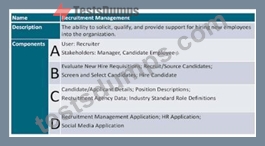
Which of the following ore A and C?
- A. Roles, Information
- B. Actors, Actions.
- C. Who, What.
- D. Organization, Data.
Answer: A
Explanation:
Explanation
This answer is based on the definition and components of a business capability as "an ability that a business possesses to achieve a specific outcome" . A business capability consists of four components: who, what, where, and how. Who refers to the roles or actors that perform or enable the capability. What refers to the functions or activities that constitute the capability. Where refers to the locations or channels where the capability is executed or delivered. How refers to the processes or methods that govern the capability. In the image provided by the user, A and C are examples of who and what components, respectively. Therefore, A and C are roles and information, which are two types of who and what components.
NEW QUESTION # 21
Complete the sentence. An information map is a____________________________________.
- A. description of the Business units that use capacities and participate in value streams
- B. target description of information assets needed to support the business
- C. representation of where the business information is held within the enterprise
- D. collection of Information concepts and their relationships to one another
Answer: D
Explanation:
Explanation
This answer is based on the definition of an information map as "a visualization tool and can show either the index of information that is available or required and where it can be found, or the flow of information and will comprise information elements and the relation between them" 1. An information map is a way to represent the business vocabulary and the associations among different information concepts. It is not a target description of information assets, a description of the business units, or a representation of where the business information is held, which are different aspects of information management.
NEW QUESTION # 22
What Business Architecture concept is most related to an Information Map?
- A. Heal Map
- B. Business Capability Map
- C. Value Stream Map
- D. Organization Map
Answer: B
Explanation:
Explanation
This answer is based on the relationship between information maps and business capability maps as described in the TOGAF Series Guide: Information Mapping 1. According to this guide, "Information Maps are a part of the core set of artifacts that provide a powerful representation of the business. Information Maps are also a high-level description of the informational requirements of a business and are a key input into its Information Systems Architecture design." Therefore, information maps are most related to business capability maps, which define "what" a business does at its core. The other options are not as closely related to information maps, as they focus on different aspects of the business architecture.
NEW QUESTION # 23
Which of the following are two concepts used for structuring a business capability model?
- A. Mapping. Sorting
- B. Aligning. Layering
- C. Stratification, Leveling
- D. Categorizing, Grouping
Answer: D
Explanation:
Explanation
This answer is based on the TOGAF Series Guide: Business Capabilities , which states that "A business capability model is a structured representation of the capabilities of an organization. It is typically structured using two concepts: categorizing and grouping." Categorizing is the process of assigning capabilities to different categories based on their nature, purpose, or function. Grouping is the process of arranging capabilities into different levels or layers based on their granularity, abstraction, or dependency. The other options are not correct, as they are not concepts used for structuring a business capability model.
NEW QUESTION # 24
Whichof the following best describes a TOGAF Business Scenario?
- A. A technique for constructing business models in a form enabling reasoning, insight, and clarity.
- B. A complete description of a business problem in both business and architectural terms.
- C. A method forensuring that the business processes deliver the required outcomes.
- D. A specification of the conventions for a particular kindof business architecture view.
Answer: B
Explanation:
Explanation
This answer is based on the definition of a TOGAF Business Scenario as "a technique for articulating, developing, and validating the requirements of the business" 1. A TOGAF Business Scenario is a complete description of a business problem in both business and architectural terms, which enables individual requirements to be viewed in relation to one another in the context of the overall problem. A TOGAF Business Scenario consists of six elements: business environment, actors, roles, business process, desired outcome, and quality attributes. The other options are not correct, as they do not describe a TOGAF Business Scenario.
NEW QUESTION # 25
Which of the following is a purpose of mapping capabilities to value stream stages?
- A. To provide a self-contained business that is Independent of the organizational structure.
- B. To describe the business in terms of services provided and consumed.
- C. To classify, group, and align capacities into categories for a deeper understanding
- D. To Identity which business capabilities are critical to deliver value
Answer: D
Explanation:
Explanation
This answer is based on the TOGAF Series Guide: Business Capabilities 3, which states that "Mapping capabilities to value stream stages allows an organization to identify which capabilities are critical to deliver value to stakeholders and which capabilities are less important or even unnecessary." Mapping capabilities to value stream stages helps to assess the alignment and impact of the business capabilities on the value delivery process. It also helps to prioritize and optimize the capabilities based on their contribution to value creation.
The other options are not correct, as they are not purposes of mapping capabilities to value stream stages.
NEW QUESTION # 26
Which of me following is considered a guying principle when creating value streams?
- A. Avoid going down to operational levels of detail
- B. Create an Initial set of value streams that map one-to-one to existing capabilities.
- C. Identify the lop-level value streams from components of capabilities
- D. Start with internal value streams within the organization
Answer: A
Explanation:
Explanation
This answer is based on the TOGAF Series Guide: Value Streams 2, which states that "A guiding principle when creating value streams is to avoid going down to operational levels of detail. The purpose of a value stream is to provide a high-level view of how value is created and delivered by an enterprise." Going down to operational levels of detail can make the value stream too complex and difficult to understand and communicate. It can also obscure the strategic focus and direction of the value stream. The other options are not correct, as they are not guiding principles when creating value streams.
NEW QUESTION # 27
In what TOGAF ADM phase is the Information map translated into data models?
- A. Phase C
- B. Phase A
- C. Preliminary Phase
- D. Phase E
Answer: A
Explanation:
Explanation
his answer is based on the TOGAF Standard, Version 9.2 - Phase C: Information Systems Architectures 2, which states that "The objective of Phase C is to develop Target Information Systems (Data and Application) Architecture descriptions that will enable the enterprise to address the Request for Architecture Work and stakeholder concerns." In this phase, the Information Map is translated into data models that describe the structure and relationships of the data entities required by the enterprise. The data models are part of the Data Architecture, which is one of the two components of the Information Systems Architecture. The other options are not correct, as they are not phases where the Information Map is translated into data models.
NEW QUESTION # 28
What Business Architecture concept is most related to an Information Map?
- A. Heal Map
- B. Business Capability Map
- C. Value Stream Map
- D. Organization Map
Answer: B
Explanation:
Explanation
This answer is based on the relationship between information maps and business capability maps as described in the TOGAF Series Guide: Information Mapping 1. According to this guide, "Information Maps are a part of the core set of artifacts that provide a powerful representation of the business. Information Maps are also a high-level description of the informational requirements of a business and are a key input into its Information Systems Architecture design." Therefore, information maps are most related to business capability maps, which define "what" a business does at its core. The other options are not as closely related to information maps, as they focus on different aspects of the business architecture.
NEW QUESTION # 29
Which of the following best describes a benefit of business models?
- A. They can be used to resolve conflict amongst different stakeholders.
- B. They can be used to calculate detailed cost estimates.
- C. They can improve communication among business executives.
- D. They have a consistent format that can be easily understood.
Answer: C
Explanation:
Explanation
This answer is based on the benefit of business models as communication tools, as stated in the article
"Business Models - Example, Types, Importance & Advantages" 2. According to this article, "Advantages of Business Models. A good business model gives the company a competitive edge in the industry. A strong business model provides the company good reputation in the market place encouraging investors to remain invested in the company." One of the ways that a good business model can achieve these advantages is by improving communication among business executives, as well as with other stakeholders such as customers, suppliers, and investors. A clear and concise business model can help convey the value proposition, target market, revenue streams, and cost structure of the business in an effective way. The other options are not as accurate or relevant as benefits of business models.
NEW QUESTION # 30
Which of me following is a benefit of Value Stream Mapping?
- A. It helps to ensure that investments and project initiatives are prioritized and funded at a level matching with their value.
- B. It highlights the value of Individual work packages needed to develop the business architecture.
- C. It helps to assess an organization s effectiveness at creating, capturing, and delivering value for different stakeholders.
- D. It helps to identify value. duplication and redundancy across the enterprise.
Answer: C
Explanation:
Explanation
This answer is based on the definition and purpose of value stream mapping as "a technique for modeling, measuring, and analyzing the flow of value from the provider to the consumer through a value stream" . Value stream mapping helps to assess an organization's effectiveness at creating, capturing, and delivering value for different stakeholders, as it shows how value is generated and delivered by the organization's processes, activities, resources, and capabilities. It also helps to identify the sources of waste, inefficiency, and variation in the value delivery process. The other options are not correct, as they are not benefits of value stream mapping.
NEW QUESTION # 31
Which of the following best describes what a business model is?
- A. A maturity model tor IT process management, continuous improvement and best practices.
- B. The description of the structure and interaction of applications that provide Key business functions.
- C. The representation of business assets in use, or planned by the enterprise.
- D. The rationale for how an organization, creates, deliveries and captures value.
Answer: D
Explanation:
Explanation
A business model is a plan that describes how a business intends to make money by providing value to its customers or clients. It defines the value proposition, the target market, the revenue streams, and the cost structure of the business. According to Investopedia 1, a business model is "a company's plan for making a profit. It identifies the products or services the business plans to sell, its identified target market, and any anticipated expenses
NEW QUESTION # 32
......
The Open Group OGB-001 (TOGAF Business Architecture Part 1) exam is a certification program designed for professionals who are interested in advancing their knowledge and skills in business architecture. The Open Group is a global consortium that provides standards, certifications, and best practices in various areas of information technology. The TOGAF Business Architecture Part 1 exam is one of the many certification programs offered by The Open Group to help IT professionals achieve their career goals.
The OGB-001 exam covers the foundational principles of business architecture and its relationship to the overall enterprise architecture. OGB-001 exam evaluates the candidate's understanding of business capabilities, value streams, and business models. It also assesses their knowledge of the business architecture development process, including the use of various tools and techniques to create and manage business architecture artifacts. Passing the OGB-001 exam demonstrates that a candidate has a solid understanding of the principles and best practices of business architecture and is ready to apply them in a real-world setting.
Exam Dumps OGB-001 Practice Free Latest The Open Group Practice Tests: https://www.testsdumps.com/OGB-001_real-exam-dumps.html
OGB-001 Exam Questions | Real OGB-001 Practice Dumps: https://drive.google.com/open?id=1bu8siovcIq7P5cGzR1GvXEplm7Qn0LDN
