

AACE-PSP Exam Dumps Pass with Updated 2026 Certified Exam Questions
AACE-PSP Exam Questions - Real & Updated Questions PDF
NEW QUESTION # 86
Which of the following documents is most likely to be of the LEAST value to a planner/scheduler when planning a contractor's baseline critical path schedule for the construction of a large high-clearance bridge located very near an airport? The contractor has been awarded the contract.
- A. The regulations published by the government aviation agency
- B. The project plans and specifications
- C. The project geotechnical report
- D. The government's report on future high-clearance bridge projects
Answer: D
Explanation:
When planning a contractor's baseline critical path schedule for constructing a high-clearance bridge near an airport, a planner/scheduler must consider documents directly relevant to the project's execution and constraints. Here's the detailed reasoning:
Project Plans and Specifications (Option A):
These documents contain the detailed design, materials, and methods necessary for construction. They are indispensable for planning the baseline critical path schedule.
Project Geotechnical Report (Option B):
The geotechnical report provides critical information about soil conditions, foundational requirements, and potential challenges, which significantly influence construction sequencing and methods.
Regulations Published by the Government Aviation Agency (Option C):
As the project is near an airport, these regulations will likely impose height restrictions, flight path considerations, and safety requirements. Compliance with these regulations is crucial to avoid project delays or legal issues.
Government's Report on Future High-Clearance Bridge Projects (Option D):
This document provides information on future projects and does not pertain to the current construction project. It does not provide actionable data or constraints affecting the planning or execution of the baseline critical path schedule for the awarded project.
Conclusion: Option D is the least valuable document in this scenario as it does not contribute directly to the planning or scheduling of the current project.
Reference:
This conclusion aligns with principles outlined in the PSP Study Guide (2019), where the importance of relevant project documents (e.g., specifications, regulations, and geotechnical data) in the planning process is emphasized.
NEW QUESTION # 87
Determine the driving activity for Activity 10001.
- A. There is no driving activity for Activity 10001 in the backward pass.
- B. Activity 11001.
- C. Activity 10002.
- D. Activity 9005.
Answer: C
NEW QUESTION # 88
Which of the following procedures is generally recognized as acceptable when updating a schedule?
- A. Change a calculated date in the future
- B. Report an actual date when the activity is on a non-work calendar for that date
- C. Change the WBS assignment for an activity
- D. Change a previously reported actual date
Answer: A
NEW QUESTION # 89
In a "crashed" schedule, which is a chain of activities that precede activity 2004?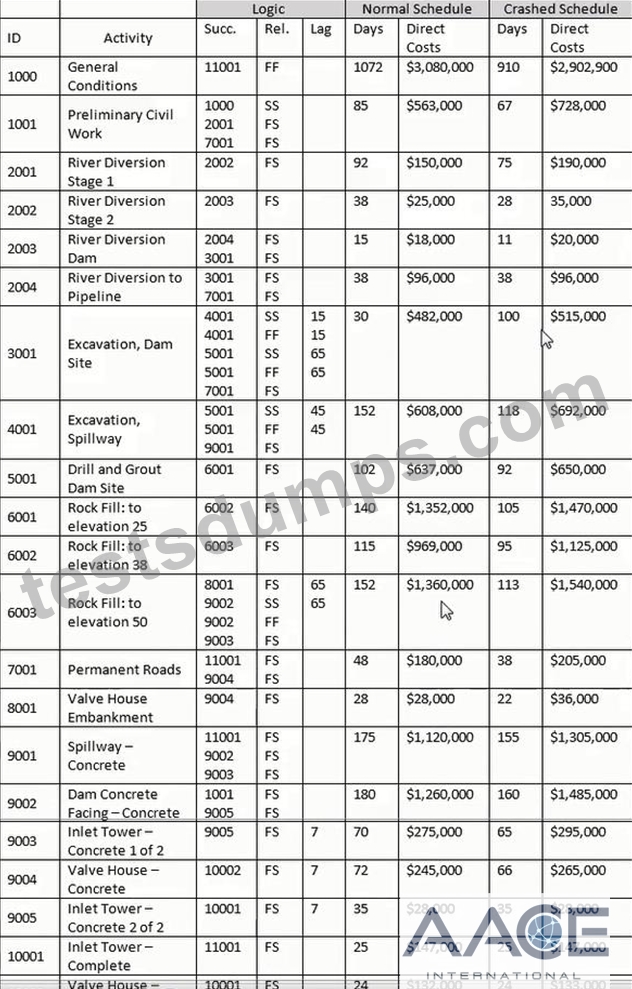
- A. 2001, 2002, 2003, 2007
- B. 1001, 2002, 2003
- C. 1001, 2001, 2002, 2003
- D. 1001, 2002, 2002, 2003, 3001
Answer: C
Explanation:
* Crashed Schedule Predecessors to Activity 2004:
Activity 2004 (River Diversion to Pipeline) depends on completion of:
1001 (Preliminary Civil Work).
2001 (River Diversion Stage 1).
2002 (River Diversion Stage 2).
2003 (River Diversion Dam).
* Exclusion of Other Activities:
Activity 2007 is not part of the crashed schedule's direct predecessor chain.
Other options include duplicated or incorrect entries.
* PSP Study Guide Reference:
Logical sequence analysis confirms these predecessors (Ref: PSP Study Guide, Chapter 2A: Activity Sequencing and Critical Path Analysis).
NEW QUESTION # 90
What is the workweek period for this project?
- A. Sunday through Saturday
- B. Monday through Saturday
- C. Sunday through Friday
- D. Monday through Friday
Answer: A
NEW QUESTION # 91
Assuming activities 2001 through 2004 comprise the same WBS element, construct a WBS summary activity for activities 2001 through 2004. Use the normal schedule, what is the cost of the activity?
- A. $321.000
- B. $327,000
- C. $289.000
- D. $193,000
Answer: A
Explanation:
* A WBS summary activity aggregates costs of constituent activities (2001 through 2004).
* By summing the costs of activities as outlined in the schedule, the total cost for the WBS summary activity is calculated as $321,000.
* Reference: PSP Study Guide, Section 1.3.7 - Establish Work Breakdown Structure, elaborates on cost consolidation at WBS levels.
NEW QUESTION # 92
Midway through the project you received an executed change order for this project, adding thirty-three days to the contract for weather delays. In its simplest form, how would your next project update display the changed condition?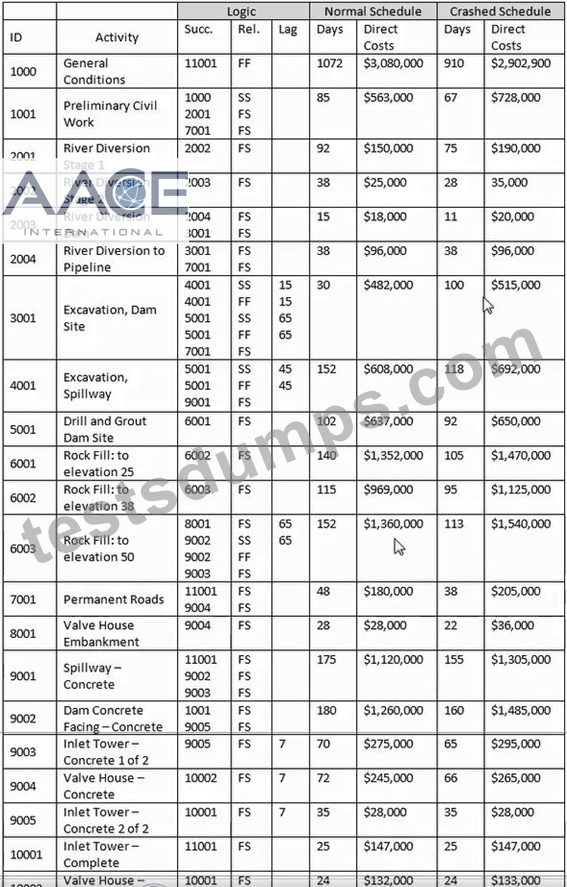
- A. After Activity 1000, add a new Activity 1050 with a start-to-start relationship to Activity 1000, and tie the end of this new activity with a finish-to-finish relationship to the final activity of the project.
- B. After Activity 1001, add a new Activity 1011 with a finish-to-start relationship to Activity 1000, and tie the end of this new activity with a finish-to-start relationship to the final activity of the project.
- C. After Activity 1000, add a new Activity 1010 with a finish-to-start relationship to Activity 1000, and tie the end of this new activity with a finish-to-start relationship to the final activity of the project.
Answer: B
NEW QUESTION # 93
Using the normal schedule, theoretically construct a hammock for activities 6001-6003. What is the duration of the hammock?
- A. 407 days
- B. 267 days
- C. 477 days
- D. 255 days
Answer: B
NEW QUESTION # 94
Which of the following risks CANNOT be estimated by BILCO with only a resource-loaded schedule?
- A. Cost overruns due to cement shortage
- B. Liquidated damages on the SDOT contract
- C. Delay due to SDOT's other projects
- D. Delay due to labor shortage
Answer: C
NEW QUESTION # 95
An early start constraint dictates
- A. The planned start of a successor activity
- B. The actual start of an activity.
- C. An activity's remaining duration.
- D. The planned start of an activity.
Answer: B
NEW QUESTION # 96
The work breakdown structure is used to organize
- A. The smallest defined work packet
- B. Similar activity coding of schedule activities
- C. The chart of accounts
- D. "Smart activity ID codes" representing similar items of scheduled work
Answer: A
NEW QUESTION # 97
Using the "normal" schedule, given Activity 3001 and the relationship with Activity 4001, what is indicated?
- A. These activities are concurrent with Activity 4001 starting 15 days earlier than the start of Activity 3001.
- B. These activities are concurrent with Activity 4001 starting 15 days after the start of Activity 3001.
- C. The activities occur in series with a 15-day lag.
- D. The activities run concurrently.
Answer: C
NEW QUESTION # 98
Why does activity 1001 have two successor activities?
- A. Because the late finish of 1001 and the late start of 7001 require two successors
- B. Because the problem could not effectively work with only one successor
- C. Because the duration of activities 2001, 2002 and 200.f require two successors
- D. Because there are two defined logic paths for the work
Answer: D
NEW QUESTION # 99
Using the normal schedule, what is the early finish date and total float of Activity 10002?
- A. 17 Dec 2023. and 4 days of total float
- B. 24 Nov 2023. and 24 days of tree float
- C. 21 Dec 2023. and 4 days of total float
- D. 24 Dec 2023. and 24 days of tree float
Answer: C
Explanation:
The early finish date and total float are determined using CPM calculations. The PSP Study Guide outlines that early finish is calculated as the early start date plus activity duration, adjusted for calendar constraints (PSP Study Guide, Subchapter 2.2.5, "Constraints and Calendars").
Steps:
Determine early start using forward pass calculations.
Add the activity duration.
Consider non-working days or holidays as per the project calendar.
Calculate float as the difference between late start and early start or late finish and early finish.
NEW QUESTION # 100
Theoretically construct a summary activity for activities 6001 through 6003. Identify the governing predecessor and successor activities for the hammock:
- A. Predecessor is activity 5001, successor is activity 8001
- B. Predecessor is activity 4001, successor is activity 8001
- C. Predecessor is activity 5001, successor is activity 8002
- D. Predecessor is activity 9001, successor is activity 9002
Answer: A
Explanation:
* Definition of a Summary Activity (Hammock):
A summary activity, also referred to as a hammock activity, spans multiple detailed tasks and is governed by the earliest start (ES) of the first task and the latest finish (LF) of the last task.
* Activities 6001 through 6003 Overview:
6001: Starts after 5001 (Drill and Grout Dam Site).
6003: Ends before 8001 (Rock Fill to elevation 50).
* Identifying Predecessor and Successor:
Predecessor: Activity 5001 (Drill and Grout Dam Site).
Successor: Activity 8001 (Rock Fill to elevation 50).
* Cross-Verification:
Logical and temporal dependencies confirm that Activity 5001 must precede the hammock, and Activity 8001 must succeed it (Ref: PSP Study Guide, Chapter 2A: Logical Sequencing and Activity Relationships
NEW QUESTION # 101
Scenario:
The entire network consists of the following activities and relationships. Activity A is twenty days long and is tied to Activity B, a ten-day activity, with a finish-to-finish tie with a lag value of five Activity B is tied to Activity C, a twenty-day activity, with a start-to-start relationship with a lag value of five.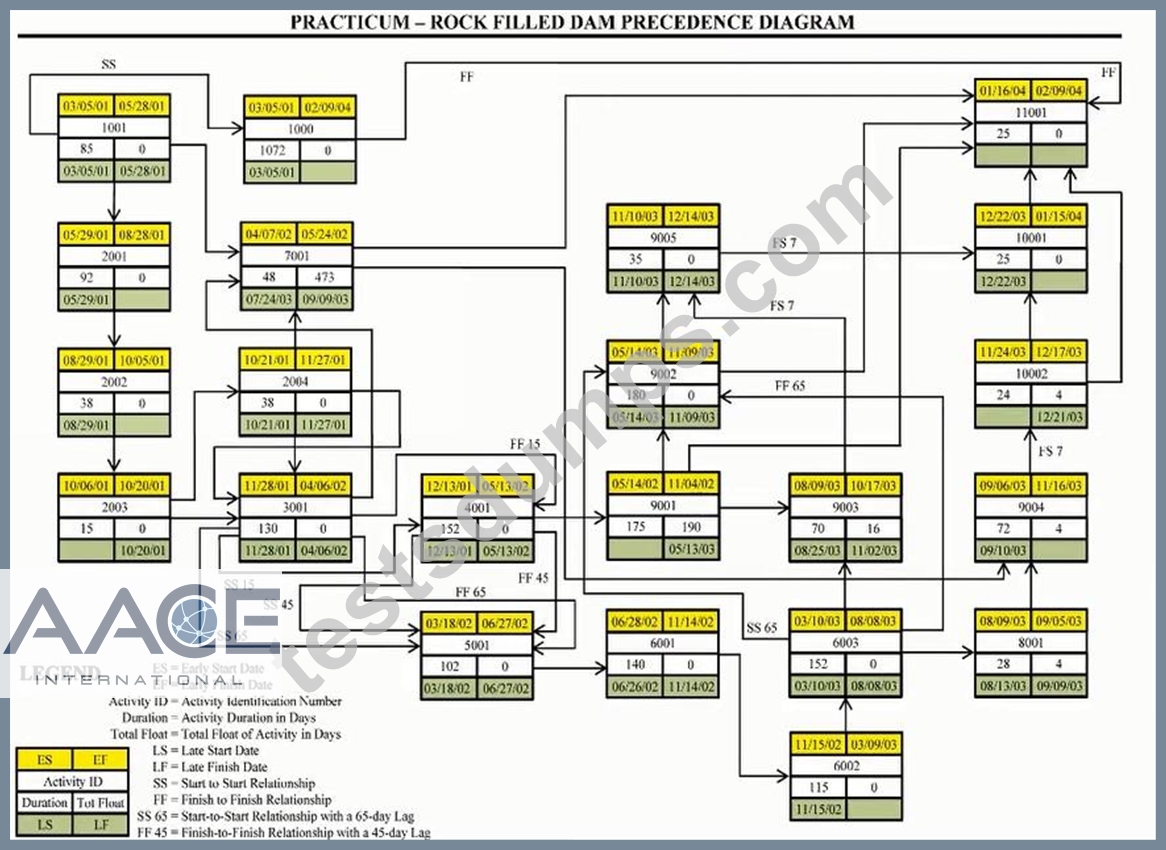
PSP Activities Table
Scope Known about Rock-Filled Dam Project:
The dam requires river diversion and work over two or more rainy seasons. The contract is lump sum, competitively bid, and will be self-performed. The owner has attempted to shift all risk to the contractor by employing "no differing sit conditions" and "no damage for delay" clauses. There is a bonus/penalty provision of $2,500 per calendar day for early or late delivery. The early completion bonus is capped at $500,000, with no cap for late delivery penalty.
Liquidated damages end at the finish of demobilization. Indirect costs per calendar day are $2,800 for the "normal" schedule and $3,200 for the "crashed" schedule. The winter/wet weather season is 151 days between October 15 and March 25 of each year, reduces the efficiency of the contractor's operations by 20% and costs the contractor $10,000 per day. Assume a start date of March 5, 2001 and use a 7-day work week.
The following table lists work activities as planned by the contractor.
Theoretically construct a summary activity for only those activities with a finish-to-start relationship for Activities 8001 through 10001. Using the "normal" schedule, what is the cost of this hammock?
- A. $552,000.
- B. $420,000.
- C. $524,000.
- D. $307,000.
Answer: A
NEW QUESTION # 102
If after calculating a schedule an activity exhibits negative total float, which of the following is certain? The activity
- A. Was completed in the past.
- B. Has yet to be completed.
- C. It is on the critical path.
- D. Is a milestone.
Answer: B
Explanation:
Negative total float occurs when an activity's scheduled completion date extends beyond the project deadline due to constraints. This condition indicates that the activity is still pending and needs immediate attention to avoid further delays.
Option A (milestone) is unrelated.
Option B (critical path) is not necessarily true, as activities with negative float can exist off the critical path under certain constraints.
Option C (completed in the past) is incorrect as negative float applies only to future or ongoing activities.
NEW QUESTION # 103
Based on the available scope information and required accuracy, different cost estimated models or methodologies are utilized Which of the following statements is NOT true?
- A. The Parametric model is used when Class 5 or Class 4 estimates are required
- B. The Deterministic model is used when Class 3 through 1 estimates are required
- C. The Deterministic model is used when Class 5 through 3 estimated are required
- D. The Parametric model is used when detailed quantities are not known
Answer: C
NEW QUESTION # 104
If all other work proceeds according to the Baseline plan, how many times will the critical path change?
- A. Does not change.
- B. 2.
- C. 1.
- D. 3.
Answer: A
NEW QUESTION # 105
......
The AACE-PSP certification focuses on assessing the candidate's knowledge and skills in the field of project planning and scheduling. AACE-PSP exam covers a wide range of topics, including project planning, scheduling, resource management, and earned value management. AACE-PSP exam is designed to test the candidate's ability to apply planning and scheduling principles and techniques to real-world projects.
AACE-PSP Certification is a thorough program that evaluates professionals based on their experience and knowledge in project planning and scheduling. Planning & Scheduling Professional (PSP) Exam certification process enables individuals to demonstrate their expertise with project planning, scheduling, cost management, resource optimization strategies, resource levelling, and organizational planning, among other things. Professionals who earn AACE-PSP Certification have demonstrated their commitment to the highest standards of professionalism in the industry, gaining the respect and trust of stakeholders across every professional and industrial field.
Pass Guaranteed Quiz 2026 Realistic Verified Free AACE International: https://www.testsdumps.com/AACE-PSP_real-exam-dumps.html
Free AACE Certification AACE-PSP Ultimate Study Guide: https://drive.google.com/open?id=1oqLEIs7ozh_icuxYSotUO64-3TWudEwY
