

[Dec-2021] The Best Microsoft Windows 10 Release 1809 and later Study Guide for the MD-101 Exam
MD-101 certification guide Q&A from Training Expert TestsDumps
Requirements
This certification exam does not have any official requirements. However, the candidates should be conversant with Microsoft 365 workloads. These individuals should also have experience and be proficient in maintaining, deploying, and configuring Windows 10 as well as non-Windows technologies & devices.
The target candidates for the Microsoft MD-101 exam are Administrators. These professionals configure, deploy, monitor, manage, and secure client applications as well as devices within enterprise environments. They also have the skills in handling identity, apps, access, updates, and policies. These specialists collaborate with the Microsoft 365 Enterprise Administrators to develop and apply the device strategy that will meet the business requirements of a modern organization.
NEW QUESTION 99
You have a Microsoft 365 subscription.
You plan to enroll devices in Microsoft Endpoint Manager that have the platforms and versions shown in the following table.
You need to configure device enrollment to meet the following requirements:
Ensure that only devices that have approved platforms and versions can enroll in Endpoint Manager.
Ensure that devices are added to Microsoft Azure Active Directory (Azure AD) groups based on a selection made by users during the enrollment.
Which device enrollment setting should you configure for each requirement? To answer, select the appropriate options in the answer area.
NOTE: Each correct selection is worth one point.
Answer:
Explanation:
Reference:
https://docs.microsoft.com/en-us/mem/intune/enrollment/enrollment-restrictions-set
https://docs.microsoft.com/en-us/mem/intune/enrollment/device-group-mapping
NEW QUESTION 100
Your network contains an Active Directory domain. The domain contains 1,200 computers that run Windows
8.1.
You deploy an Upgrade Readiness solution in Microsoft Azure and configure the computers to report to Upgrade Readiness.
From Upgrade Readiness, you open a table view of the applications.
You need to filter the view to show only applications that can run successfully on Windows 10.
How should you configure the filter in Upgrade Readiness? To answer, select the appropriate options in the answer area.
NOTE: Each correct selection is worth one point.
Answer:
Explanation: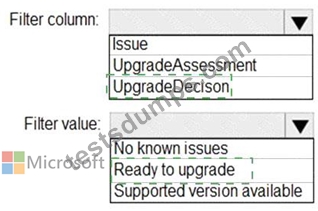
Explanation
References:
https://docs.microsoft.com/en-us/windows/deployment/upgrade/upgrade-readiness-resolve-issues
NEW QUESTION 101
You have unrooted devices enrolled in Microsoft Intune as shown in the following table.
The devices are members of a group named Group1.
In Intune, you create a device compliance location that has the following configurations:
* Name: Network1
* IPv4 range: 192.168.0.0/16
In Intune, you create a device compliance policy for the Android platform. The policy has following configurations:
* Name: Policy1
* Device health: Rooted devices: Block
* Locations: Location: Network1
* Mark device noncompliant: Immediately
* Assigned: Group1
In Intune device compliance policy has the following configurations:
* Mark devices with no compliance policy assigned as: Compliant
* Enhanced jailbreak detection: Enabled
* Compliance status validity period (days): 20
For each of the following statements, select Yes if the statement is true. Otherwise, select No.
NOTE: Each correct selection is worth one point.
Answer:
Explanation:
Reference:
https://docs.microsoft.com/en-us/intune/device-compliance-get-started
NEW QUESTION 102
You have a Microsoft 365 subscription.
You have 10 computers that run Windows 10 and are enrolled in mobile device management (MDM) You need to deploy the Microsoft Office 365 ProPlus suite to all the computers. What should you do?
- A. From Microsoft Azure Active Directory (Azure AD), add an app registration.
- B. From Microsoft Azure Active Directory (Azure AD), add an enterprise application
- C. From the Device Management admin center, add an app.
- D. From the Device Management admin center, create a Windows 10 device profile.
Answer: B
Explanation:
Topic 2, Litware inc
This is a case study. Case studies are not timed separately. You can use as much exam time as you would like to complete each case. However, there may be additional case studies and sections on this exam. You must manage your time to ensure that you are able to complete all questions included on this exam in the time provided.
To answer the questions included in a case study, you will need to reference information that is provided in the case study. Case studies might contain exhibits and other resources that provide more information about the scenario that is described in the case study. Each question is independent of the other questions in this case study.
At the end of this case study, a review screen will appear. This screen allows you to review your answers and to make changes before you move to the next section of the exam. After you begin a new section, you cannot return to this section.
To start the case study
To display the first question in this case study, click the button. Use the buttons in the left pane to explore the content of the case study before you answer the questions. Clicking these buttons displays information such as business requirements, existing environment, and problem statements. When you are ready to answer a question, click the Existing Environment Current Business Model The Los Angeles office has 500 developers. The developers work flexible hours ranging from 11:00 to 22:00.
Litware has a Microsoft System Center 2012 R2 Configuration Manager deployment. During discovery, the company discovers a process where users are emailing bank account information of its customers to internal and external recipients.
Current Environment
The network contains an Active Directory domain that is synced to Microsoft Azure Active Directory (Azure AD). The functional level of the forest and the domain is Windows Server 2012 R2. All domain controllers run Windows Server 2012 R2.
Litware has the computers shown in the following table.
The development department uses projects in Azure DevOps to build applications.
Most of the employees in the sales department are contractors. Each contractor is assigned a computer that runs Windows 10. At the end of each contract, the computer is assigned to different contractor. Currently, the computers are re-provisioned manually by the IT department.
Problem Statements
Litware identifies the following issues on the network:
* Employees in the Los Angeles office report slow Internet performance when updates are downloading.
The employees also report that the updates frequently consume considerable resources when they are installed. The Update settings are configured as shown in the Updates exhibit. (Click the Updates button.)
* Management suspects that the source code for the proprietary applications in Azure DevOps in being shared externally.
* Re-provisioning the sales department computers is too time consuming.
Requirements
Business Goals
Litware plans to transition to co-management for all the company-owned Windows 10 computers. Whenever possible, Litware wants to minimize hardware and software costs.
Device Management Requirements
Litware identifies the following device management requirements:
* Prevent the sales department employees from forwarding email that contains bank account information.
* Ensure that Microsoft Edge Favorites are accessible from all computers to which the developers sign in.
* Prevent employees in the research department from copying patented information from trusted applications to untrusted applications.
Technical Requirements
Litware identifies the following technical requirements for the planned deployment:
* Re-provision the sales department computers by using Windows AutoPilot.
* Ensure that the projects in Azure DevOps can be accessed from the corporate network only.
* Ensure that users can sign in to the Azure AD-joined computers by using a PIN. The PIN must expire every 30 days.
* Ensure that the company name and logo appears during the Out of Box Experience (OOBE) when using Windows AutoPilot.
Exhibits
NEW QUESTION 103
Your company has an infrastructure that has the following:
* A Microsoft 365 tenant
* An Active Directory forest
* Microsoft Store for Business
* A Key Management Service (KMS) server
* A Windows Deployment Services (WDS) server
* A Microsoft Azure Active Directory (Azure AD) Premium tenant
The company purchases 100 new computers that run Windows 10.
You need to ensure that the new computers are joined automatically to Azure AD by using Windows AutoPilot.
What should you use? To answer, select the appropriate options in the answer area.
NOTE: Each correct selection is worth one point.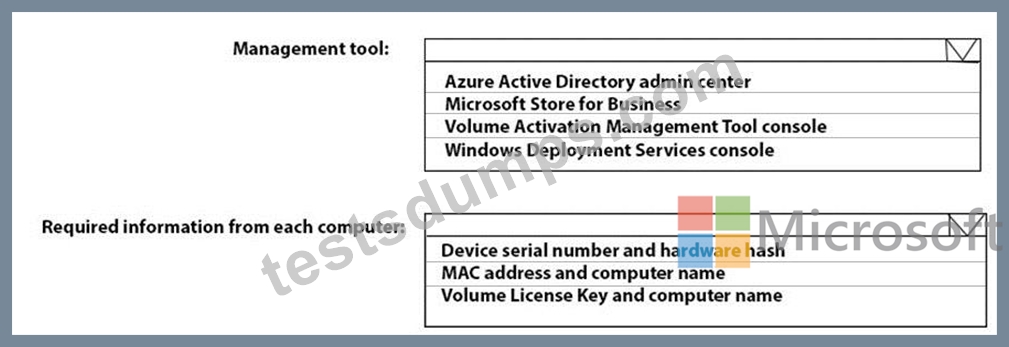
Answer:
Explanation:
Reference:
https://docs.microsoft.com/en-us/intune/enrollment-autopilot
NEW QUESTION 104
Your company has a Microsoft Azure Active Directory (Azure AD) tenant.
The company uses Microsoft Intune to manage iOS, Android, and Windows 10 devices.
The company plans to purchase 1,000 iOS devices. Each device will be assigned to a specific user.
You need to ensure that the new iOS devices are enrolled automatically in Intune when the assigned user signs in for the first time.
Which three actions should you perform in sequence? To answer, move the appropriate actions from the list of actions to the answer area and arrange them in the correct order.
Answer:
Explanation: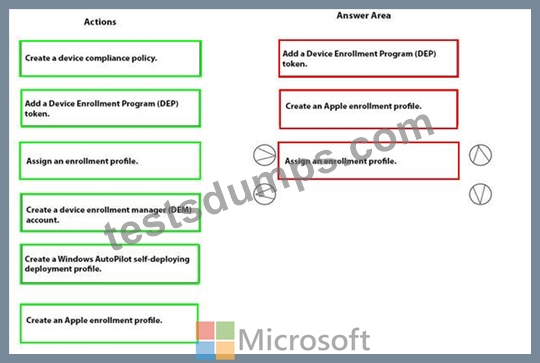
Reference:
https://docs.microsoft.com/en-us/intune/device-enrollment-program-enroll-ios
NEW QUESTION 105
What should you configure to meet the technical requirements for the Azure AD-joined computers?
- A. The Accounts options in an endpoint protection profile.
- B. Windows Hello for Business from the Microsoft Intune blade in the Azure portal.
- C. A password policy from the Microsoft Office 365 portal.
- D. The Password Policy settings in a Group Policy object (GPO).
Answer: B
Explanation:
References:
https://docs.microsoft.com/en-us/windows/security/identity-protection/hello-for-business/hello-manage-inorganization
Topic 2, Contoso Ltd
Contoso Ltd
This is a case study. Case studies are not timed separately. You can use as much exam time as you would like to complete each case. However, there may be additional case studies and sections on this exam. You must manage your time to ensure that you are able to complete all questions included on this exam in the time provided.
To answer the questions included in a case study, you will need to reference information that is provided in the case study. Case studies might contain exhibits and other resources that provide more information about the scenario that is described in the case study. Each question is independent of the other questions in this case study.
At the end of this case study, a review screen will appear. This screen allows you to review your answers and to make changes before you move to the next section of the exam. After you begin a new section, you cannot return to this section.
To start the case study
To display the first question in this case study, click the Next button. Use the buttons in the left pane to explore the content of the case study before you answer the questions. Clicking these buttons displays information such as business requirements, existing environment, and problem statements. When you are ready to answer a question, click the Question button to return to the question.
Overview
Contoso, Ltd, is a consulting company that has a main office in Montreal and two branch offices in Seattle and New York.
Contoso has the users and computers shown in the following table.
The company has IT, human resources (HR), legal (LEG), marketing (MKG) and finance (FIN) departments.
Contoso uses Microsoft Store for Business and recently purchased a Microsoft 365 subscription.
The company is opening a new branch office in Phoenix. Most of the users in the Phoenix office will work from home.
Existing Environment
The network contains an Active Directory domain named contoso.com that is synced to Microsoft Azure Active Directory (Azure AD).
All member servers run Windows Server 2016. All laptops and desktop computers run Windows 10 Enterprise.
The computers are managed by using Microsoft System Center Configuration Manager. The mobile devices are managed by using Microsoft Intune.
The naming convention for the computers is the department acronym, followed by a hyphen, and then four numbers, for example, FIN-6785. All the computers are joined to the on-premises Active Directory domain.
Each department has an organization unit (OU) that contains a child OU named Computers. Each computer account is in the Computers OU of its respective department.
Intune Configuration
Requirements
Planned Changes
Contoso plans to implement the following changes:
* Provide new computers to the Phoenix office users. The new computers have Windows 10 Pro preinstalled and were purchased already.
* Start using a free Microsoft Store for Business app named App1.
* Implement co-management for the computers.
Technical Requirements:
Contoso must meet the following technical requirements:
* Ensure that the users in a group named Group4 can only access Microsoft Exchange Online from devices that are enrolled in Intune.
* Deploy Windows 10 Enterprise to the computers of the Phoenix office users by using Windows Autopilot.
* Monitor the computers in the LEG department by using Windows Analytics.
* Create a provisioning package for new computers in the HR department.
* Block iOS devices from sending diagnostic and usage telemetry data.
* Use the principle of least privilege whenever possible.
* Enable the users in the MKG department to use App1.
* Pilot co-management for the IT department.
NEW QUESTION 106
You have 200 computers that run Windows 10. The computers are joined to Microsoft Azure Active Directory (Azure AD) and enrolled in Microsoft Intune.
You need to ensure that only applications that you explicitly allow can run on the computers.
What should you use?
- A. Windows Defender Exploit Guard
- B. Windows Defender Antivirus.
- C. Windows Defender Credential Guard
- D. Windows Defender Application Guard
Answer: D
Explanation:
Reference:
https://docs.microsoft.com/en-us/windows/security/threat-protection/device-guard/introduction-to-device-guardv based-security-and-windows-defender-application-control
NEW QUESTION 107
You have a computer named Computer1 that runs Windows 10.
Computer1 has the users shown in the following table.
User1 signs in to Computer1, creates the following files, and then signs out:
* docx in C:\Users\User1\Desktop
* docx in C:\Users\Public\Public Desktop
* docx in C:\Users\Default\ Desktop
User3 signs in to Computer1 and creates a file named File4.docx in C:\Users\User3\Desktop.
User2 has never signed in to Computer1.
How many DOCX files will appear on the desktop of each user the nest time each user signs in? To answer, select the appropriate options in the answer area.
NOTE: Each correct selection is worth one point.
Answer:
Explanation:
Explanation
NEW QUESTION 108
You have a Microsoft Intune subscription that has the following device compliance policy settings:
Mark devices with no compliance policy assigned as: Compliant
Compliance status validity period (days): 14
On January 1, you enroll Windows 10 devices in Intune as shown in the following table.
On January 4, you create the following two device compliance policies:
Name: Policy1
Platform: Windows 10 and later
Require BitLocker: Require
Mark device noncompliant: 5 days after noncompliance
Scope (Tags): Tag1
Name: Policy2
Platform: Windows 10 and later
Firewall: Require
Mark device noncompliant: Immediately
Scope (Tags): Tag2
On January 5, you assign Policy1 and Policy2 to Group1.
For each of the following statements, select Yes if the statement is true. Otherwise, select No.
NOTE: Each correct selection is worth one point.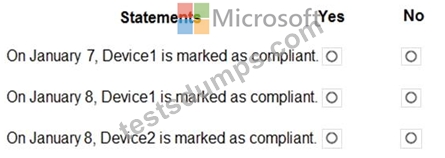
Answer:
Explanation:
Explanation:
Box 1: No.
Policy1 and Policy2 apply to Group1 which Device1 is a member of. Device1 does not meet the firewall requirement in Policy2 so the device will immediately be marked as non-compliant.
Box 2: No
For the same reason as Box1.
Box 3: Yes
Policy1 and Policy2 apply to Group1. Device2 is not a member of Group1 so the policies don't apply.
The Scope (tags) have nothing to do with whether the policy is applied or not. The tags are used in RBAC.
NEW QUESTION 109
You have Windows 10 devices that are managed by using Microsoft Intune. Intune and the Microsoft Store for Business are integrated.
You need to deploy the Remote Desktop modern app as an automatic install to the Windows 10 devices without user interaction.
Which three actions should you perform? Each correct answer presents part of the solution.
NOTE: Each correct selection is worth one point.
- A. From the Intune portal, create a Microsoft Store app for the Remote Desktop modern app.
- B. Create an Azure Active Directory group that contains the Windows 10 devices.
- C. From the Microsoft Store for Business portal, assign a license for the app to all the users in the Azure Active Directory group.
- D. For your organization, make the app available in the Microsoft Store for Business.
- E. From the Intune portal assign the app to the Azure Active Directory group.
- F. Create an Azure Active Directory group that contains all users.
Answer: A,B,E
Explanation:
Reference:
https://docs.microsoft.com/en-us/mem/intune/apps/apps-add
https://docs.microsoft.com/en-us/mem/intune/apps/apps-deploy
https://docs.microsoft.com/en-us/mem/intune/apps/windows-store-for-business
NEW QUESTION 110
You have a Microsoft Intune subscription.
You create the Windows Autopilot deployment profile-shown in the following exhibit.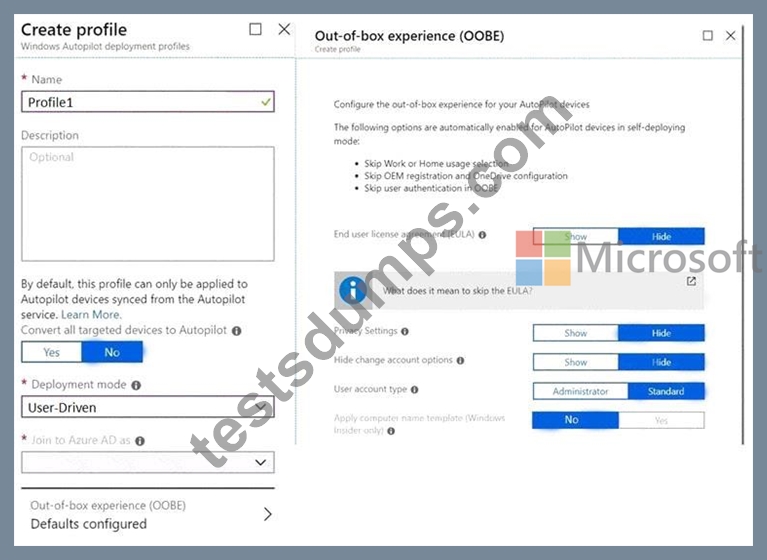
Use the drop-down menus to select the answer choice that completes each statement based on the information presented in the graphic.
NOTE: Each correct selection is worth one point.
Answer:
Explanation:
Explanation
References:
https://docs.microsoft.com/en-us/windows/deployment/windows-autopilot/user-driven
NEW QUESTION 111
Your network contains an Active Directory domain named constoso.com that is synced to Microsoft Azure Active Directory (Azure AD). All computers are enrolled in Microsoft Intune.
The domain contains the computers shown in the following table.
You are evaluating which Intune actions you can use to reset the computers to run Windows 10 Enterprise with the latest update.
Which computers can you reset by using each action? To answer, select the appropriate options in the answer area.
NOTE: Each correct selection is worth one point.
Answer:
Explanation:
Reference:
https://docs.microsoft.com/en-us/intune/device-fresh-start
https://docs.microsoft.com/en-us/intune/devices-wipe
NEW QUESTION 112
Your company has computers that run Windows 10. The company uses Microsoft Intune to manage the computers.
You have an app protection policy for Microsoft Edge. You assign the policy to a group.
On a computer named Computer1, you open Microsoft Edge.
You need to verify whether Microsoft Edge on Computer1 is protected by the app protection policy.
Which column should you add in Task Manager?
- A. UAC virtualization
- B. Data Execution Prevention
- C. Enterprise Context
- D. Operating system context
Answer: C
Explanation:
Explanation
Explanation/Reference:
https://docs.microsoft.com/en-us/windows/security/information-protection/windows-information-protection/wip- app-enterprise-context
https://www.itpromentor.com/win10-mam-wip/
Manage Apps and Data
Testlet 1
This is a case study. Case studies are not timed separately. You can use as much exam time as you would like to complete each case. However, there may be additional case studies and sections on this exam. You must manage your time to ensure that you are able to complete all questions included on this exam in the time provided.
To answer the questions included in a case study, you will need to reference information that is provided in the case study. Case studies might contain exhibits and other resources that provide more information about the scenario that is described in the case study. Each question is independent of the other questions in this case study.
At the end of this case study, a review screen will appear. This screen allows you to review your answers and to make changes before you move to the next section of the exam. After you begin a new section, you cannot return to this section.
To start the case study
To display the first question in this case study, click the Next button. Use the buttons in the left pane to explore the content of the case study before you answer the questions. Clicking these buttons displays information such as business requirements, existing environment, and problem statements. When you are ready to answer a question, click the Question button to return to the question.
General Overview
Litware, Inc. is an international manufacturing company that has 3,000 employees. The company has sales, marketing, research, human resources (HR), development, and IT departments.
Litware has two main offices in New York and Los Angeles. Litware has five branch offices in Asia.
Existing Environment
Current Business Model
The Los Angeles office has 500 developers. The developers work flexible hours ranging from 11 AM to 10 PM.
Litware has a Microsoft System Center 2012 R2 Configuration Manager deployment.
During discovery, the company discovers a process where users are emailing bank account information of its customers to internal and external recipients.
Current Environment
The network contains an Active Directory domain that is synced to Microsoft Azure Active Directory (Azure AD).
The functional level of the forest and the domain is Windows Server 2012 R2. All domain controllers run Windows Server 2012 R2.
Litware has the computers shown in the following table.
The development department uses projects in Azure DevOps to build applications.
Most of the employees in the sales department are contractors. Each contractor is assigned a computer that runs Windows 10. At the end of each contract, the computer is assigned to a different contractor. Currently, the computers are re-provisioned manually by the IT department.
Problem Statements
Litware identifies the following issues on the network:
* Employees in sales department computers is too time the Los Angeles office report slow Internet performance when updates are downloading. The employees also report that the updates frequently consume considerable resources when they are installed. The Update settings are configured as shown in the Updates exhibit. (Click the Updates button.)
* Management suspects that the source code for the proprietary applications in Azure DevOps in being shared externally.
* Re-provisioning theconsuming.
Requirements
Business Goals
Litware plans to transition to co-management for all the company-owned Windows 10 computers. Whenever possible, Litware wants to minimize hardware and software costs.
Device Management Requirements
Litware identifies the following device management requirements:
* Prevent the sales department employees from forwarding email that contains bank account information.
* Ensure that Microsoft Edge Favorites are accessible from all computers to which the developers sign in.
* Prevent employees in the research department from copying patented information from trusted applications to untrusted applications.
Technical Requirements
Litware identifies the following technical requirements for the planned deployment:
* Re-provision the sales department computers by using Windows AutoPilot.
* Ensure that the projects in Azure DevOps can be accessed from the corporate network only.
* Ensure that users can sign in to the Azure AD-joined computers by using a PIN. The PIN must expire every
30 days.
* Ensure that the company name and logo appears during the Out of Box Experience (OOBE) when using Windows AutoPilot.
Exhibits
Manage Apps and Data
Testlet 2
This is a case study. Case studies are not timed separately. You can use as much exam time as you would like to complete each case. However, there may be additional case studies and sections on this exam. You must manage your time to ensure that you are able to complete all questions included on this exam in the time provided.
To answer the questions included in a case study, you will need to reference information that is provided in the case study. Case studies might contain exhibits and other resources that provide more information about the scenario that is described in the case study. Each question is independent of the other questions in this case study.
At the end of this case study, a review screen will appear. This screen allows you to review your answers and to make changes before you move to the next section of the exam. After you begin a new section, you cannot return to this section.
To start the case study
To display the first question in this case study, click the Next button. Use the buttons in the left pane to explore the content of the case study before you answer the questions. Clicking these buttons displays information such as business requirements, existing environment, and problem statements. When you are ready to answer a question, click the Question button to return to the question.
Overview
Contoso, Ltd., is a consulting company that has a main office in Montreal and two branch offices in Seattle and New York.
Contoso has the users and computers shown in the following table.
The company has IT, human resources (HR), legal (LEG), marketing (MKG) and finance (FIN) departments.
Contoso uses Microsoft Store for Business and recently purchased a Microsoft 365 subscription.
The company is opening a new branch office in Phoenix. Most of the users in the Phoenix office will work from home.
Existing Environment
The network contains an Active Directory domain named contoso.com that is synced to Microsoft Azure Active Directory (Azure AD).
All member servers run Windows Server 2016. All laptops and desktop computers run Windows 10 Enterprise.
The computers are managed by using Microsoft System Center Configuration Manager. The mobile devices are managed by using Microsoft Intune.
The naming convention for the computers is the department acronym, followed by a hyphen, and then four numbers, for example, FIN-6785. All the computers are joined to the on-premises Active Directory domain.
Each department has an organization unit (OU) that contains a child OU named Computers. Each computer account is in the Computers OU of its respective department.
Intune Configuration
Requirements
Planned Changes
Contoso plans to implement the following changes:
* Provide new computers to the Phoenix office users. The new computers have Windows 10 Pro preinstalled and were purchased already.
* Start using a free Microsoft Store for Business app named App1.
* Implement co-management for the computers.
Technical Requirements:
Contoso must meet the following technical requirements:
* Ensure that the users in a group named Group4 can only access Microsoft Exchange Online from devices that are enrolled in Intune.
* Deploy Windows 10 Enterprise to the computers of the Phoenix office users by using Windows Autopilot.
* Monitor the computers in the LEG department by using Windows Analytics.
* Create a provisioning package for new computers in the HR department.
* Block iOS devices from sending diagnostic and usage telemetry data.
* Use the principle of least privilege whenever possible.
* Enable the users in the MKG department to use App1.
* Pilot co-management for the IT department.
NEW QUESTION 113
What is the maximum number of devices that User1 and User2 can enroll in Intune? To answer, select the appropriate options in the answer area.
NOTE: Each correct selection is worth one point.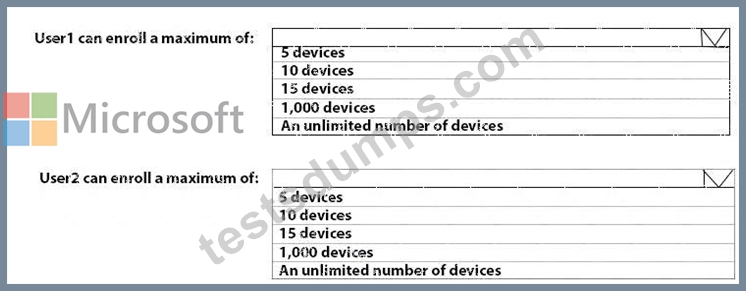
Answer:
Explanation:
Explanation
NEW QUESTION 114
You are creating a device configuration profile in Microsoft Intune.
You need to implement an ADMX-backed policy.
Which profile type should you use?
- A. Device restrictions
- B. Device restrictions (Windows 10 Team)
- C. Identity protection
- D. Custom
Answer: D
Explanation:
Explanation/Reference:
https://blogs.technet.microsoft.com/senthilkumar/2018/05/21/intune-deploying-admx-backed-policies-using- microsoft-intune/
NEW QUESTION 115
You are evaluating which devices are compliant.
For each of the following statements, select Yes if the statement is true. Otherwise, select No.
NOTE: Each correct selection is worth one point.
Answer:
Explanation:
NEW QUESTION 116
You network contains an Active Directory domain. The domain contains 200 computers that run Windows 8.1. You have a Microsoft Azure subscription.
You plan to upgrade the computers to Windows 10.
You need to generate an Upgrade Readiness report for the computers.
What should you do? To answer, select the appropriate options in the answer area.
NOTE: Each correct selection is worth one point.
Answer:
Explanation:
NEW QUESTION 117
You have a computer named Computer1 that runs Windows 10.
The Wi-Fi network profile for Computer1 is configured as shown in the following exhibit.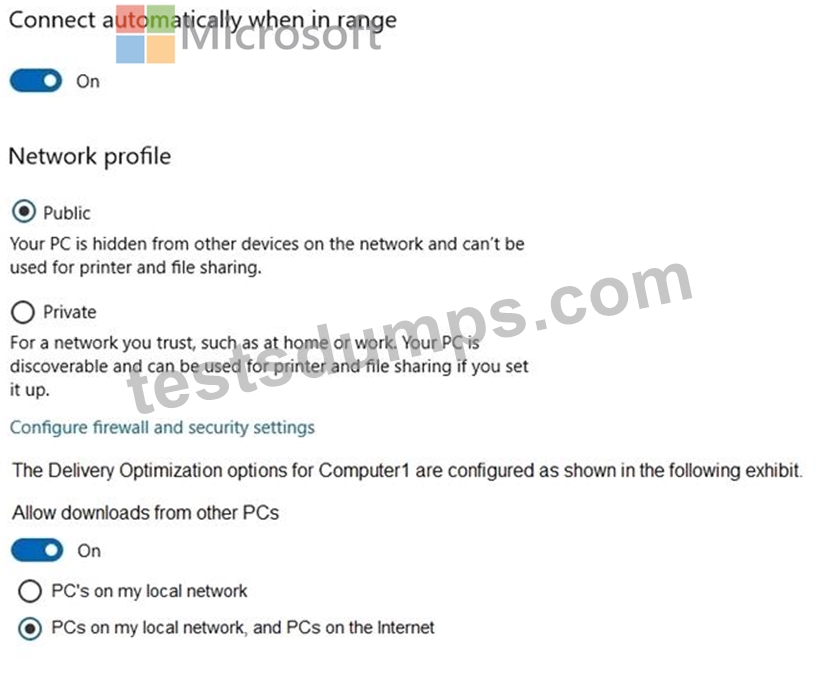
From which computers will Computer1 will receive updates and to which computers will Computer1 provide updates? To answer, select the appropriate options in the answer area.
NOTE: Each correct selection is worth one point.
Answer:
Explanation:
NEW QUESTION 118
Your company uses Microsoft Intune.
More than 500 Android and iOS devices are enrolled in the Intune tenant.
You plan to deploy new Intune policies. Different policies will apply depending on the version of Android or iOS installed on the device.
You need to ensure that the policies can target the devices based on their version of Android or iOS.
What should you configure first?
- A. Groups that have dynamic membership rules in Microsoft Azure Active Directory (Azure AD)
- B. Corporate device identifiers in Intune
- C. Device categories in Intune
- D. Device settings in Microsoft Azure Active Directory (Azure AD)
Answer: A
Explanation:
Explanation
https://blogs.technet.microsoft.com/pauljones/2017/08/29/dynamic-group-membership-in-azure-active-directory
NEW QUESTION 119
You use the Microsoft Deployment Toolkit (MDT) to deploy Windows 10.
You need to modify the deployment share to meet the following requirements:
Ensure that the user who performs the installation is prompted to set the local Administrator password.
Define a rule for how to name computers during the deployment.
The solution must NOT replace the existing WinPE image.
Which file should you modify for each requirement? To answer, select the appropriate options in the answer area.
NOTE: Each correct selection is worth one point.
Answer:
Explanation: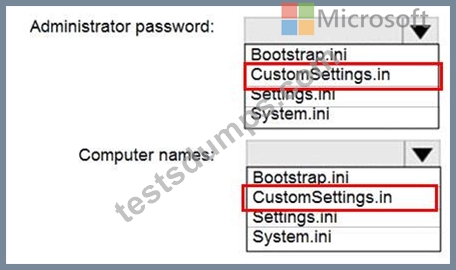
Reference:
https://docs.microsoft.com/en-us/windows/deployment/deploy-windows-mdt/deploy-a-windows-10-image-using-mdt
NEW QUESTION 120
Your network contains an Active Directory domain. Active Directory is synced with Microsoft Azure Active Directory (Azure AD).
There are 500 domain-joined computers that run Windows 10. The computers are joined to Azure AD and enrolled in Microsoft Intune.
You plan to implement Windows Defender Exploit Guard.
You need to create a custom Windows Defender Exploit Guard policy, and then distribute the policy to all the computers.
What should you do? To answer, select the appropriate options in the answer area.
NOTE: Each correct selection is worth one point.
Answer:
Explanation:
Explanation
References:
https://docs.microsoft.com/en-us/intune/endpoint-protection-windows-10
https://docs.microsoft.com/en-us/windows/security/threat-protection/windows-defender-exploit-guard/enable-exp
NEW QUESTION 121
You have a workgroup computer named Computer1 that runs Windows 10 and has the users shown in the following table.
Group1 is a member of Group3.
You are creating a file named Kiosk.xml that specifies a lockdown profile for a multi-app kiosk.
Kiosk.xml contains the following section.
You apply Kiosk.xml to Computer1.
For each of the following statements, select Yes if the statement is true. Otherwise, select No.
NOTE: Each correct selection is worth one point.
Answer:
Explanation:
Reference:
https://docs.microsoft.com/en-us/windows/configuration/lock-down-windows-10-to-specific-apps#config-for-group-accounts
NEW QUESTION 122
Your company plans to deploy Windows 10 to devices that will be configured for English use and other devices that will be configured for Korean use.
You need to create a single multivariant provisioning package for the planned devices.
You create the provisioning package.
What should you do next to add the language settings to the package?
- A. Create a file named Languages.xml that contains a header for Korean.
- B. Modify the .ppkg file.
- C. Modify the Customizations.xml file.
- D. Create a file named Languages.xml that contains a header for English.
Answer: C
Explanation:
Follow these steps to create a provisioning package with multivariant capabilities.
1. Build a provisioning package and configure the customizations you want to apply during certain conditions.
2. After you've configured the settings, save the project.
3. Open the project folder and copy the customizations.xml file to any local location.
4. Use an XML or text editor to open the customizations.xml file.
5. Edit the customizations.xml file to create a Targets section to describe the conditions that will handle your multivariant settings.
6. In the customizations.xml file, create a Variant section for the settings you need to customize.
7. Save the updated customizations.xml file and note the path to this updated file. You will need the path as one of the values for the next step.
8. Use the Windows Configuration Designer command-line interface to create a provisioning package using the updated customizations.xml.
References:
https://docs.microsoft.com/en-us/windows/configuration/provisioning-packages/provisioning-multivariant Manage and Protect Devices Testlet 1 This is a case study. Case studies are not timed separately. You can use as much exam time as you would like to complete each case. However, there may be additional case studies and sections on this exam. You must manage your time to ensure that you are able to complete all questions included on this exam in the time provided.
To answer the questions included in a case study, you will need to reference information that is provided in the case study. Case studies might contain exhibits and other resources that provide more information about the scenario that is described in the case study. Each question is independent of the other questions in this case study.
At the end of this case study, a review screen will appear. This screen allows you to review your answers and to make changes before you move to the next section of the exam. After you begin a new section, you cannot return to this section.
To start the case study
To display the first question in this case study, click the Next button. Use the buttons in the left pane to explore the content of the case study before you answer the questions. Clicking these buttons displays information such as business requirements, existing environment, and problem statements. When you are ready to answer a question, click the Question button to return to the question.
Overview
Contoso, Ltd, is a consulting company that has a main office in Montreal and two branch offices in Seattle and New York.
Contoso has the users and computers shown in the following table.
The company has IT, human resources (HR), legal (LEG), marketing (MKG) and finance (FIN) departments.
Contoso uses Microsoft Store for Business and recently purchased a Microsoft 365 subscription.
The company is opening a new branch office in Phoenix. Most of the users in the Phoenix office will work from home.
Existing Environment
The network contains an Active Directory domain named contoso.com that is synced to Microsoft Azure Active Directory (Azure AD).
All member servers run Windows Server 2016. All laptops and desktop computers run Windows 10 Enterprise.
The computers are managed by using Microsoft System Center Configuration Manager. The mobile devices are managed by using Microsoft Intune.
The naming convention for the computers is the department acronym, followed by a hyphen, and then four numbers, for example, FIN-6785. All the computers are joined to the on-premises Active Directory domain.
Each department has an organizational unit (OU) that contains a child OU named Computers. Each computer account is in the Computers OU of its respective department.
Intune Configuration
Requirements
Planned Changes
Contoso plans to implement the following changes:
* Provide new computers to the Phoenix office users. The new computers have Windows 10 Pro preinstalled and were purchased already.
* Start using a free Microsoft Store for Business app named App1.
* Implement co-management for the computers.
Technical Requirements:
Contoso must meet the following technical requirements:
* Ensure that the users in a group named Group4 can only access Microsoft Exchange Online from devices that are enrolled in Intune.
* Deploy Windows 10 Enterprise to the computers of the Phoenix office users by using Windows Autopilot.
* Monitor the computers in the LEG department by using Windows Analytics.
* Create a provisioning package for new computers in the HR department.
* Block iOS devices from sending diagnostic and usage telemetry data.
* Use the principle of least privilege whenever possible.
* Enable the users in the MKG department to use App1.
* Pilot co-management for the IT department.
Manage and Protect Devices
Question Set 2
NEW QUESTION 123
......
How much MD-101 Exam Cost
The price of the MD-101 exam is $165 USD.
The Best Microsoft MD-101 Study Guides and Dumps of 2021: https://www.testsdumps.com/MD-101_real-exam-dumps.html
MD-101 Certification Overview Latest MD-101 PDF Dumps: https://drive.google.com/open?id=1t-Q7yjlWqO0nSAA0MQghIVAwuL11ZQn8
