

[Jul-2024] Microsoft AZ-305 Test Engine PDF - All Free Dumps from TestsDumps
Get New AZ-305 Certification – Valid Exam Dumps Questions
Microsoft AZ-305 Exam is a part of the Microsoft Certified: Azure Solutions Architect Expert certification, which is a prestigious certification for cloud architects. Designing Microsoft Azure Infrastructure Solutions certification is designed to validate the candidate's expertise in designing and implementing solutions that run on Microsoft Azure. Designing Microsoft Azure Infrastructure Solutions certification also demonstrates the candidate's ability to manage and monitor Azure resources and optimize Azure workloads for cost and performance.
NEW QUESTION # 114
You deploy several Azure SQL Database instances.
You plan to configure the Diagnostics settings on the databases as shown in the following exhibit.
Use the drop-down menus to select the answer choice that completes each statement based on the information presented in the graphic.
NOTE: Each correct selection is worth one point.
Answer:
Explanation:
NEW QUESTION # 115
You have an app that generates 50,000 events daily.
You plan to Stream the events to an Azure event hub and use Event Hubs Capture to implement cold path processing Of the events Output Of Event Hubs Capture will be consumed by a reporting system.
You reed to identify which type of Azure storage must be provisioned to support Event Hubs Capture, and which inbound data format the reporting system must support.
What should you identity? To answer. select the appropriate options in the answer are a.
NOTE: Each correct selection is worth one point.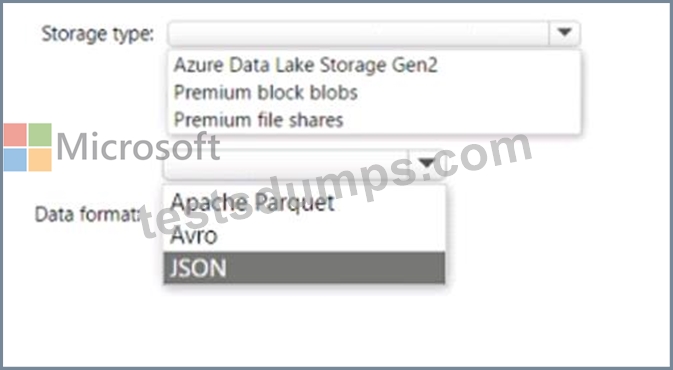
Answer:
Explanation:
NEW QUESTION # 116
You plan to deploy an Azure web app named Appl that will use Azure Active Directory (Azure AD) authentication.
App1 will be accessed from the internet by the users at your company. All the users have computers that run Windows 10 and are joined to Azure AD.
You need to recommend a solution to ensure that the users can connect to App1 without being prompted for authentication and can access App1 only from company-owned computers.
What should you recommend for each requirement? To answer, select the appropriate options in the answer area.
NOTE: Each correct selection is worth one point.
Answer:
Explanation:
Explanation
Graphical user interface, text, application, chat or text message Description automatically generated
Box 1: An Azure AD app registration
Azure active directory (AD) provides cloud based directory and identity management services.You can use azure AD to manage users of your application and authenticate access to your applications using azure active directory.
You register your application with Azure active directory tenant.
Box 2: A conditional access policy
Conditional Access policies at their simplest are if-then statements, if a user wants to access a resource, then they must complete an action.
By using Conditional Access policies, you can apply the right access controls when needed to keep your organization secure and stay out of your user's way when not needed.
Timeline Description automatically generated
Reference:
https://codingcanvas.com/using-azure-active-directory-authentication-in-your-web-application/
https://docs.microsoft.com/en-us/azure/active-directory/conditional-access/overview
https://docs.microsoft.com/en-us/powerapps/developer/data-platform/walkthrough-register-app-azure-active-dire
"After consenting to use their Dataverse account with the ISV's application, end users can connect to Dataverse environment from external application. The consent form is not displayed again to other users after the first user who has already consented to use the ISV's app. Apps registered in Azure Active Directory are multi-tenant, which implies that other Dataverse users from other tenant can connect to their environment using the ISV's app."
NEW QUESTION # 117
You plan to create an Azure environment that will contain a root management group and 10 child management groups. Each child management group will contain five Azure subscriptions. You plan to have between 10 and
30 resource groups in each subscription.
You need to design an Azure governance solution. The solution must meet the following requirements:
* Use Azure Blueprints to control governance across all the subscriptions and resource groups.
* Ensure that Blueprints-based configurations are consistent across all the subscriptions and resource groups.
* Minimize the number of blueprint definitions and assignments.
What should you include in the solution? To answer, select the appropriate options in the answer area. NOTE:
Each correct selection is worth one point.
Answer:
Explanation:
Explanation
1. Root management group
2. The subscriptions
Reference: https://docs.microsoft.com/en-us/azure/governance/blueprints/create-blueprint-portal Assign a blueprint After a blueprint has been published, it can be assigned to a subscription. Assign the blueprint that you created to one of the subscriptions under your management group hierarchy. If the blueprint is saved to a subscription, it can only be assigned to that subscription.
NEW QUESTION # 118
You are evaluating whether to use Azure Traffic Manager and Azure Application Gateway to meet the connection requirements for App1.
What is the minimum numbers of instances required for each service? To answer, select the appropriate options in the answer area.
NOTE: Each correct selection is worth one point.
Answer:
Explanation:
Explanation:
NEW QUESTION # 119
You have an Azure subscription that contains a Basic Azure virtual WAN named Virtual/WAN1 and the virtual hubs shown in the following table.
You have an ExpressRoute circuit in the US East region.
You need to create an ExpressRoute association to VirtualWAN1.
What should you do first?
- A. Enable the ExpressRoute premium add-on.
- B. Upgrade VirtualWAN1 to Standard.
- C. Create a gateway on Hub1.
- D. Create a hub virtual network in US East.
Answer: B
Explanation:
US East and US West are in the same geopolitical region so there is no need for enabling ExpressRoute premium add-on https://docs.microsoft.com/en-us/azure/virtual-wan/virtual-wan-about#basicstandard The current config of virtual WAN is only Basic as given, so it can connect to only site to site VPN, to connect to express route it needs to be upgraded from basic to standard. https://docs.microsoft.com/en-us/azure/virtual-wan/virtual-wan-about
https://docs.microsoft.com/en-us/azure/virtual-wan/virtual-wan-about
NEW QUESTION # 120
You are evaluating whether to use Azure Traffic Manager and Azure Application Gateway to meet the connection requirements for App1.
What is the minimum numbers of instances required for each service? To answer, select the appropriate options in the answer area.
NOTE: Each correct selection is worth one point.
Answer:
Explanation:
Explanation
NEW QUESTION # 121
You have an Azure subscription that contains 300 Azure virtual machines that run Windows Server 2016.
You need to centrally monitor all warning events in the System logs of the virtual machines.
What should you include in the solutions? To answer, select the appropriate options in the answer area.
NOTE: Each correct selection is worth one point.
Answer:
Explanation:
Reference:
https://docs.microsoft.com/en-us/azure/azure-monitor/platform/data-sources-windows-events
https://docs.microsoft.com/en-us/azure/azure-monitor/platform/agent-windows
NEW QUESTION # 122
You are designing a cost-optimized solution that uses Azure Batch to run two types of jobs on Linux nodes.
The first job type will consist of short-running tasks for a development environment. The second job type will consist of long-running Message Passing Interface (MPI) applications for a production environment that requires timely job completion.
You need to recommend the pool type and node type for each job type. The solution must minimize compute charges and leverage Azure Hybrid Benefit whenever possible.
What should you recommend? To answer, select the appropriate options in the answer area.
NOTE: Each correct selection is worth one point.
Answer:
Explanation:
Explanation:
Graphical user interface, text, application Description automatically generated
NEW QUESTION # 123
You configure OAuth2 authorization in API Management as shown in the following exhibit.
Use the drop-down menus to select the answer choice that completes each statement based on the information presented in the graphic.
NOTE: Each correct selection is worth one point.
Answer:
Explanation:
Explanation
Graphical user interface, text, application, email Description automatically generated
Box 1: Web applications
The Authorization Code Grant Type is used by both web apps and native apps to get an access token after a user authorizes an app.
Note: The Authorization Code grant type is used by confidential and public clients to exchange an authorization code for an access token.
After the user returns to the client via the redirect URL, the application will get the authorization code from the URL and use it to request an access token.
Reference:
https://developer.okta.com/blog/2018/04/10/oauth-authorization-code-grant-type
https://connect2id.com/products/server/docs/guides/client-registration
NEW QUESTION # 124
You are evaluating whether to use Azure Traffic Manager and Azure Application Gateway to meet the connection requirements for App1.
What is the minimum numbers of instances required for each service? To answer, select the appropriate options in the answer area.
NOTE: Each correct selection is worth one point.
Answer:
Explanation:
NEW QUESTION # 125
You have a resource group named RG1 that contains the objects shown in the following table.
You need to configure permissions so that App1 can copy all the secrets from KV1 to KV2. App1 currently has the Get permission for the secrets in KV1.
Which additional permissions should you assign to App1? To answer, select the appropriate options in the answer area.
NOTE: Each correct selection is worth one point.
Answer:
Explanation:
Reference:
https://docs.microsoft.com/en-us/rest/api/keyvault/
NEW QUESTION # 126
You have an on-premises database that you plan to migrate to Azure.
You need to design the database architecture to meet the following requirements:
* Support scaling up and down.
* Support geo-redundant backups.
* Support a database of up to 75 TB.
* Be optimized for online transaction processing (OLTP).
What should you include in the design? To answer, select the appropriate options in the answer area.
NOTE: Each correct selection is worth one point.
Answer:
Explanation:
Explanation
Box 1: Azure SQL Database
Azure SQL Database:
Database size always depends on the underlying service tiers (e.g. Basic, Business Critical, Hyperscale).
It supports databases of up to 100 TB with Hyperscale service tier model.
Active geo-replication is a feature that lets you to create a continuously synchronized readable secondary database for a primary database. The readable secondary database may be in the same Azure region as the primary, or, more commonly, in a different region. This kind of readable secondary databases are also known as geo-secondaries, or geo-replicas.
Azure SQL Database and SQL Managed Instance enable you to dynamically add more resources to your database with minimal downtime.
Box 2: Hyperscale
Reference:
https://docs.microsoft.com/en-us/azure/azure-sql/database/active-geo-replication-overview
https://medium.com/awesome-azure/azure-difference-between-azure-sql-database-and-sql-server-on-vm-compar
NEW QUESTION # 127
A company named Contoso, Ltd. has an Azure Active Directory (Azure AD) tenant that is integrated with Microsoft Office 365 and an Azure subscription.
Contoso has an on-premises identity infrastructure. The infrastructure includes servers that run Active Directory Domain Services (AD DS), and Azure AD Connect Contoso has a partnership with a company named Fabrikam, Inc. Fabrikam has an Active Directory forest and an Office 365 tenant. Fabrikam has the same on-premises identity infrastructure as Contoso.
A team of 10 developers from Fabrikam will work on an Azure solution that will be hosted in the Azure subscription of Contoso. The developers must be added to the Contributor role for a resource in the Contoso subscription.
You need to recommend a solution to ensure that Contoso can assign the role to the 10 Fabrikam developers.
The solution must ensure that the Fabrikam developers use their existing credentials to access resources.
What should you recommend?
- A. Configure an AD FS relying party trust between the fabrikam and Contoso AD FS infrastructures.
- B. In the Azure AD tenant of Contoso, use MIM to create guest accounts for the Fabrikam developers.
- C. Configure a forest trust between the on-premises Active Directory forests of Contoso and Fabrikam.
- D. Configure an organization relationship between the Office 365 tenants of Fabrikam and Contoso.
Answer: C
Explanation:
Trust configurations - Configure trust from managed forests(s) or domain(s) to the administrative forest A one-way trust is required from production environment to the admin forest.
Selective authentication should be used to restrict accounts in the admin forest to only logging on to the appropriate production hosts.
References:
https://docs.microsoft.com/en-us/windows-server/identity/securing-privileged-access/securing-privileged-access-
NEW QUESTION # 128
You have an Azure subscription that contains the storage accounts shown in the following table.
You plan to implement two new apps that have the requirements shown in the following table.
Which storage accounts should you recommend using for each app? To answer, select the appropriate options in the answer area.
NOTE: Each correct selection is worth one point.
Answer:
Explanation:
Explanation
https://docs.microsoft.com/en-us/azure/storage/common/storage-account-overview
https://www.edureka.co/community/40011/different-storage-accounts-there-major-difference-between
https://insidemstech.com/tag/general-purpose-v2/
In conclusion the correct answers are:
Box1 --> Storage1 and Storage3 only
Box2 --> Storage1 and Storage4 only
https://docs.microsoft.com/en-us/azure/storage/files/storage-how-to-create-file-share?tabs=azure-portal#basics
NEW QUESTION # 129
You plan to migrate data to Azure.
The IT department at your company identifies the following requirements:
* The storage must support 1 PB of data.
* The data must be stored in blob storage.
* The storage must support three levels of subfolders.
* The storage must support access control lists (ACLs).
You need to meet the requirements.
What should you use?
- A. a premium storage account that is configured for block blobs
- B. a general purpose v2 storage account that has hierarchical namespace enabled
- C. a premium storage account that is configured for page blobs
- D. a premium storage account that is configured for files shares and supports large file shares
Answer: B
Explanation:
Explanation
Microsoft recommends that you use a GPv2 storage account for most scenarios. It supports up to 5 PB, and blob storage including Data Lake storage.
Note: A key mechanism that allows Azure Data Lake Storage Gen2 to provide file system performance at object storage scale and prices is the addition of a hierarchical namespace. This allows the collection of objects/files within an account to be organized into a hierarchy of directories and nested subdirectories in the same way that the file system on your computer is organized. With a hierarchical namespace enabled, a storage account becomes capable of providing the scalability and cost-effectiveness of object storage, with file system semantics that are familiar to analytics engines and frameworks.
References:
https://docs.microsoft.com/en-us/azure/storage/common/storage-account-overview
https://docs.microsoft.com/en-us/azure/storage/blobs/data-lake-storage-namespace
NEW QUESTION # 130
You have several Azure App Service web apps that use Azure Key Vault to store data encryption keys.
Several departments have the following requests to support the web app:
Which service should you recommend for each department's request? To answer, configure the appropriate options in the answer area.
NOTE: Each correct selection is worth one point.
Answer:
Explanation:
Explanation
Graphical user interface, text, application Description automatically generated
NEW QUESTION # 131
You are designing an order processing system in Azure that will contain the Azure resources shown in the following table.
The order processing system will have the following transaction flow:
A customer will place an order by using App1.
When the order is received, App1 will generate a message to check for product availability at vendor 1 and vendor 2.
An integration component will process the message, and then trigger either Function1 or Function2 depending on the type of order.
Once a vendor confirms the product availability, a status message for App1 will be generated by Function1 or Function2.
All the steps of the transaction will be logged to storage1.
Which type of resource should you recommend for the integration component?
D18912E1457D5D1DDCBD40AB3BF70D5D
Which type of resource should you recommend for the integration component?
- A. an Azure Event Hubs capture
- B. an Azure Data Factory pipeline
- C. an Azure Event Grid domain
- D. an Azure Service Bus queue
Answer: B
Explanation:
Explanation
A data factory can have one or more pipelines. A pipeline is a logical grouping of activities that together perform a task.
The activities in a pipeline define actions to perform on your data.
Data Factory has three groupings of activities: data movement activities, data transformation activities, and control activities.
Azure Functions is now integrated with Azure Data Factory, allowing you to run an Azure function as a step in your data factory pipelines.
Reference:
https://docs.microsoft.com/en-us/azure/data-factory/concepts-pipelines-activities
NEW QUESTION # 132
......
100% Passing Guarantee - Brilliant AZ-305 Exam Questions PDF: https://www.testsdumps.com/AZ-305_real-exam-dumps.html
AZ-305 Dumps 2024 - NewMicrosoft Exam Questions: https://drive.google.com/open?id=14Xm7X89YJqOpmO2lpV8eDlnLHdh7wt4g
