

New 2022 Guaranteed Success with TestsDumps PCAP-31-03 Dumps Python Institute PDF Questions
Exceptional Practice To Certified Associate in Python Programming Pass the First Time
How to study the PCAP - Certified Associate in Python Programming (PCAP-31-03) Exam
Preparation and study materials for the PCAP - Certified Associate in Python Programming (PCAP-31-03) Exam is provided by several online platforms including the Python Institute for free. Interested candidates can simply search online with the name of the exam and can find learning materials or take the highly recommended PCAP-31-03 practice exams. To use the material provided by Python Institute, sign up for PCAP - Certified Associate in Python Programming (PCAP-31-03) course to immerse yourself in programming and to learn Python from scratch. Their course will train you for jobs and professions related to the widely known development of the software, which involves not only developing the code itself as a junior developer, but also designing computer systems and testing software.
Completing this course can be a step-stone for learning some other language of programming and exploring technologies that use Python as a basis (e.g., Django). This introductory course is characterized by its student affordability, friendliness, and transparency. It all starts from the absolute basics, leading you to complex problems step by step, making you a responsible software developer capable of taking on numerous challenges in many IT industry positions. Refer to the links at the end of this document for more information on study materials.
Topics of PCAP - Certified Associate in Python Programming (PCAP-31-03) Exam
The syllabus for the PCAP-31-03 dumps is listed below in detail of each section and their topics:
1. Control and Evaluations (25%)
Objectives covered by this section:
- the pass instruction
- literals: Boolean, integer, floating-point numbers, scientific notation, strings
- bitwise operators: ~ & ^ | « »
- string operators: * +
- Boolean operators: not and or
- building loops: while, for, range(), in, iterating through sequences
- simple strings: constructing, assigning, indexing, slicing comparing, immutability
- simple lists: constructing vectors, indexing, and slicing, the len() function
- operators: unary and binary, priorities and binding
- assignments and shortcut operators
- controlling loop execution: break, continue
- expanding loops: while-else, for-else, nesting loops, and conditional statements
- basic input and output: input(), print(), int(), float(), str() functions
- basic concepts: interpreting and the interpreter, compilation and the compiler, language elements, lexis, syntax and semantics, Python keywords, instructions, indenting
- relational operators (== != > >= < <= ), building complex Boolean expressions
- accuracy of floating-point numbers
- numeric operators: * / % // + â
- formatting print() output with end= and sep= arguments
- conditional statements: if, if-else, if-elif, if-elif-else
2. Data Aggregates (25%)
Objectives covered by this section:
- lists in lists: matrices and cubes
- tuples vs. lists: similarities and differences, lists inside tuples and tuples inside lists
- dictionaries: building, indexing, adding and removing keys, iterating through dictionaries as well as their keys and values, checking key existence, keys(), items(), and values() methods
- lists in detail: indexing, slicing, basic methods (append(), insert(), index()) and functions (len(), sorted(), etc.), del instruction, iterating lists with the for loop, initializing, in and not in operators, list comprehension, copying and cloning
- tuples: indexing, slicing, building, immutability
- strings in detail: ASCII, UNICODE, UTF-8, immutability, escaping using the \ character, quotes and apostrophes inside strings, multiline strings, copying vs. cloning, advanced slicing, string vs. string, string vs. non-string, basic string methods (upper(), lower(), isxxx(), capitalize(), split(), join(), etc.) and functions (len(), chr(), ord()), escape characters
3. Functions and Modules (25%)
Objectives covered by this section:
- import directives, qualifying entities with module names, initializing modules
- the if operator
- constructing and distributing packages, packages vs. directories, the role of the init.py file
- map(), filter(), reduce(), reversed(), sorted() functions and the sort() method
- pyc file creation and usage
- name scopes, name hiding (shadowing), the global keyword
- writing and using modules, the name variable
- converting generator objects into lists using the list() function
- return and yield keywords, returning results, the None keyword, recursion
- parameters vs. arguments, positional keyword and mixed argument passing, default parameter values
- Python hashbangs, using multiline strings as module documentation
- lambda functions, defining and using
- defining and invoking your functions and generators
- hiding module entities
4. Classes, Objects, and Exceptions (25%)
Objectives covered by this section:
- using predefined exceptions and defining your ones
- exceptions hierarchy, assigning more than one exception to one except branch
- introspection: dict, name, module, bases properties, examining class/object structure
- defining your classes, superclasses, subclasses, inheritance, searching for missing class components, creating objects
- hasattr(), type(), issubclass(), isinstance(), super() functions
- the role of the str method
- input/output basics: opening files with the open() function, stream objects, binary vs. text files, newline character translation, reading and writing files, byte array objects
- name mangling
- inheritance and overriding, finding class/object components
- the init method
- adding your exceptions to an existing hierarchy
- the anatomy of an exception object
- single inheritance vs. multiple inheritances
- writing and using constructors
- class attributes: class variables and instance variables, defining, adding, and removing attributes, explicit constructor invocation
- read(), readinto(), readline(), write(), close() methods
- assertions
- the try-except-else-finally block, the raise statement, the except-as variant
- class methods: defining and using the self-parameter meaning and usage
- invoking methods, passing and using the self-argument/parameter
NEW QUESTION 14
Which of the following lines of code will work flawlessly when put independently inside the add_new () method in order to make the snippet's output equal to [0, 1, 1] ? (Select two answers)
- A. self .put self.get () [-1])
- B. put self.store(1])
- C. self put stire(1])
- D. self .put (self.store[1])
Answer: C,D
NEW QUESTION 15
Is it possible to safely check if a class/object has a certain attribute?
- A. yes, by using the hasattr ( ) method
- B. yes, by using the hasattr attribute
- C. yes, by using the hassattr ( ) function
- D. no, it is not possible
Answer: A
NEW QUESTION 16
Which of the following statements are true? (Select two answers)
- A. \e is an escape sequence used to mark the end of lines
- B. II in ASCII stands for Information Interchange
- C. ASCII is synonymous with UTF-8
- D. a code point is a number assigned to a given character
Answer: B,C
NEW QUESTION 17
Which of the following lambda definitions are correct? (Select two answers)
- A. lambda x, y; (x, y)
- B. lambda x, y; x\\y - x%y
- C. lanbda x, y; return x\\y - x%y
- D. lambda (x, y = x\\y x%y
Answer: A,B
NEW QUESTION 18
Assuming that the code below has been placed inside a file named code.py and executed successfully, which of the following expressions evaluate to True? (Select two answers)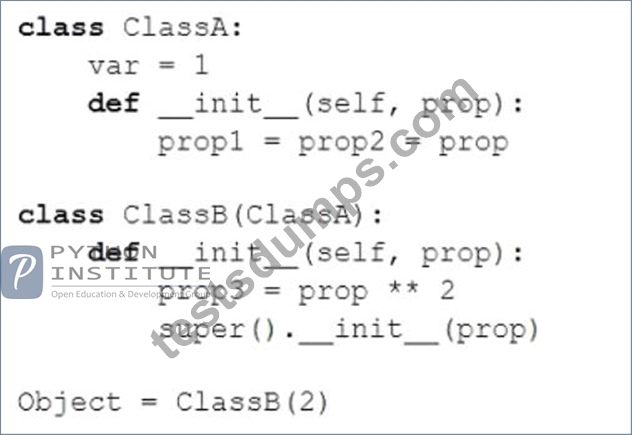
- A. _name == _main_'
- B. str(Object) == 'Object'
- C. len(ClassB.__bases__) == 1
- D. ClassA. _module_ == 'ClassA'
Answer: A,C
NEW QUESTION 19
What is the expected behavior of the following code?
- A. it outputs nothing
- B. it raises an exception
- C. it outputs False
- D. it outputs True
Answer: D
NEW QUESTION 20
Which of the following statements are true? (Select two answers)
- A. a code point is a point inside the code when execution stops immediately
- B. an escape sequence can be recognized by the # sign put in front of it.
- C. ASCII is the name of a character coding standard
- D. UTF-8 is one of the ways of representing UNICODE code points.
Answer: C,D
NEW QUESTION 21
What is the expected behavior of the following snippet?
It will:
- A. print3
- B. cause a runtime exception on line 03
- C. cause a runtime exception on line 01
- D. cause a runtime exception on line 02
Answer: A
Explanation:
NEW QUESTION 22
Assuming that the snippet below has been executed successfully, which of the following expressions will evaluate to True? (Select two answers) string = 'python' [::2] string = string[-1] + string[-2]
- A. string[0] == 'o'
- B. string is None
- C. len (string] == 3
- D. string[0] == string[-1]
Answer: A
NEW QUESTION 23
Which line can be used instead of the comment to cause the snippet to produce the following expected output? (Select two answers) Expected output:
1 2 3
Code:
- A. a, b, c = a, b, c
- B. c, b, a = b, a, c
- C. a, b, c = c, a, b
- D. c, b, a = a, c, b
Answer: B,C
NEW QUESTION 24
What is the expected behavior of the following code?
- A. it outputs 2
- B. it outputs 0
- C. it outputs 1
- D. it raises an exception
Answer: D
NEW QUESTION 25
Assuming that the code below has been placed inside a file named code.py and executed successfully, which of the following expressions evaluate to True? (Select two answers)
- A. _name == _main_'
- B. str(Object) == 'Object'
- C. len(ClassB.__bases__) == 1
- D. ClassA. _module_ == 'ClassA'
Answer: A,C
NEW QUESTION 26
Assuming that the following inheritance set is in force, which of the following classes are declared properly? (Select two answers)
- A. class Class_2(B,D): pass
- B. class Class_1(C,D): pass
- C. class Class_4 (D, A) : pass
- D. class Class_3(A,C): pass
Answer: B,C
NEW QUESTION 27
What is the expected behavior of the following code?
- A. the code is erroneous and it will not execute
- B. it outputs [4, 2, 0]
- C. it outputs [3, 1]
- D. it outputs [1, 3]
Answer: A
NEW QUESTION 28
If you need a function that does nothing, what would you use instead of XXX? (Select two answers) def idler ( ):
XXX
- A. None
- B. exit
- C. pass
- D. return
Answer: A,C
NEW QUESTION 29
Assuming that the following code has been executed successfully, selected the expression which evaluate to True (Select two answers) Def f (x, y); Nom, denom = x, y def g ( ) ; Return nom / denom A = f (1, 2) B = f (3, 4)
- A. b ( ) == 4
- B. a is not None
- C. a ( ) == 4
- D. a ! = b
Answer: B,D
NEW QUESTION 30
What is the expected output of the following snippet?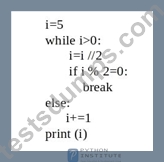
- A. the code is erroneous
- B. 0
- C. 1
- D. 2
Answer: A
NEW QUESTION 31
Assuming that the following code has been executed successfully, select the expressions which evaluate to True (Select two answers)
- A. b( ) > 2
- B. a is not None
- C. a is b
- D. a() > 2
Answer: A,B,D
NEW QUESTION 32
What is the expected behavior of the following code?
- A. it outputs 2
- B. it outputs 1
- C. the code is erroneous and it will not execute
- D. it outputs 3
Answer: D
NEW QUESTION 33
A compiler is a program designed to (select two answers)
- A. translate the source code into machine code
- B. check the source code in order to see if its correct
- C. rearrange the source code to make it clearer
- D. execute the source code
Answer: A,B
NEW QUESTION 34
Which of the listed actions can be applied to the following tuple? (Select two answers)
- A. tup.append (0)
- B. tup [:]
- C. tup [0]
- D. del tup
Answer: B,D
NEW QUESTION 35
Which of the following snippets will execute without raising any unhandled exceptions? (Select answers) A)
B)
C)
D)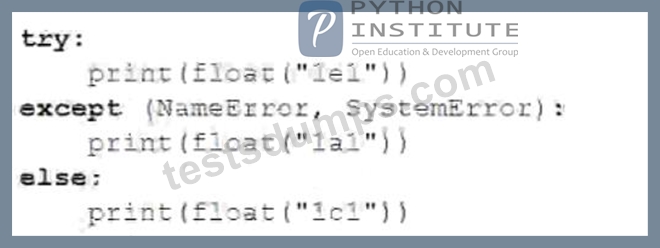
- A. Option D
- B. Option A
- C. Option C
- D. Option B
Answer: A,C,D
NEW QUESTION 36
What is the expected behavior of the following code?
- A. it outputs 3
- B. it outputs 2
- C. the code is erroneous and it will not execute
- D. it outputs 1
Answer: C
NEW QUESTION 37
What is the expected output of the following code if the file named existing_text_file is a non-zero length text file located inside the working directory?
- A. the number of lines contained inside the file
- B. the length of the last line from the file
- C. 0
- D. the length of the first line from the file
Answer: C
NEW QUESTION 38
......
PCAP-31-03 EXAM DUMPS WITH GUARANTEED SUCCESS: https://www.testsdumps.com/PCAP-31-03_real-exam-dumps.html
Best Quality Python Institute PCAP-31-03 Exam Questions: https://drive.google.com/open?id=1QGqR33HkhAtyt305JtGNGKG37Iv6Uq9N
