

NEW 2023 Certification Sample Questions DP-420 Dumps & Practice Exam
DP-420 Deluxe Study Guide with Online Test Engine
Microsoft DP-420 certification exam is designed to test the candidate's knowledge and skills in designing and implementing cloud-native applications using Microsoft Azure Cosmos DB. DP-420 exam is intended for individuals who have experience in developing and deploying cloud applications using Microsoft Azure and are interested in incorporating Azure Cosmos DB into their applications.
The Microsoft DP-420 exam validates the candidate's knowledge of Azure Cosmos DB, including its features, capabilities, and design patterns. It also tests the candidate's ability to design and implement applications using Azure Cosmos DB, including data model design, partitioning strategies, and data consistency models. DP-420 exam also covers best practices for deploying, monitoring, and troubleshooting cloud-native applications using Azure Cosmos DB.
The DP-420 certification exam is intended for individuals who have experience with Azure Cosmos DB and want to showcase their expertise in designing and implementing cloud-native applications. DP-420 exam is ideal for professionals who have experience working with Azure Cosmos DB, but who want to deepen their knowledge and gain a deeper understanding of how to design and implement cloud-native applications using this technology.
NEW QUESTION # 10
You have a database named db1 in an Azure Cosmos DB for NoSQL account named account1. The db1 database has a manual throughput of 4,000 request units per second (RU/s).
You need to move db1 from manual throughput to autoscale throughput by using the Azure CLI. The solution must provide a minimum of 4,000 RU/s and a maximum of 40,000 RU/s.
How should you complete the CLI statements? To answer, select the appropriate options in the answer area.
NOTE: Each correct selection is worth one point.
Answer:
Explanation: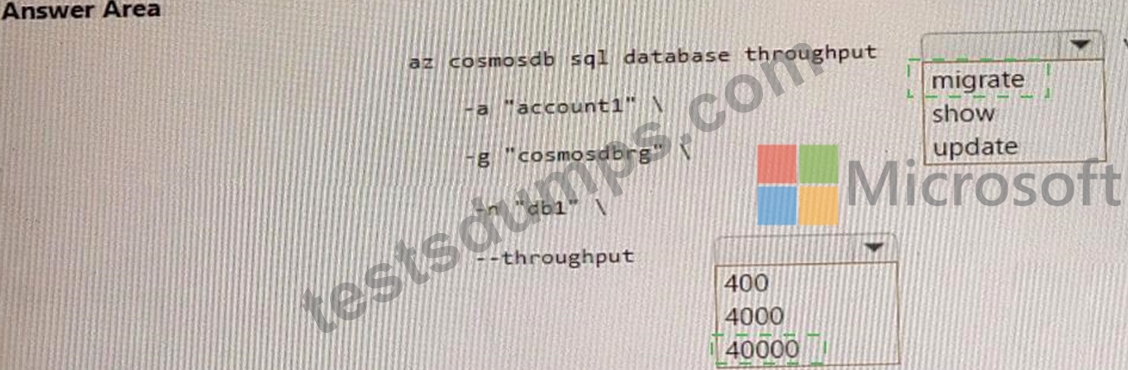
Explanation
Migrate
40000
According to the Azure CLI reference , you need to use the az cosmosdb sql database throughput migrate command to migrate the throughput of the SQL database between autoscale and manually provisioned. You also need to use the --throughput-type parameter to specify the type of throughput to migrate to, and the --max-throughput parameter to specify the maximum throughput resource can scale to (RU/s).
To complete the CLI statements, you should replace the missing values with:
* --throughput-type autoscale
* --max-throughput 40000
The final command should look like this:
az cosmosdb sql database throughput migrate \
--account-name account1 \
--name db1 \
--resource-group rg1 \
--throughput-type autoscale \
--max-throughput 40000
NEW QUESTION # 11
You have the Azure Cosmos DB for NoSQL containers shown in the following table.
You have the items shown in the following table.
When will each item expire? To answer, select the appropriate options in the answer are a.
NOTE: Each correct selection is worth one point.
Answer:
Explanation:
NEW QUESTION # 12
You have an Apache Spark pool in Azure Synapse Analytics that runs the following Python code in a notebook.
For each of the following statements, select Yes if the statement is true. Otherwise, select No.
NOTE: Each correct selection is worth one point.
Answer:
Explanation:
NEW QUESTION # 13
You have a database in an Azure Cosmos DB SQL API Core (SQL) account that is used for development.
The database is modified once per day in a batch process.
You need to ensure that you can restore the database if the last batch process fails. The solution must minimize costs.
How should you configure the backup settings? To answer, select the appropriate options in the answer area.
NOTE: Each correct selection is worth one point.
Answer:
Explanation:
NEW QUESTION # 14
You have a multi-region Azure Cosmos DB account named account1 that has a default consistency level of strong.
You have an app named App1 that is configured to request a consistency level of session.
How will the read and write operations of App1 be handled? To answer, select the appropriate options in the answer area.
NOTE: Each correct selection is worth one point.
Answer:
Explanation:
Explanation
Box 1 = Write and replicate data to every region synchronously
This is because the write concern is mapped to the default consistency level configured on your Azure Cosmos DB account2, which is strong in this case. Strong consistency ensures that every write operation is synchronously committed to every region associated with your Azure Cosmos DB account1. The request level consistency level of session only applies to the read operations of App11.
Box 2: That has the lowest estimated latency to the client
This is because the read operations of App1 will use the session consistency level that is specified in the request options. Session consistency is a client-centric consistency model that guarantees monotonic reads, monotonic writes, and read-your-own-writes within a session. A session is scoped to a client connection or a stored procedure execution. Session consistency allows clients to read from any region that has the lowest latency to the client.
NEW QUESTION # 15
You have a database named db1 in an Azure Cosmos DB for NoSQL
You are designing an application that will use dbl.
In db1, you are creating a new container named coll1 that will store in coll1.
The following is a sample of a document that will be stored in coll1.
The application will have the following characteristics:
* New orders will be created frequently by different customers.
* Customers will often view their past order history.
You need to select the partition key value for coll1 to support the application. The solution must minimize costs.
To what should you set the partition key?
- A. orderDate
- B. id
- C. orderId
- D. customerId
Answer: A
Explanation:
Based on the characteristics of the application and the provided document structure, the most suitable partition key value for coll1 in the given scenario would be the customerId, Option B.
The application frequently creates new orders by different customers and customers often view their past order history. Using customerId as the partition key would ensure that all orders associated with a particular customer are stored in the same partition. This enables efficient querying of past order history for a specific customer and reduces cross-partition queries, resulting in lower costs and improved performance.
a partition key is a JSON property (or path) within your documents that is used by Azure Cosmos DB to distribute data among multiple partitions3. A partition key should have a high cardinality, which means it should have many distinct values, such as hundreds or thousands1. A partition key should also align with the most common query patterns of your application, so that you can efficiently retrieve data by using the partition key value1.
Based on these criteria, one possible partition key that you could use for coll1 is B. customerId.
This partition key has the following advantages:
It has a high cardinality, as each customer will have a unique ID3.
It aligns with the query patterns of the application, as customers will often view their past order history3.
It minimizes costs, as it reduces the number of cross-partition queries and optimizes the storage and throughput utilization1.
This partition key also has some limitations, such as:
It may not be optimal for scenarios where orders need to be queried independently from customers or aggregated by date or other criteria3.
It may result in hot partitions or throttling if some customers create orders more frequently than others or have more data than others1.
It may not support transactions across multiple customers, as transactions are scoped to a single logical partition2.
Depending on your specific use case and requirements, you may need to adjust this partition key or choose a different one. For example, you could use a synthetic partition key that concatenates multiple properties of an item2, or you could use a partition key with a random or pre-calculated suffix to distribute the workload more evenly2.
NEW QUESTION # 16
You have an Azure Cosmos DB for NoSQL account.
The change feed is enabled on a container named invoice.
You create an Azure function that has a trigger on the change feed.
What is received by the Azure function?
- A. only the changed properties and the system-defined properties of the updated items
- B. all the properties of the original items and the updated items
- C. all the properties of the updated items
- D. only the partition key and the changed properties of the updated items
Answer: A
Explanation:
According to the Azure Cosmos DB documentation12, the change feed is a persistent record of changes to a container in the order they occur. The change feed outputs the sorted list of documents that were changed in the order in which they were modified.
The Azure function that has a trigger on the change feed receives all the properties of the updated items2. The change feed does not include the original items or only the changed properties. The change feed also includes some system-defined properties such as _ts (the last modified timestamp) and _lsn (the logical sequence number)3.
Therefore, the correct answer is:
NEW QUESTION # 17
You have an Azure Cosmos DB Core (SQL) API account named account1.
You have the Azure virtual networks and subnets shown in the following table.
The vnet1 and vnet2 networks are connected by using a virtual network peer.
The Firewall and virtual network settings for account1 are configured as shown in the exhibit.
For each of the following statements, select Yes if the statement is true. Otherwise, select No.
NOTE: Each correct selection is worth one point.
Answer:
Explanation:
Explanation
Box 1: Yes
VM1 is on vnet1.subnet1 which has the Endpoint Status enabled.
Box 2: No
Only virtual network and their subnets added to Azure Cosmos account have access. Their peered VNets cannot access the account until the subnets within peered virtual networks are added to the account.
Box 3: No
Only virtual network and their subnets added to Azure Cosmos account have access.
Reference: https://docs.microsoft.com/en-us/azure/cosmos-db/how-to-configure-vnet-service-endpoint
NEW QUESTION # 18
You have an Azure Cosmos DB Core (SQL) account that has a single write region in West Europe.
For each of the following statements, select Yes if the statement is true. Otherwise, select No.
NOTE: Each correct selection is worth one point.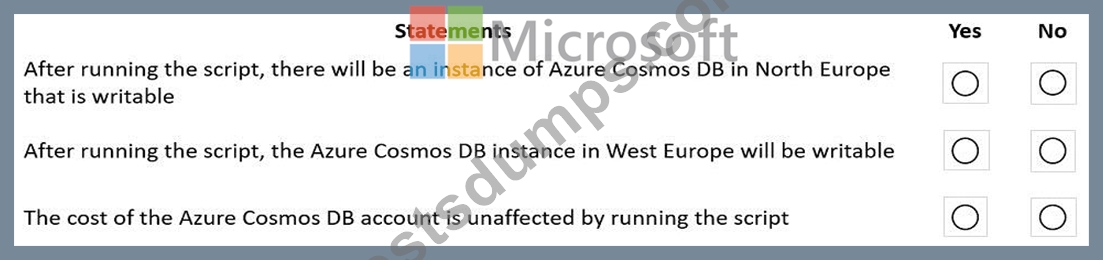
Answer:
Explanation: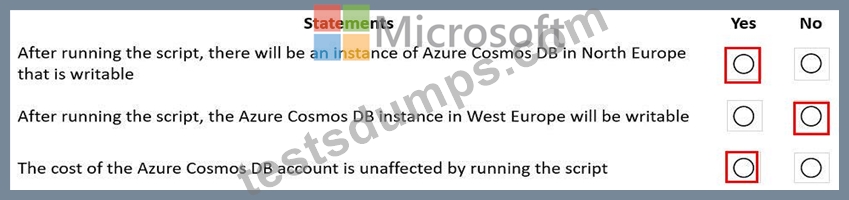
Reference:
https://docs.microsoft.com/en-us/azure/cosmos-db/sql/how-to-multi-master
https://docs.microsoft.com/en-us/azure/cosmos-db/optimize-cost-regions
NEW QUESTION # 19
You have three containers in an Azure Cosmos DB Core (SQL) API account as shown in the following table.
You have the following Azure functions:
A function named Fn1 that reads the change feed of cn1
A function named Fn2 that reads the change feed of cn2
A function named Fn3 that reads the change feed of cn3
You perform the following actions:
Delete an item named item1 from cn1.
Update an item named item2 in cn2.
For an item named item3 in cn3, update the item time to live to 3,600 seconds.
For each of the following statements, select Yes if the statement is true. Otherwise, select No.
NOTE: Each correct selection is worth one point.
Answer:
Explanation:
Reference:
https://docs.microsoft.com/en-us/azure/cosmos-db/sql/change-feed-design-patterns
https://docs.microsoft.com/en-us/azure/cosmos-db/change-feed
NEW QUESTION # 20
You plan to store order data in Azure Cosmos DB for NoSQL account. The data contains information about orders and their associated items.
You need to develop a model that supports order read operations. The solution must minimize the number or requests.
- A. Create a single database that contains a container for order and a container for order items.
- B. Create a database for orders and a database for order items.
- C. Create a single database that contains one container. Store orders and order items in separate documents in the container.
- D. Create a single database that contains one container. Create a separate document for each order and embed the order items into the order documents.
Answer: D
Explanation:
Explanation
Azure Cosmos DB is a multi-model database that supports various data models, such as documents, key-value, graph, and column-family3. The core content-model of Cosmos DB's database engine is based on atom-record-sequence (ARS), which allows it to store and query different types of data in a flexible and efficient way3.
To develop a model that supports order read operations and minimizes the number of requests, you should consider the following factors:
The size and shape of your data
The frequency and complexity of your queries
The latency and throughput requirements of your application
The trade-offs between storage efficiency and query performance
Based on these factors, one possible model that you could implement is B. Create a single database that contains one container. Create a separate document for each order and embed the order items into the order documents.
This model has the following advantages:
It stores orders and order items as self-contained documents that can be easily retrieved by order ID1.
It avoids storing redundant data or creating additional containers for order items1.
It allows you to view the order history of a customer with simple queries1.
It leverages the benefits of embedding data, such as reducing the number of requests, improving query performance, and simplifying data consistency2.
This model also has some limitations, such as:
It may not be suitable for some order items that have data that is greater than 2 KB, as it could exceed the maximum document size limit of 2 MB2.
It may not be optimal for scenarios where order items need to be queried independently from orders or aggregated by other criteria2.
It may not support transactions across multiple orders or customers, as transactions are scoped to a single logical partition2.
Depending on your specific use case and requirements, you may need to adjust this model or choose a different one. For example, you could use a hybrid data model that combines embedding and referencing data2
, or you could use a graph data model that expresses entities and relationships as vertices and edges.
NEW QUESTION # 21
You plan to implement con-iot1 and con-iot2.
You need to configure the default Time to Live setting for each container. The solution must meet the loT telemetry requirements.
What should you configure? To answer, select the appropriate options in the answer NOTE: Each correct selection is worth one point.
Answer:
Explanation:
NEW QUESTION # 22
Note: This question is part of a series of questions that present the same scenario. Each question in the series contains a unique solution that might meet the stated goals. Some question sett might have more than one correct solution, while others might not have a correct solution.
After you answer a question in this section, you will NOT be able to return to it. As a result, these questions will not appear in the review screen.
You have a container named conlainer1 in an Azure Cosmos DB for NoSQL account.
You need to make the contents of container1 available as reference data for an Azure Stream Analytics job.
Solution: You create an Azure function to copy data to another Azure Cosmos DB for NoSQL container.
Does this meet the goal?
- A. Yes
- B. No
Answer: B
NEW QUESTION # 23
Note: This question is part of a series of questions that present the same scenario. Each question in the series contains a unique solution that might meet the stated goals. Some question sets might have more than one correct solution, while others might not have a correct solution.
After you answer a question in this section, you will NOT be able to return to it. As a result, these questions will not appear in the review screen.
You have a container named container1 in an Azure Cosmos DB Core (SQL) API account.
You need to make the contents of container1 available as reference data for an Azure Stream Analytics job.
Solution: You create an Azure Data Factory pipeline that uses Azure Cosmos DB Core (SQL) API as the input and Azure Blob Storage as the output.
Does this meet the goal?
- A. Yes
- B. No
Answer: B
Explanation:
Explanation
Instead create an Azure function that uses Azure Cosmos DB Core (SQL) API change feed as a trigger and Azure event hub as the output.
The Azure Cosmos DB change feed is a mechanism to get a continuous and incremental feed of records from an Azure Cosmos container as those records are being created or modified. Change feed support works by listening to container for any changes. It then outputs the sorted list of documents that were changed in the order in which they were modified.
The following diagram represents the data flow and components involved in the solution:
Reference: https://docs.microsoft.com/en-us/azure/cosmos-db/sql/changefeed-ecommerce-solution
NEW QUESTION # 24
You have a database in an Azure Cosmos DB for NoSQL account that is configured for multi-region writes.
You need to use the Azure Cosmos DB SDK to implement the conflict resolution policy for a container. The solution must ensure that any conflict sent to the conflict feed.
Solution: You set ConfilictResolutionMode to Custom. You Set ResolutionProcedures to a custom stored procedure. You configure the custom stored procedure to use the isTomstone parameter to resolve conflict.
Does this meet the goal?
- A. Yes
- B. No
Answer: B
Explanation:
Explanation
The solution is incorrect because there is no "isTom" parameter in the Azure Cosmos DB SDK. The correct parameter is "isTombstone".
NEW QUESTION # 25
You have a container named container1 in an Azure Cosmos DB Core (SQL) API account.
The following is a sample of a document in container1.
{
"studentId": "631282",
"firstName": "James",
"lastName": "Smith",
"enrollmentYear": 1990,
"isActivelyEnrolled": true,
"address": {
"street": "",
"city": "",
"stateProvince": "",
"postal": "",
}
}
The container1 container has the following indexing policy.
{
"indexingMode": "consistent",
"includePaths": [
{
"path": "/*"
},
{
"path": "/address/city/?"
}
],
"excludePaths": [
{
"path": "/address/*"
},
{
"path": "/firstName/?"
}
]
}
For each of the following statements, select Yes if the statement is true. Otherwise, select No.
NOTE: Each correct selection is worth one point.
Answer:
Explanation:
NEW QUESTION # 26
You have a database in an Azure Cosmos DB for NoSQL account that is configured for multi-region writes.
You need to use the Azure Cosmos DB SDK to implement the conflict resolution policy for a container. The solution must ensure that any conflict sent to the conflict feed.
Solution: You set ConfilictResolutionMode to Custom and you use the default settings for the policy.
Does this meet the goal?
- A. Yes
- B. No
Answer: B
Explanation:
Setting ConflictResolutionMode to Custom and using the default settings for the policy will not ensure that conflicts are sent to the conflict feed. You need to define a custom stored procedure using the "conflictingItems" parameter to handle conflicts properly.
NEW QUESTION # 27
You have an Azure Cosmos DB Core (SQL) API account that is configured for multi-region writes. The account contains a database that has two containers named container1 and container2.
The following is a sample of a document in container1:
{
"customerId": 1234,
"firstName": "John",
"lastName": "Smith",
"policyYear": 2021
}
The following is a sample of a document in container2:
{
"gpsId": 1234,
"latitude": 38.8951,
"longitude": -77.0364
}
You need to configure conflict resolution to meet the following requirements:
For container1 you must resolve conflicts by using the highest value for policyYear.
For container2 you must resolve conflicts by accepting the distance closest to latitude: 40.730610 and longitude: -73.935242.
Administrative effort must be minimized to implement the solution.
What should you configure for each container? To answer, drag the appropriate configurations to the correct containers. Each configuration may be used once, more than once, or not at all. You may need to drag the split bar between panes or scroll to view content.
NOTE: Each correct selection is worth one point.
Answer:
Explanation:
Explanation
Box 1: Last Write Wins (LWW) (default) mode
Last Write Wins (LWW): This resolution policy, by default, uses a system-defined timestamp property. It's based on the time-synchronization clock protocol.
Box 2: Merge Procedures (custom) mode
Custom: This resolution policy is designed for application-defined semantics for reconciliation of conflicts.
When you set this policy on your Azure Cosmos container, you also need to register a merge stored procedure.
This procedure is automatically invoked when conflicts are detected under a database transaction on the server. The system provides exactly once guarantee for the execution of a merge procedure as part of the commitment protocol.
Reference:
https://docs.microsoft.com/en-us/azure/cosmos-db/conflict-resolution-policies
https://docs.microsoft.com/en-us/azure/cosmos-db/sql/how-to-manage-conflicts
NEW QUESTION # 28
You configure Azure Cognitive Search to index a container in an Azure Cosmos DB Core (SQL) API account as shown in the following exhibit.
Use the drop-down menus to select the answer choice that completes each statement based on the information presented in the graphic.
NOTE: Each correct selection is worth one point.
Answer:
Explanation:
Explanation
Box 1: country
The country field is filterable.
Note: filterable: Indicates whether to enable the field to be referenced in $filter queries. Filterable differs from searchable in how strings are handled. Fields of type Edm.String or Collection(Edm.String) that are filterable do not undergo lexical analysis, so comparisons are for exact matches only.
Box 2: name
The name field is not Retrievable.
Retrievable: Indicates whether the field can be returned in a search result. Set this attribute to false if you want to use a field (for example, margin) as a filter, sorting, or scoring mechanism but do not want the field to be visible to the end user.
Note: searchable: Indicates whether the field is full-text searchable and can be referenced in search queries.
Reference: https://docs.microsoft.com/en-us/rest/api/searchservice/create-index
NEW QUESTION # 29
You have a container that stores data about families. The following is a sample document.
For each of the following statements, select Yes if the statement is true. otherwise, select No.
NOTE: Each correct selection is worth one point.
Answer:
Explanation:
NEW QUESTION # 30
You have a database in an Azure Cosmos DB for NoSQL account that is configured for multi-region writes.
You need to use the Azure Cosmos DB SDK to implement the conflict resolution policy for a container. The solution must ensure that any conflict sent to the conflict feed.
Solution: You set ConfilictResolutionMode to Custom and you use the default settings for the policy.
Does this meet the goal?
- A. Yes
- B. No
Answer: A
Explanation:
Setting ConflictResolutionMode to Custom and using the default settings for the policy will not ensure that conflicts are sent to the conflict feed. You need to define a custom stored procedure using the "conflictingItems" parameter to handle conflicts properly.
NEW QUESTION # 31
You have a database in an Azure Cosmos DB for NoSQL account that is configured for multi-region writes.
You need to use the Azure Cosmos DB SDK to implement the conflict resolution policy for a container. The solution must ensure that any conflict sent to the conflict feed.
Solution: You set ConfilictResolutionMode to Custom. You Set ResolutionProcedures to a custom stored procedure. You configure the custom stored procedure to use the isTomstone parameter to resolve conflict.
Does this meet the goal?
- A. Yes
- B. No
Answer: B
Explanation:
The solution is incorrect because there is no "isTom" parameter in the Azure Cosmos DB SDK. The correct parameter is "isTombstone".
NEW QUESTION # 32
You have a container in an Azure Cosmos DB for NoSQL account that stores data about orders. The following is a sample of an order document.
Documents are up to 2 KB.
You plan to receive one million orders daily.
Customers will frequently view then past order history.
You are the evaluating whether to use orderDate as the partition key.
What are two effects of using orderDate as the partition key? Each correct answer presents a complete solution.
NOTE: Each correct selection is worth one point.
- A. Queries will run cross-partition.
- B. You will exceed the maximum number of partition key values.
- C. There will always be a hot partition.
- D. You will exceed the maximum storage per partition.
Answer: A,C
NEW QUESTION # 33
You have an Azure Cosmos DB database that contains a container named container 1. The container1 container is configured with a maximum of 20,000 RU/s and currently contains 240 GB of data.
You need to estimate the costs of container1 based on the current usage.
How many RU/s will be charged?
- A. 0
- B. 20,000
- C. 1
- D. 4.000
Answer: B
NEW QUESTION # 34
Note: This question is part of a series of questions that present the same scenario. Each question in the series contains a unique solution that might meet the stated goals. Some question sets might have more than one correct solution, while others might not have a correct solution.
After you answer a question in this section, you will NOT be able to return to it. As a result, these questions will not appear in the review screen.
You have an Azure Cosmos DB Core (SQL) API account named account 1 that uses autoscale throughput.
You need to run an Azure function when the normalized request units per second for a container in account1 exceeds a specific value.
Solution: You configure the function to have an Azure CosmosDB trigger.
Does this meet the goal?
- A. Yes
- B. No
Answer: B
Explanation:
Explanation
Instead configure an Azure Monitor alert to trigger the function.
You can set up alerts from the Azure Cosmos DB pane or the Azure Monitor service in the Azure portal.
Reference: https://docs.microsoft.com/en-us/azure/cosmos-db/create-alerts
NEW QUESTION # 35
......
DP-420 dumps review - Professional Quiz Study Materials: https://www.testsdumps.com/DP-420_real-exam-dumps.html
DP-420 Test Prep Training Practice Exam Questions Practice Tests: https://drive.google.com/open?id=1HkEnmng2CgfXPpy84iWbvniZ5RmhPAeW
