

Validate your Skills with Updated Cloud-Digital-Leader Exam Questions & Answers and Test Engine
Tested & Approved Cloud-Digital-Leader Study Materials Download Free Updated 224 Questions
Importance of the quality of Google Cloud Digital Leader Exam preparation materials
The preparation materials of the Google Cloud Digital Leader Exam are written by experts. They are designed to help you pass your test on the first attempt. The Google Cloud Digital Leader exam is a very popular exam. Many people prepare for this exam, but not all of them can pass it on the first attempt. If you want to do well in this certification and want to pass it on the first attempt, you need to use good preparation materials. In any case, you can pass the test by using our preparation materials. Google Cloud Digital Leader Dumps PDF and Google Cloud Digital Leader Practice Exam are the most effective ones among them. Deployment sales machines can be customized by two ways: one is to directly modify the machine through the Google Cloud Platform Console, the other is to use Cloud Deployment Manager to manage and even set up a group of machines. Costs benefits are huge here, and it is a great way to go. Billing is done on a per-minute basis, with a minimum of 15 minutes.
When using our materials, you will find that they are easy to understand and use for preparing for your certification. Our materials contain all the information needed for you to pass the exam successfully. That is why many people choose our products when preparing for their exams. You can also get assistance from our support team if you have any problems while preparing for your certification.
How to schedule for Google Cloud Digital Leader Exam
To be able to take Google's Digital Leader Certification Exam, you will need to register yourself.
Follow the steps below to register yourself for this exam:
Step 1: Go to Google Cloud and scroll down.
Step 2: Click on “Register Now” and then click on the “Registration” tab.
Step 3: Enter your personal information like name, email address, contact number, company name, and country under “Digital Leader Exam Registration Form.”
Step 4: Fill in the captcha and click on “Register Now”.
Step 5: Log in with your Google account (Gmail).
Step 6: If you have a G Suite Account click on “Accept” otherwise click on “I accept”.
Step 7: When you see the next page, click on “Continue”.
Step 8: Click on the appropriate button (it will be based on your registration status) and then enter the Captcha Code.
NEW QUESTION 15
Your Google Cloud Platform [GCP] admin has to manage a bunch of API keys for external services that are accessed by different applications, which are used by a few teams. What is the best way to manage them?
- A. Encrypt the information and store it in Cloud Storage for centralized access. Give the decrypt key only to the users who need to access it.
- B. Share the information in a Github repository and grant access to the repo in IAM as required.
- C. Store the information in Secret Manager and give IAM read permissions as re-quired.
- D. Store the information in Kubernetes Secrets and only grant read permissions to users as required.
Answer: C
Explanation:
Store the information in Secret Manager is a secure and convenient storage system for API keys, passwords, certificates, and other sensitive data. Secret Manager provides a central place and single source of truth to manage access, and audit secrets across Google Cloud.
https://cloud.google.com/secret-manager
NEW QUESTION 16
You are currently managing workloads running on Windows Server for which your company owns the licenses. Your workloads are only needed during working hours, which allows you to shut down the instances during the weekend. Your Windows Server licenses are up for renewal in a month, and you want to optimize your license cost.
What should you do?
- A. Migrate the workloads to Compute Engine with a bring-your-own-license (BYOL) model
- B. Migrate the workloads to Compute Engine with a pay-as-you-go (PAYG) model
- C. Renew your licenses for an additional period of 3 years. Renew your licenses for an additional period of 3 years. Negotiate a cost reduction with your current hosting provider wherein infrastructure cost is reduced when workloads are not in use
- D. Renew your licenses for an additional period of 2 years. Negotiate a cost reduction by committing to an automatic renewal of the licenses at the end of the 2 year period
Answer: A
NEW QUESTION 17
Your organization wants to migrate your on-premises environment to Google Cloud. The on-premises environment consists of containers and virtual machine instances. Which Google Cloud products can help to migrate the container images and the virtual machine disks?
- A. Artifact Registry and Cloud Storage
- B. Pub/Sub and Cloud Storage
- C. Dataflow and BigQuery
- D. Compute Engine and Filestore
Answer: D
NEW QUESTION 18
You are working with the head of the IT team and planning the move of computing systems. The questionnaire indicates that they have a reporting application that runs almost 24 hours every day of the week. When there is extra load, it queues up the processing and executes tasks when there is less demand. Which of these compute options would you recommend for them?
- A. Serverless option - Cloud Run
- B. Use a serverless option - App Engine Standard for Flex
- C. Use a server-based option - Compute Engine.
- D. Use a serverless option - Cloud Functions
Answer: D
Explanation:
- Because Compute Engine VMs are the preferred compute option as they are long-running.
NEW QUESTION 19
Your organization is developing a mobile app and wants to select a fully featured cloud-based compute platform for it.
Which Google Cloud product or feature should your organization use?
- A. App Engine
- B. Google Kubernetes Engine
- C. Firebase
- D. Cloud Functions
Answer: A
NEW QUESTION 20
Which of the following statements is/are true about Google Cloud BigTable?
- A. It can not be used in Real-time Ad analytics and tracking thousands of IoT Devices Data.
- B. It Scales from Giga Byte to Peta Byte with No Downtime.
- C. It is not compatible with Hadoop.
- D. It is an enterprise-level Database that offers relational and non-relational features
Answer: B
Explanation:
Cloud Bigtable
A fully managed, scalable NoSQL database service for large analytical and operational workloads with up to 99.999% availability.
- Consistent sub-10ms latency-handle millions of requests per second
- Ideal for use cases such as personalization, ad tech, fintech, digital media, and IoT
- Seamlessly scale to match your storage needs; no downtime during reconfiguration
- Designed with a storage engine for machine learning applications leading to better predictions
- Easily connect to Google Cloud services such as BigQuery or the Apache ecosystem
NEW QUESTION 21
An organization runs their application on a virtual machine, but every time they want to edit specific features, they have to bring the system offline to update the applica-tion. What would be a more appropriate solution for their app?
- A. Containers
- B. Hypervisors
- C. Solid State Disk
- D. GPUs
Answer: A
Explanation:
Because containers can compartmentalize applications which enables parts to be edited in isolation.
Reference link- https://cloud.google.com/learn/what-are-containers
NEW QUESTION 22
Your organization is developing a plan for migrating to Google Cloud.
What is a best practice when initially configuring your Google Cloud environment?
- A. Create a project via Google Cloud Console per department in your company
- B. Make every member of your company the project owner
- C. Define your resource hierarchy with an organization node on top
- D. Create projects based on tem members' requests
Answer: C
NEW QUESTION 23
A startup is planning to create their entire suite of applications on Google Cloud. They are looking at various open source technologies to build applications. One of the considera-tion is about having a well integrated monitoring tool. They have to be able to constantly review load capacity and performance of their applications and virtual machines. What would you advise them to do?
- A. Since they are using open source for applications, find another open source monitoring tool and integrate it, which could turn out to be very cheap.
- B. It is best to build a custom solution so that they know it integrates well with all their custom applications.
- C. Use the Google Cloud Operations Suite which contains monitoring among other operations tools.
- D. Update the application code to regularly write to output logs. Export the logs to BigQuery to analyze them frequently.
Answer: C
Explanation:
Operations Suite is well integrated into Google and it s the recommended option.
References: https://cloud.google.com/products/operations
NEW QUESTION 24
Your organization needs to plan its cloud infrastructure expenditures.
Which should your organization do?
- A. If your organization uses only cloud resources, infrastructure costs are no longer part of your overall budget
- B. Review cloud resource costs frequently, because costs change often based on use
- C. Review cloud resource costs annually as part of planning your organization's overall budget
- D. Involve fewer people in cloud resource planning than your organization did for on-premises resource planning
Answer: C
NEW QUESTION 25
Your customer is making a decision on whether to move to Google Cloud. Their key concern is about 10,000 VMs that are part of their IT infrastructure used across more than 110 applications. They are apprehensive of too many changes at this stage. They want to get to Google Cloud in the easiest way possible with minimal disruption. What option would you recommend for them?
- A. Use Migrate for Anthos
- B. Re-architect on-prem to use Kubernetes and then slowly extend and bridge the on-prem data center to the Google Cloud data center.
- C. Use Migrate for Compute
- D. Lift and shift the VMs to serverless options like App Engine Flex.
Answer: C
Explanation:
Migrate for Compute Engine's advanced replication migration technology copies instance data to Google Cloud in the background with no interruptions to the source workload that's running.
https://cloud.google.com/migrate/compute-engine
NEW QUESTION 26
Your organization recently migrated its compute workloads to Google Cloud. You want these workloads in Google Cloud to privately and securely access your large volume of on-premises data, and you also want to minimize latency.
What should your organization do?
- A. Peer your on-premises data center to Google's Edge Network
- B. Create a VPC between your on-premises data center and your Google resources
- C. Use Storage Transfer Service to securely make your data available to Google Cloud
- D. Use Transfer Appliance to securely make your data available to Google Cloud
Answer: A
Explanation:
https://cloud.google.com/network-connectivity/docs/direct-peering
NEW QUESTION 27
You are a program manager within a Software as a Service (SaaS) company that offers rendering software for animation studios. Your team needs the ability to allow scenes to be scheduled at will and to be interrupted at any time to restart later. Any individual scene rendering takes less than 12 hours to complete, and there is no service-level agreement (SLA) for the completion time for all scenes. Results will be stored in a global Cloud Storage bucket. The compute resources are not bound to any single geographical location. This software needs to run on Google Cloud in a cost-optimized way.
What should you do?
- A. Create a reservation for the minimum number of Compute Engine instances you will use
- B. Develop the application so it can run in an unmanaged instance group
- C. Deploy the application on Compute Engine using preemptible instances
- D. Start more instances with fewer virtual centralized processing units (vCPUs) instead of fewer instances with more vCPUs
Answer: C
Explanation: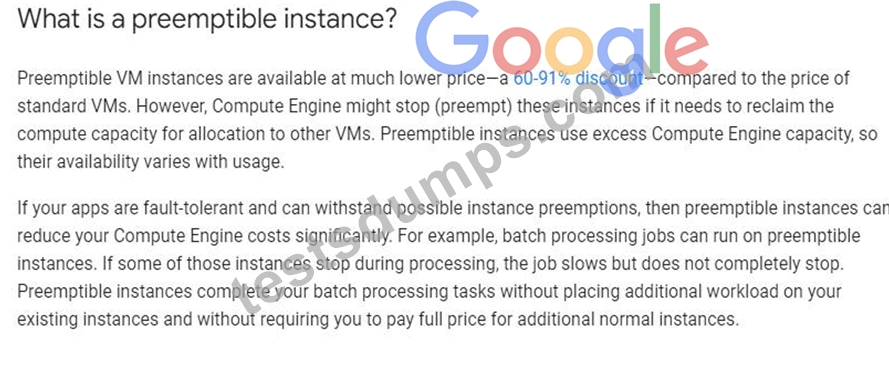
https://cloud.google.com/compute/docs/instances/preemptible
NEW QUESTION 28
What according to you are NOT the key capabilities of In-App Messaging?
- A. Increasing conversion for user-to-user sharing
- B. Creating customized and flexible alerts
- C. Sending relevant messages to the target audience
- D. Target messages accordingly to the change in the behavior pattern of the target audience.
Answer: A
Explanation:
In-App Messaging
Engage active app users with contextual messages.
Firebase In-App Messaging helps you engage users who are actively using your app by sending them targeted and contextual messages that nudge them to complete key in-app actions - like beating a game level, buying an item, or subscribing to content.
NEW QUESTION 29
Your organization runs many workloads in different Google Cloud projects, each linked to the same billing account. Each project's workload costs can vary from month to month, but the overall combined cost of all projects is relatively stable. Your organization needs to optimize its cost.
What should your organization do?
- A. Purchase a commitment per project for each project's usual minimum
- B. Move all workloads from all different projects into one single consolidated project
- C. Turn on committed use discount sharing, and create a commitment for the combined usage
- D. Create a billing account per project, and link each project to a different billing account
Answer: D
Explanation:
Billing contacts
NEW QUESTION 30
All Google Cloud Platform services are associated with a project that is used to provide what functions?
- A. Manage Container Deployments
- B. Manage DNS Services
- C. Enable Services and APIs
- D. None of the Above
Answer: C
Explanation:
Enable Services and APIs
Reference link- https://cloud.google.com/storage/docs/projects
NEW QUESTION 31
You are consulting for a client who is migrating to Google Cloud. They presently have a matrix or-ganization. Their IT environments were managed around projects. Each team had multiple projects. All the projects had a flat structure under the company. What would you advise them when plan-ning for the move?
- A. On Google Cloud, create a folder corresponding to each team. Under that, there could be projects or further sub folders as the team decides.
- B. In terms of not disturbing the project developers and testers, advise them that the strategic decision is to retain the structure on Google Cloud also.
- C. Since a Project could spawn other sub-Projects, on Google Cloud it is better to as-sign a folder for each Project.
- D. The flat structure is what is currently used in IT organizations, and this can be used as-is which will provide the best results.
Answer: A
Explanation:
Folders for a related group of projects are the recommended approach.
-> A flat structure under the organization node is possible on Google Cloud, but it is not recommended. It becomes tougher to manage.
-> Projects cannot have sub-projects; there can only be resources within Projects.
Reference link- https://cloud.google.com/resource-manager/docs/cloud-platform-resource-hierarchy
NEW QUESTION 32
A customer of yours has an SLA with their client that a particular service will respond within 4 sec-onds. The end client has reported that it feels slower. Your engineers do a trial at the client site and notice that there seems to be a delay for many of the requests. It's your team's responsibility to iden-tify the issue quickly within the strict timeline for fixes according to the contract, and then fix it. What should you do?
- A. Recommend a move to serverless technologies which will scale automatically on demand.
- B. Check if the browsers used by the client are different from yours. If they are, that's most likely the issue. Ensure that everybody uses the latest version of the browser that you are also using.
- C. Add logging statements at multiple points in the application, build it, and deploy it. Now new requests will give us information on latency in the logs.
- D. Use Cloud Trace to collect latency data and track how requests propagate and why there is a delay.
Answer: D
Explanation:
Cloud Trace is a built-in tool in the Operations suite to identify issues like latency.
-> Such fixes are unlikely to change core issues like the service itself being architected or written sub-optimally. Though changes like browser, networking, etc. are helpful, it would be the wrong approach to first recommend that the customer upgrade all their hardware and software.
-> Rewriting code and logging information is going to be time consuming. In general though, logging should always be included in code and it can give good insights. But tracing is way more specific and comprehensive for this requirement.
-> In certain cases, we might identify scaling as the issue. But we should first identify the core problem. So, start with tracing. We can also achieve scale in server-ful technologies.
Reference link- https://cloud.google.com/trace
NEW QUESTION 33
You are migrating workloads to the cloud. The goal of the migration is to serve customers worldwide as quickly as possible According to local regulations, certain data is required to be stored in a specific geographic area, and it can be served worldwide. You need to design the architecture and deployment for your workloads.
What should you do?
- A. Select a private cloud provider that globally replicates data storage for fast data access
- B. Select a public cloud provider that is only active in the required geographic area
- C. Select a public cloud provider that guarantees data location in the required geographic area
- D. Select a private cloud provider that is only active in the required geographic area
Answer: D
Explanation:
Many companies choose private cloud over public cloud because private cloud is an easier way (or the only way) to meet their regulatory compliance requirements. Others choose private cloud because their workloads deal with confidential documents, intellectual property, personally identifiable information (PII), medical records, financial data, or other sensitive data.
NEW QUESTION 34
You decide to migrate your on-premises environment to the cloud. You need to determine which resource components still need to be assigned ownership.
Which two functions are owned by a public cloud provider? (Choose two.)
- A. Hardware maintenance
- B. Infrastructure deployment automation
- C. Infrastructure architecture
- D. Hardware capacity management
- E. Fixing application security issues
Answer: A,D
Explanation:
In a shared responsible model, hardware maintence and capacity management cloud provider is the responsible part.
NEW QUESTION 35
Which of the following methods should you use when you require a dynamic way of provisioning VMs on Compute Engine when it is observed that the exact specifications will be in a dedicated configuration file and you want to follow Google's recommended practices.
- A. Unmanaged Instance Group
- B. Cloud Composer
- C. Managed Instance Group
- D. Deployment Manager
Answer: D
Explanation:
The question is about a dynamic way to provision VM, it can be achieved by a Deployment manager or by using terraform. MIG is creating multiple machines based on templates by load balancing
NEW QUESTION 36
......
Regular Free Updates Cloud-Digital-Leader Dumps Real Exam Questions Test Engine: https://www.testsdumps.com/Cloud-Digital-Leader_real-exam-dumps.html
Practice Test Questions Verified Answers As Experienced in the Actual Test!: https://drive.google.com/open?id=1105nJB_-rfzo7-F8j15syofEahWhGUN1
