

Best Value Available! 2026 Realistic Verified Free L5M9 Exam Questions
Pass Your Exam Easily! L5M9 Real Question Answers Updated
NEW QUESTION # 70
Bilal is an Operations Manager at an apple pie manufacturer and is currently undertaking an Aggregate Capacity Analysis.
What is the purpose of this?
- A. It will help Bilal decide if he needs to hire more workers in the short term to ensure the factory produces enough apple pies to meet demand
- B. It will help Bilal assess if he is working within the allocated budget
- C. It will give Bilal an overall evaluation of the company's ability to meet demand fluctuations
- D. It will tell Bilal if he has the correct number of apples he needs to produce the desired number of apple pies
Answer: C
Explanation:
4 is the correct answer. Aggregate Capacity Analysis looks as medium-term capacity to see whether supply can match demand. This is from p.23. Aggregate means 'from a group or cluster' and therefore requires quite a few bits of data. For this reason option 1 is incorrect as this describes a very short term look at capacity analysis.
NEW QUESTION # 71
Little Joy Ltd is a large company with several functional departments. Below are details of four departments. For each, you must decide which functional area of the business the department is, as well as the SERVQUAL Gap that each Department Lead is concerned with.
Department 1: This department is concerned with the creation of products. The products are created in line with BS EN 716-1 and undergo vigorous tests before they leave the factory. Many customers are unaware of the additional costs of testing to BS EN 716-1 and complain about the price of this product line.
Department 2: Other departments of the business are internal customers of this functional area and approach the Department Lead when they require something to be bought. Often the internal customers have unrealistic expectations of the timescales involved in the process and the Department Lead spends a lot of time explaining lead times and logistics.
Department 3: This functional area creates the budgets for the company and emails these to the Department Leads at the beginning of every quarter. Due to the complexity of the documents, other functional areas of the business often don't understand the information provided.
Department 4: This area of the business is concerned with revenue, which has recently slumped. The Department Lead is conducting market surveys to find out the reason for this.
Complete the table below by listing the Functional Area of the business, and the corresponding SERVQUAL Gap. Each response should only be used once: procurement, finance, sales, production, satisfaction gap, delivery gap, standards gap, communication gap.
Which of the following will you put into box 6?
- A. standards gap
- B. satisfaction gap
- C. delivery gap
- D. communication gap
Answer: C
Explanation:
The correct answers are as follows:
NEW QUESTION # 72
Below are details of five companies who operate a Total Quality Management System (TQM). For each company, select the system used and identify which area of the Balanced Scorecard this relates to.
Company 1: The focus of this company is to gather real-time data to assess the quality of products created during the manufacturing process. There are tight budgets and reworking any defects will affect the bottom line.
Company 2: This company is concerned about how their products are received. They have recently completed market research focused on their client's feelings. The objective is now to improve the product's look and performance to meet these expectations.
Company 3: The focus of this company is defining the customer requirements and translating this into a high-quality specification and effective operational process.
Company 4: Within this company there is a group of 6 employees who meet regularly with the objective of reducing issues that arise in the manufacturing of products.
Complete the table below by listing the TQM System used and the relevant Balanced Scorecard criteria for each company. Each response should only be used once: Quality Circle, Statistical Process Control, Kansei Engineering, Quality Function Deployment, Finance Criteria, Business Process Criteria, Learning and Growth Criteria, Customer Criteria.
Which of the following will you put into box 3?
- A. statistical process control
- B. quality function deployment
- C. quality circle
- D. kansei engineering
Answer: B
Explanation:
The correct answers are as follows: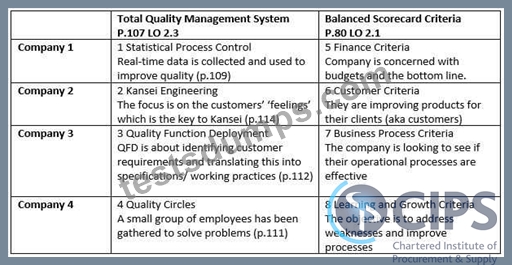
NEW QUESTION # 73
At which point in the manufacturing process would Failure Mode and Effective Analysis (FMEA) be first used?
- A. once all items have been processed, before the are sent to customers
- B. before manufacturing begins
- C. on a faulty item if it is returned from a customer
- D. at regular intervals during the manufacturing process
Answer: B
Explanation:
The question asks when it can be FIRST used so the correct answer is 1. FMEA detects failures early in the process, usually before mass production begins, and looks at potential failures in both design and process. It may be conducted when you have a prototype as well as later on in the manufacturing process, or when products are returned faulty. P.97-98
NEW QUESTION # 74
The methodology for defining customer requirements and creating products that meet those needs is commonly known as which of the following?
- A. quality function deployment
- B. value engineering
- C. defining business needs
- D. business process re-engineering
Answer: A
Explanation:
This is Quality Function Deployment. It's a framework for ensuring that products are designed in line with what customers want/ need. P.112
NEW QUESTION # 75
Which of the following is a benefit to a company of introducing TQM?
- A. increased customer loyalty
- B. improved supplier relations
- C. benchmarking is made easier
- D. higher profit margins
Answer: A
Explanation:
Increased customer loyalty is a benefit of TQM (p.107). This is because the focus of TQM is customer satisfaction and this in turn will lead to customer loyalty.
NEW QUESTION # 76
According to the Taguchi Loss Function there are two types of costs incurred when there is an issue with quality. What are these?
- A. private costs and public costs
- B. financial costs and reputational costs
- C. social costs and environmental costs
- D. private costs and social costs
Answer: D
Explanation:
The correct answer is private costs and social costs. Private costs include internal costs to the business (such as downtime, loss of staff/ money etc) and social costs affect the community and environment. P.133
NEW QUESTION # 77
Penny is the Operations Manager at a small furniture manufacturing company that makes tables and chairs, among other wooden household items. In the manufacturing site there is a small warehouse which stores inventory which is used in unforeseen circumstances such as a late delivery. What is the name given to this type of inventory?
- A. work-in progress
- B. buffer stock
- C. anticipation inventory
- D. transit inventory
Answer: B
Explanation:
This is buffer stock because it is being used as a safety for if something goes wrong with the current planned production schedule.. Anticipation Inventory is when you order extra materials in anticipation that something in the future will affect the level of production, such as a labour strike or a sharp price increase. These two are quite similar but the difference is buffer stock is held all the time and you don't anticipate something drastic is going to change in the future- you're just holding the extra stock because you're risk adverse. Anticipation Inventory isn't always held, it's collected when you think something bad is going to happen in the future and you'll need it. Work-in-progress is half-finished products and transit inventory is products that are currently being moved, for example on a delivery truck so these two are obvious wrong answers. See p.25 for different types of inventory
NEW QUESTION # 78
Which of the following is not a key stakeholder in the implementation of Six-Sigma?
- A. suppliers
- B. processes
- C. employees
- D. customers
Answer: A
Explanation:
Suppliers are not a stakeholder for Six Sigma- the other three are- this is from p.136
NEW QUESTION # 79
In Operations Management strategies, there are 10 strategic areas which fall into two categories: structure-related and infrastructure-related. Which of the following are structure-related? Select TWO
- A. new product development
- B. supply network
- C. quality
- D. performance measurements
- E. capacity
Answer: B,E
Explanation:
Capacity and Supply Network are structure-related. The other three are Infrastructure-related. This is from p.35-36 of the study guide. Structure is about the 'hardware' of the business and physical attributes. Infra-structure is considered the software and are easier to change.
NEW QUESTION # 80
In the Balanced Scorecard approach to measuring performance measures, which of the following is considered a 'hard parameter'?
- A. learning and growth
- B. customer
- C. financial
- D. business processes
Answer: C
Explanation:
Finance is the 'hard' parameter, and the other three are soft p.79. If you've not come across the Balanced Scorecard before this is one that's worth learning as it comes up in other modules at Level 5. I particularly like this YouTube video which explains the concept extremely well: https://www.youtube.com/watch?v=lGJ-25hikHA
NEW QUESTION # 81
How can a company measure the dependability of an item it produces? Select TWO
- A. gross profit margin
- B. how quickly complaints are resolved
- C. number of injuries caused by the product
- D. documentation is accurate
- E. variety of colours offered
Answer: C,D
Explanation:
1 and 5 are characteristics of dependability (p.76). 2 is about speed, 3 is about flexibility and 4 is about cost.
NEW QUESTION # 82
Which of the following are considered 'transformed resources' and an input into the Operations Process (input- processoutput)?
Select THREE
- A. money
- B. information
- C. raw materials
- D. employees
- E. customers
Answer: B,C,E
Explanation:
Customers, Raw Materials and Information are inputs. This is from p.44-45. Raw materials is the obvious one- it's the input in manufacturing and is transformed into a finished good. Information is an input in the service industry- for example a lawyer or an accountant requires information in order to prepare their case. Customers is the other correct answer and is an input in things like hairdressing (you can't cut hair without a customer's head!). Employees are considered transforming inputs not transformed resources (p.45). Money is also not an input as it isn't converted into an output.
NEW QUESTION # 83
The RATER methodology looks at the key dimensions to providing an effective service. Which of the following is not a dimension of this framework?
- A. assurance
- B. empathy
- C. responsiveness
- D. tangibles
Answer: C
Explanation:
Responsiveness is incorrect. The R in RATER stands for reliability. The full acronym is; reliability, assurance, tangibles, empathy, responsiveness. P.58
NEW QUESTION # 84
There are four manufacturing companies located on Seashell Industrial Estate. Each company creates a different product and employs a different maintenance approach to its operations. For each company, select the corresponding maintenance approach and the key operating process characteristic.
Company 1: This company creates craft beer and offers customers a tour of the brewery for a small charge. The brewing equipment is serviced monthly and the brewery is kept extremely clean. All equipment is labelled with the last service date.
Company 2: This company produces seasonal items such as Easter Eggs and Christmas Cake. The equipment has a control panel where lights will flash red advising staff to check oil levels and components. Staff can then report issues to the maintenance team if remedial work is required. Product demand fluctuates throughout the year.
Company 3: This equipment does not often break down and is only fixed when it is reported by staff as no longer working. Company 3 creates toys, providing a large range of product sizes and colours based on different customer requirements.
Company 4: Parts of the machine are serviced quarterly but in general, the machine is left to run its course and is then replaced when it is no longer financially viable to fix. The company produces cereal and the operating process is focused on the quantity produced and therefore uses standardised processes.
Complete the table below by listing the maintenance approach and operating process characteristic for each company. Each response should only be used once: preventative maintenance, run to breakdown maintenance, condition-based maintenance, mixed maintenance, volume, visibility, variation, variety
Which of the following will you put into box 1?
- A. condition-based maintenance
- B. run-to-breakdown maintenance
- C. mixed maintenance
- D. preventative maintenance
Answer: D
Explanation:
The correct answers are as follows:
NEW QUESTION # 85
......
Actual Questions Answers Pass With Real L5M9 Exam Dumps: https://www.testsdumps.com/L5M9_real-exam-dumps.html
L5M9 Dumps Prepare Your Exam With 124 Questions: https://drive.google.com/open?id=1IfViYKwcaYLdS8FYolF4zT8qlL2pZO_F
